Intended strategy refers to a company’s planned course of action designed to achieve long-term goals and competitive advantage. Exploring intended strategy examples helps businesses understand how clear objectives, structured planning, and resource allocation drive ‘success‘.
From market expansion plans to product innovation strategies, these examples highlight the importance of proactive decision-making.
Last Updated – May, 2026
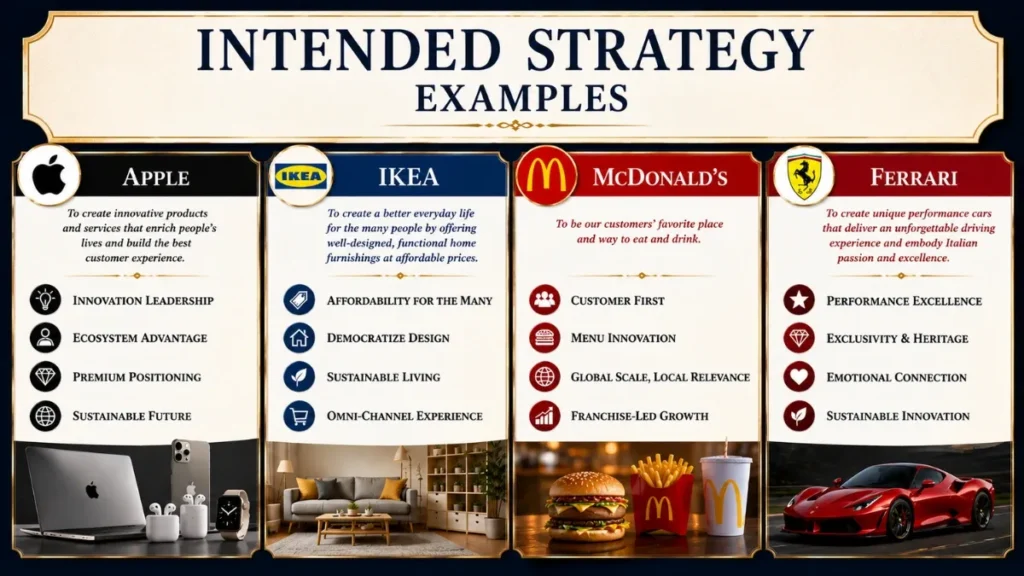
Intended Strategy Examples That Shaped Industries
From Apple’s ecosystem lock-in to IKEA’s flat-pack revolution, a definitive guide to deliberate strategic planning with real-world proof.
Intended strategy is the deliberate, premeditated plan that leaders design before action begins. Unlike emergent strategy, which evolves through trial and error, intended strategy is purpose-built, documented, and driven by vision.
What Is an Intended Strategy?
An intended strategy is a fully formulated plan of action, developed by top leadership that specifies organizational goals, competitive positioning, and resource allocation before implementation begins. It represents what an organization plans to do, as opposed to what it actually ends up doing.
The concept Inteded Strategy was formalized by management theorist Henry Mintzberg in his landmark 1978 paper in Management Science. Mintzberg argued that strategy exists on a continuum: on one end sits the purely intended (deliberate) strategy; on the other, the purely emergent. In reality, most successful organizations blend both.
A key insight: not all intended strategies become realized strategies. Plans change, markets shift, and competitors disrupt. The portion of intended strategy that survives and gets executed is called the deliberate strategy. The portion abandoned is called the unrealized strategy.
“Strategy is not the consequence of planning, but the opposite: it is the starting point.”— Henry Mintzberg, The Rise and Fall of Strategic Planning (1994)
Intended Strategy vs Emergent Strategy
Understanding intended strategy requires contrasting it with its counterpart. Here is how the two differ across critical dimensions:
| Dimension | Intended Strategy | Emergent Strategy |
|---|---|---|
| Origin | Top-down, leadership-driven | Bottom-up, frontline-driven |
| Timing | Planned before execution | Develops during execution |
| Documentation | Formal plans, roadmaps, goals | Often informal, learned behavior |
| Flexibility | Low – structured commitments | High – adaptive by nature |
| Risk | Misalignment with market reality | Lack of direction or coherence |
| Best For | Stable industries, clear vision | Fast-changing, uncertain markets |
10 Real-World Intended Strategy Examples
The following cases demonstrate how organizations across sectors designed and executed powerful intended strategies, and what the outcomes reveal about strategic planning in practice.
Ecosystem Lock-In Strategy
Apple Inc. (2001–Present)Apple’s entry into music with the iPod was not accidental. Leadership deliberately planned an integrated hardware-software-content ecosystem: iPod → iTunes → iPhone → App Store → iCloud. Each product was designed to increase switching costs for users.
Flat-Pack Democratization
IKEA (1956–Present)Founder Ingvar Kamprad deliberately designed IKEA’s entire value chain around a single mission: high-quality furniture at prices the majority of people can afford. This meant flat-pack self-assembly, massive warehouses doubling as showrooms, and locating stores outside city centers.
Accelerating the World’s Transition to Sustainable Energy
Tesla (2006–Present)Elon Musk’s 2006 “Secret Master Plan” is perhaps the most publicly documented intended strategy in corporate history. Start with a high-price sports car → use profits to build an affordable sedan → use that to build a mass-market car → also provide zero-emission electric power generation.
Experience Over Product
Starbucks (1987–2000s)Howard Schultz intentionally designed Starbucks as a “third place” neither home nor work, inspired by Italian espresso bars. The intended strategy was never to sell the cheapest coffee but to sell an aspirational experience, commanding premium pricing through atmosphere and personalization.
Logistics as Competitive Moat
Amazon (1997–Present)Jeff Bezos’s 1997 shareholder letter explicitly stated the intended strategy: sacrifice short-term profits to build long-term customer loyalty through unmatched selection, price, and convenience. This deliberate plan led Amazon to build its own logistics network, fulfillment centers, and cloud infrastructure.
Global Standardization with Local Adaptation
McDonald’s (1961–Present)Ray Kroc’s intended strategy was to create a franchise system delivering an identical experience worldwide; same taste, same speed, same cleanliness standards while allowing local menu adaptations. The Franchise Operations Manual ran to hundreds of pages before a single restaurant was franchised.
Direct-to-Consumer Disruption
Warby Parker (2010–Present)Warby Parker launched with a fully articulated intended strategy: cut out optical retail middlemen, sell prescription glasses directly to consumers online at $95, and disrupt a market where Luxottica had near-monopoly pricing power. Even the home try-on program was planned pre-launch.
Premium Positioning Through Scarcity
Ferrari (1947–Present)Ferrari has deliberately intended to produce fewer cars than the market demands, a strategy explicitly stated by leadership across decades. By capping production and maintaining a years-long waiting list, Ferrari preserves exclusivity, resale value, and brand mystique at every price point.
Dominating a Niche Globally
Tetra Pak (1951–Present)Tetra Pak’s founders intended from day one to solve a single global problem, how to package liquids hygienically at scale, and to own the entire solution: packaging material, filling machines, and distribution. They installed machines cheaply then locked in recurring revenue from packaging material.
Network-Effect Platform Strategy
Visa (1958–Present)Bank of America’s 1958 BankAmericard (later Visa) was deliberately designed as a two-sided platform strategy: sign up merchants and cardholders simultaneously, making each side more valuable as the other grows. The intended strategy recognized network effects before the term existed in management literature.
Mintzberg’s Intended Strategy Framework
Henry Mintzberg’s framework identifies five forms of strategy, known as the 5 Ps of Strategy: Plan, Ploy, Pattern, Position, and Perspective. Intended strategy sits primarily within the Plan and Position dimensions ,it is a conscious, deliberate course of action formulated in advance.
The Strategy Realization Model
According to Mintzberg, the Realized Strategy = Deliberate Strategy + Emergent Strategy. Of any original intended strategy, research suggests only 10–30% is fully realized as planned. The rest is either abandoned due to changed circumstances or replaced by emergent patterns discovered during execution.
This does not mean intended strategy fails, it means strategic leaders must build in checkpoints to adapt the plan while maintaining the core vision.
How to Create an Intended Strategy
Building a durable intended strategy is a disciplined process. Leaders who do it well follow a structured approach:
-
01
Conduct a rigorous situational analysis. Use frameworks like SWOT, PESTLE, and Porter’s Five Forces to understand your competitive environment. The strategy must be grounded in reality, not wishful thinking.
-
02
Define a clear, long-term strategic intent. Articulate where you want the organization to be in 5-10 years. Make it ambitious but achievable. Tesla’s “accelerate the world’s transition to sustainable energy” is a model of strategic intent.
-
03
Identify your core competitive advantage. Determine whether your strategy is built on cost leadership, differentiation, or focus (Porter’s Generic Strategies). Mixed signals dilute execution.
-
04
Allocate resources deliberately. Intended strategy without resource commitment is wishful thinking. Assign budgets, headcount, and capabilities aligned with strategic priorities before execution starts.
-
05
Build in strategic checkpoints. Establish quarterly or annual reviews to assess whether the intended strategy remains relevant. Allow for course corrections without abandoning the core vision.
-
06
Communicate and cascade the strategy. An intended strategy known only to the C-suite will not be executed. Every team must understand how their work connects to the larger plan.
Why Intended Strategies Fail
Intended strategy is not a guarantee of success. The most common failure modes include:
| Failure Mode | Description | Example |
|---|---|---|
| Analysis Paralysis | Over-planning delays execution until the market window closes | Many tech incumbents in the 2010s mobile wave |
| Rigidity | Adhering to the plan despite clear market signals to adapt | Kodak’s digital photography delay |
| Execution Gap | Plan is sound but operational capabilities don’t match | New entrants underestimating supply chain complexity |
| Misaligned Incentives | Middle management’s incentives contradict the intended strategy | Common in legacy enterprise transformations |
| Competitor Disruption | A rival’s emergent strategy invalidates your deliberate plan | Blockbuster’s plan to outlast streaming competitors |
Frequently Asked Questions

(Qualified) Chartered Accountant – ICAP
Master of Commerce – HEC, Pakistan
Bachelor of Accounting (Honours) – AeU, Malaysia