ISA 450 – Evaluation of Misstatements Identified during the Audit deals with the auditor’s responsibility to evaluate the effect of identified misstatements on the ‘audit’ and of uncorrected misstatements on the financial statements.
Last Updated – April, 2026
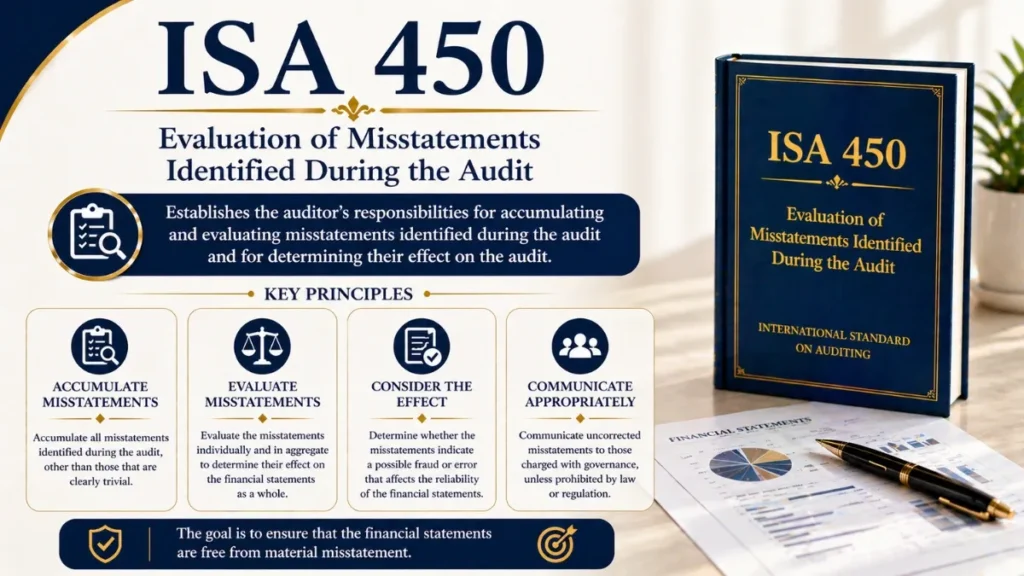
ISA 450 – Evaluation of Misstatements Identified During the Audit
A complete practitioner’s guide to understanding, applying, and documenting ISA 450 requirements from accumulation through final evaluation.
- 01Overview & Purpose of ISA 450
- 02Objective of ISA 450
- 03Key Definitions Under ISA 450
- 04Accumulation of Misstatements
- 05Reassessment of Materiality Under ISA 450
- 06Communication Requirements in ISA 450
- 07Evaluation of Uncorrected Misstatements
- 08Written Representations
- 09ISA 450 Documentation Requirements
- 10Audit Procedures Under ISA 450
- 11ISA 450 and Related Auditing Standards
- 12Practical Challenges in Applying ISA 450
- 13Frequently Asked Questions
ISA 450 governs how auditors accumulate, communicate, and ultimately evaluate all misstatements discovered during an engagement, ensuring that uncorrected and corrected misstatements do not result in a materially misstated set of financial statements.
1. Overview & Purpose of ISA 450
ISA 450 – Evaluation of Misstatements Identified During the Audit Issued by the International Auditing and Assurance Standards Board (IAASB) and forming part of the suite of clarity-redrafted International Standards on Auditing, ISA 450 addresses a critical phase of every audit: what the auditor must do once misstatements are found. Its core purpose is to ensure that the aggregate effect of misstatements, whether individually trivial or collectively material is properly considered before an audit opinion is issued.
ISA 450 is inseparable from ISA 320 (Materiality in Planning and Performing an Audit). While ISA 320 sets the materiality thresholds used to plan the audit, ISA 450 governs how discovered misstatements are measured against those thresholds and communicated to those charged with governance.
The auditor shall accumulate misstatements identified during the audit, other than those that are clearly trivial, and reassess materiality as the audit progresses in light of the misstatements found.
2. Objective of ISA 450
The stated objective of ISA 450 is straightforward:
The objective of the auditor is to evaluate the effect of identified misstatements on the audit and of uncorrected misstatements, if any, on the financial statements.
To achieve this objective, auditors must accumulate evidence of all non-trivial misstatements, communicate them on a timely basis to management, request corrections, and if corrections are refused, consider whether the aggregate of uncorrected misstatements causes the financial statements to be materially misstated.
3. Key Definitions Under ISA 450
3.1 Misstatement
A misstatement is a difference between the amount, classification, presentation, or disclosure of a reported financial statement item and the amount, classification, presentation, or disclosure required under the applicable financial reporting framework. Misstatements can arise from error or from fraud.
3.2 Factual Misstatements
Factual misstatements are misstatements about which there is no doubt. A classic example is an arithmetic error in a revenue schedule, the correct figure can be computed with certainty, and the deviation from it is unambiguous.
3.3 Judgemental Misstatements
Judgemental misstatements arise from differences between management’s judgement and the auditor’s judgement regarding accounting estimates, accounting policies, or the appropriateness of disclosures. These are more challenging to evaluate because they exist within an acceptable range of outcomes.
3.4 Projected Misstatements
Projected misstatements represent the auditor’s best estimate of total misstatements in a population based on misstatements identified in an audit sample. For example, if testing a sample of receivables reveals a 3% error rate, the projected misstatement for the full receivables balance applies that error rate to the untested portion.
3.5 Clearly Trivial Misstatements
ISA 450 recognises that not every misstatement warrants accumulation. Those that are clearly trivial individually and in aggregate, clearly inconsequential to the financial statements, need not be tracked. However, the auditor must establish a clearly trivial threshold (typically a small percentage of overall materiality, often 3–5%) and document it in the audit file.
| Type | Definition | Example | Auditor Challenge |
|---|---|---|---|
| Factual | No doubt exists about the misstatement | Arithmetic error in depreciation calculation | Low – straightforward to quantify |
| Judgemental | Difference in judgement between auditor and management | Disputed allowance for doubtful debts percentage | High – requires professional judgement |
| Projected | Extrapolation of sample misstatements to the full population | Error rate in inventory sample applied to total inventory | Medium – dependent on sampling methodology |
| Clearly Trivial | Clearly inconsequential, individually and in aggregate | Minor rounding difference of a few currency units | Very low – excluded from accumulation |
4. Accumulation of Misstatements
ISA 450 requires auditors to accumulate all misstatements identified during the audit, other than those that are clearly trivial. This obligation exists throughout the engagement, from the earliest substantive procedures through to the final analytical review performed immediately before signing the auditor’s report.
In practice, accumulation is managed through a Summary of Audit Differences (SAD) or an equivalent schedule in the audit working papers. This schedule serves multiple purposes:
- It provides a running total of identified misstatements against the materiality threshold.
- It facilitates communication with management regarding required or recommended corrections.
- It forms the evidential basis for the auditor’s final evaluation at the conclusion of the audit.
- It supports the written representation obtained from management and, where applicable, those charged with governance.
The clearly trivial amount is a matter of professional judgement and should be set before audit fieldwork begins, it is not the same as materiality and should not be confused with it. A common benchmark is approximately 3–5% of overall planning materiality.
5. Reassessment of Materiality Under ISA 450
One of the most practically important requirements of ISA 450 is that the auditor must reassess materiality as the audit progresses. If misstatements identified during the audit suggest that actual results differ significantly from preliminary estimates used to determine materiality, the auditor shall revise materiality accordingly.
A reassessment of materiality may result in a lower overall materiality threshold. This, in turn, may require the auditor to extend audit procedures, either to obtain additional evidence over previously tested areas or to test balances that were initially below the threshold of consideration.
The interplay between ISA 450 and ISA 320 is therefore dynamic: materiality is not set once and forgotten but is a living concept that responds to what the audit reveals.
6. Communication Requirements in ISA 450
6.1 Timely Communication
ISA 450 requires the auditor to communicate accumulated misstatements to management on a timely basis. Timeliness is important because it gives management the opportunity to investigate whether a misstatement actually exists and, if so, to correct the financial statements before they are finalised and the auditor’s report is signed.
6.2 Request for Correction
The auditor must request that management correct all identified misstatements. This request is not a mere formality, it reflects the auditor’s professional responsibility to support the integrity of the financial statements. Management may respond by:
- Correcting the misstatement (in which case the auditor verifies the correction and removes it from the uncorrected schedule).
- Investigating the item and concluding that no misstatement exists (with the auditor evaluating that conclusion).
- Declining to correct (in which case the item remains as an uncorrected misstatement).
6.3 Communication to Those Charged with Governance
Unless all identified misstatements are corrected, the auditor must communicate uncorrected misstatements to those charged with governance (TCWG) and explain the effect that such uncorrected misstatements, individually and in aggregate, may have on the auditor’s opinion. This communication typically occurs via the management letter or a formal written communication to the audit committee.
Corrected misstatements that are significant in terms of amount or their nature and circumstances, should also be communicated to TCWG where this assists them in understanding and discharging their oversight responsibilities.
7. Evaluation of Uncorrected Misstatements
ISA 450 requires the final evaluation of uncorrected misstatements before the auditor’s report is signed. This evaluation requires the auditor to determine whether the aggregate of uncorrected misstatements is material to the financial statements, taken as a whole.
7.1 Quantitative Evaluation
The most visible element of the evaluation is quantitative: does the aggregate monetary amount of uncorrected misstatements exceed materiality? If it does, the financial statements are materially misstated and the auditor cannot issue an unmodified opinion unless management corrects the misstatements.
The comparison must be made against performance materiality (set under ISA 320) as well as overall materiality. The auditor must also consider whether the aggregate of uncorrected misstatements that are individually below materiality could collectively be material.
7.2 Qualitative Evaluation
ISA 450 expressly requires that the evaluation also consider qualitative factors. A misstatement that is small in monetary terms may nonetheless be material because of:
- Its nature – for example, a misstatement that involves an illegal act, a breach of a loan covenant, or a change from profit to loss.
- Its implications for future periods – a misstatement in an accounting estimate that, if uncorrected, will affect future periods as well as the current one.
- Management bias – a pattern of individually immaterial misstatements, all of which favour a particular financial outcome, suggesting management manipulation.
- Disclosure misstatements – a failure to disclose a related-party transaction or a contingent liability that users of the financial statements would find significant.
ISA 450 specifically requires the auditor to consider whether the aggregate of corrected and uncorrected misstatements indicates possible management bias. Even individually corrected items can reveal a directional pattern that has implications for the auditor’s risk assessment and opinion.
8. Written Representations
ISA 450 requires the auditor to obtain a written representation from management and, where appropriate, those charged with governance, confirming that they believe the effects of uncorrected misstatements are immaterial, individually and in aggregate to the financial statements taken as a whole.
This representation is obtained in accordance with ISA 580 (Written Representations) and typically forms part of the management representation letter signed immediately before the audit report is issued. The schedule of uncorrected misstatements is appended to, or referenced in, this letter so that management explicitly acknowledges the specific items being represented upon.
9. ISA 450 Documentation Requirements
ISA 450, read alongside ISA 230 (Audit Documentation), imposes specific documentation obligations. The auditor’s working papers must include:
- The amount below which misstatements would be regarded as clearly trivial.
- All misstatements accumulated during the audit and whether they have been corrected.
- The auditor’s conclusion as to whether uncorrected misstatements are material, individually or in aggregate.
- The basis for the conclusion, including any qualitative factors considered.
10. Audit Procedures Under ISA 450
- Set the Clearly Trivial Threshold Determine the amount below which misstatements need not be accumulated. Document this in the audit plan before fieldwork commences.
- Accumulate Misstatements Throughout the Audit Record all misstatements; factual, judgemental, and projected above the clearly trivial threshold in the Summary of Audit Differences.
- Communicate to Management on a Timely Basis Bring identified misstatements to management’s attention as they are found, allowing time for investigation and correction before the report date.
- Request Correction of All Identified Misstatements Formally request that management correct the financial statements in respect of all accumulated misstatements.
- Reassess Materiality if Required If the nature or magnitude of misstatements differs significantly from planning assumptions, revise materiality and performance materiality accordingly, extending procedures if necessary.
- Evaluate Uncorrected Misstatements – Quantitatively Compare the aggregate of uncorrected misstatements against overall materiality. Assess whether individually immaterial items are collectively material.
- Evaluate Uncorrected Misstatements – Qualitatively Consider nature, disclosure implications, management bias, and any indicators of fraud or error beyond the monetary amounts involved.
- Communicate Uncorrected Misstatements to TCWG If material misstatements remain uncorrected, communicate to those charged with governance and explain the potential impact on the auditor’s opinion.
- Obtain Written Representation Secure management’s written representation confirming their belief that uncorrected misstatements are immaterial, individually and in aggregate.
- Form the Audit Opinion If material uncorrected misstatements exist, modify the audit opinion in accordance with ISA 705. If satisfied, issue an unmodified opinion.
11. ISA 450 and Related Auditing Standards
ISA 450 does not operate in isolation. Its requirements intersect with numerous other standards across the ISA framework:
- ISA 320 – Establishes materiality; ISA 450 applies materiality in evaluating misstatements discovered.
- ISA 240 – Fraud risk; ISA 450’s consideration of management bias connects directly to the auditor’s fraud responsibilities.
- ISA 260 – Communication with TCWG; ISA 450’s communication obligations are fulfilled through the framework of ISA 260.
- ISA 265 – Communication of deficiencies in internal control; systematic misstatements often signal control deficiencies reportable under ISA 265.
- ISA 330 – Responses to assessed risks; a high volume of misstatements may trigger additional procedures.
- ISA 540 – Auditing accounting estimates; judgemental misstatements are frequently linked to management’s use of estimates.
- ISA 580 – Written representations; the written representation on uncorrected misstatements is a core ISA 450 deliverable.
- ISA 705 – Modifications to the opinion; the consequence of concluding that uncorrected misstatements are material.
12. Practical Challenges in Applying ISA 450
12.1 Subjectivity in Judgemental Misstatements
The most contentious category of misstatement for practising auditors is the judgemental misstatement. Determining whether management’s estimate of, say, a warranty provision or a fair value measurement represents a misstatement requires the auditor to form an independent view. Where there is a range of acceptable values, ISA 540 guidance must be applied in conjunction with ISA 450.
12.2 Aggregation Across Financial Statement Lines
Misstatements may be spread across multiple balance sheet or income statement captions. ISA 450 requires the auditor to consider the aggregate effect, which means that minor items in several different areas may collectively become material even though each one is individually below the threshold of individual concern.
12.3 Management Resistance to Correction
Where management declines to correct identified misstatements, perhaps arguing that their accounting treatment is compliant with the applicable framework, the auditor faces a professional challenge. The auditor must evaluate the strength of management’s position and, if not persuaded, consider whether the refusal to correct requires modification of the audit opinion.
12.4 Rolling Misstatements and Prior Periods
Some misstatements, particularly those arising from accounting estimates may have their roots in prior periods. ISA 450 requires the auditor to consider the effect of such carry-over misstatements in the current period evaluation, and whether correction would affect comparatives.
13. Frequently Asked Questions
What is the difference between materiality under ISA 320 and ISA 450?
Does ISA 450 apply to all audits?
What happens if management refuses to correct a material misstatement?
How does ISA 450 address management bias?
What is a Summary of Audit Differences (SAD)?
Can clearly trivial misstatements ever become significant?
Core Concepts at a Glance
The six pillars every auditor must master when applying ISA 450 in practice.
Accumulation
All non-trivial misstatements must be accumulated throughout the audit in a structured working paper, the Summary of Audit Differences.
Reassessment
Materiality must be revisited as the audit develops. New findings can change the landscape and require extended procedures.
Communication
Timely communication to management, and ultimately to those charged with governance is a non-negotiable ISA 450 requirement.
Qualitative Evaluation
Numbers alone do not determine materiality. Nature, disclosure implications, and management bias all feed into the final evaluation.
Written Representation
A written representation confirming that uncorrected misstatements are immaterial must be obtained before the audit report is issued.
Documentation
Every conclusion under ISA 450; the clearly trivial amount, each misstatement, the final evaluation must be documented in the audit file.
Need Guidance on ISA?
Explore our full ISA library and practitioner resources, designed for audit professionals at every level.
Browse ISA Resources
(Qualified) Chartered Accountant – ICAP
Master of Commerce – HEC, Pakistan
Bachelor of Accounting (Honours) – AeU, Malaysia