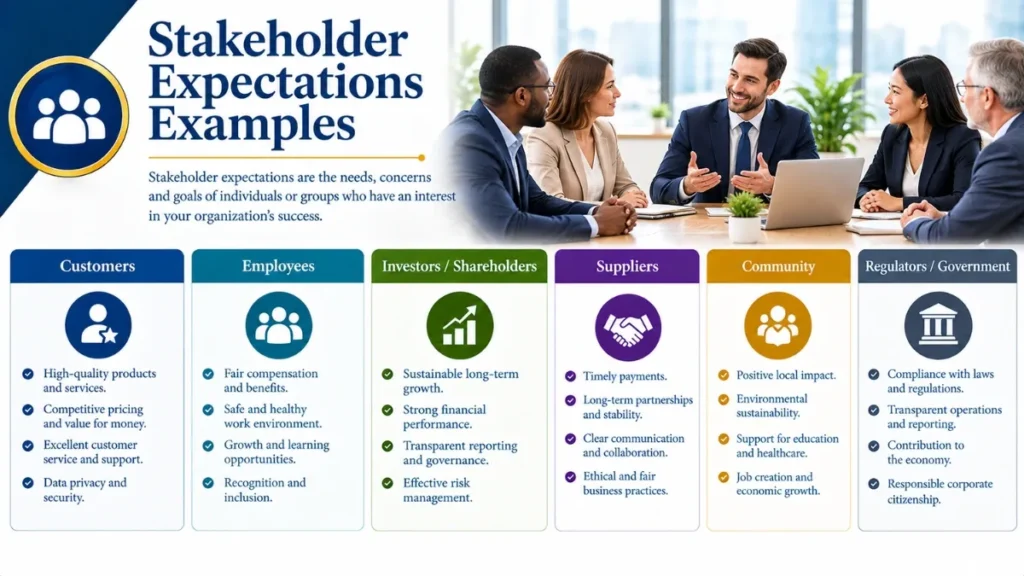
‘Stakeholder expectations’ refer to the needs, interests, and demands of individuals or groups that influence or are affected by a business. Understanding stakeholder expectations examples helps organizations align strategies, improve decision-making, and build long-term trust.
From ‘investors’ seeking returns to ‘customers’ demanding quality, managing these expectations is critical for success. Learn how identifying and addressing stakeholder needs can drive sustainable growth and strong relationships.
Last Updated – March, 2026
Stakeholder Management
Stakeholder Expectations Examples That Actually Work
A practical, real-world guide to understanding, documenting, and managing what every stakeholder group genuinely expects from your projects, products, and organization.
Foundation
What Are Stakeholder Expectations?
Stakeholder expectations are the outcomes, behaviors, standards, and deliverables that individuals or groups with an interest in your project or organization anticipate will be met. They may be explicitly stated; documented in contracts, SLAs, or project briefs or implicitly assumed based on past experience, industry norms, or personal values.
Failing to identify and align with stakeholder expectations can contribute significantly to project failure, team disengagement, and reputational damage. Getting them right builds trust, accelerates decisions, and drives sustainable results.
Stakeholder expectations span four core dimensions that every manager should map:
- Outcome expectations – what results, deliverables, or ROI they expect to receive
- Process expectations – how they expect to be consulted, updated, and involved
- Timeline expectations – when they expect milestones, reports, or decisions to occur
- Relationship expectations – the tone, respect, and transparency they anticipate in interactions
Research Insight
According to PMI’s Pulse of the Profession, organizations with mature stakeholder engagement practices consistently achieve better project outcomes. A major cause of unmet expectations is not failure to deliver, it is failure to communicate early and clearly.
Classification
Types of Stakeholders and Their Expectations
Before exploring specific examples, it is essential to understand who your stakeholders are. Different groups have fundamentally different motivations, the seven types below represent the most commonly encountered stakeholder categories in business and project contexts.
💰 Investors
- Financial return
- Risk transparency
- Governance oversight
👥 Customers
- Quality & reliability
- Value for money
- Responsive support
🧑💼 Employees
- Fair compensation
- Career growth
- Psychological safety
🤝 Suppliers
- Timely payments
- Clear specifications
- Long-term partnership
🏛️ Regulators
- Legal compliance
- Accurate reporting
- Ethical conduct
🌍 Community
- Environmental care
- Social impact
- Local employment
📰 Media
- Transparency
- Timely responses
- Accurate information
Core Examples
Stakeholder Expectations Examples by Type
Below are detailed, real-world stakeholder expectations examples for each major stakeholder group, drawn from project management, corporate governance, and business operations contexts.
Investors & Shareholders
Financial & strategic stakeholders- Quarterly earnings reports with accurate, comparable financial data
- Clear articulation of growth strategy and competitive positioning
- Dividend payments or share buyback policies that reflect performance
- Immediate disclosure of material risks, liabilities, or adverse events
- Board-level governance that protects minority shareholder interests
- ESG performance metrics aligned with responsible investment criteria
Customers & End Users
Revenue-generating stakeholders- Products that perform exactly as described in marketing materials
- Responsive support with clearly defined service-level commitments
- Transparent pricing with no hidden fees or surprise charges
- Proactive communication about service outages or product issues
- Appropriate data privacy protections and compliance with applicable privacy laws
- Consistent experience across web, mobile, and in-person channels
Employees & Teams
Internal operational stakeholders- Competitive compensation reviewed annually against market benchmarks
- Clear performance criteria and regular, constructive feedback
- Access to learning, upskilling, and internal mobility pathways
- Safe, inclusive working environment free from discrimination
- Transparent communication about company strategy and changes
- Recognition and reward that reflects contribution, not just tenure
Suppliers & Vendors
Supply chain stakeholders- Payment within agreed terms (net 30/60) without delays or disputes
- Accurate purchase orders with complete specification details
- Early notification of demand changes to avoid inventory waste
- Fair and transparent tender and procurement processes
- Long-term partnership opportunities and preferred vendor status reviews
- Ethical treatment aligned with supplier code of conduct standards
Regulators & Government
Compliance-focused stakeholders- Full compliance with all applicable laws, standards, and permits
- Accurate and timely regulatory filings, tax returns, and audits
- Immediate incident reporting as required by sector-specific laws
- Cooperation with inspections, audits, and investigations
- Transparent lobbying and political engagement disclosures
- Anti-corruption and anti-bribery policy implementation
Community & Society
Social license stakeholders- Reduction of environmental impact and published sustainability targets
- Local hiring initiatives and apprenticeship or internship programs
- Community consultation before major developments or expansions
- Charitable contributions and corporate social responsibility programs
- Responsible management of noise, traffic, waste, and emissions
- Transparent communication during crises affecting the local area
Sector Deep-Dive
Stakeholder Expectations in Different Industries
Stakeholder expectations vary significantly depending on the industry context. Here are some stakeholder expectations examples across three key sectors.
🏥 Healthcare
👨⚕️ Patients
- Accurate diagnosis and treatment
- Compassionate communication
- Timely appointment scheduling
- Confidential health records
🏛️ Health Authorities
- Infection control compliance
- Adverse event reporting
- Clinical trial transparency
- Drug safety standards
💊 Insurers
- Accurate billing codes
- Cost-effective treatment plans
- Pre-authorization adherence
- Outcome data reporting
💻 Technology & Software
🧑💻 Developers
- Clear product roadmaps
- Technical debt management
- Stable API contracts
- No-blame incident culture
🏢 Enterprise Clients
- High-availability uptime SLAs
- SOC 2 / ISO 27001 certs
- Dedicated account support
- Custom integration support
💰 Tech Investors
- ARR growth trajectory
- Net Revenue Retention
- Burn rate discipline
- Product-market fit evidence
🏗️ Construction & Infrastructure
🏛️ Government Clients
- On-time delivery milestones
- Budget adherence reports
- Safety compliance records
- Environmental assessments
🌍 Local Communities
- Minimal disruption plans
- Traffic management reports
- Local labor preference
- Site safety communication
🔨 Subcontractors
- Timely payment schedules
- Clear scope of work docs
- Access to site facilities
- Fair dispute resolution
Key Distinction
Stakeholder Expectations vs Requirements
One of the most commonly misunderstood distinctions in project and business management is the difference between stakeholder expectations and requirements. Confusing the two leads to scope gaps, dissatisfied stakeholders, and failed projects.
Expectations
- Broader in scope, include emotional and relational dimensions
- Often implicit or unstated, assumed rather than documented
- Shaped by past experience, culture, and personal values
- Can change throughout the project lifecycle
- Example: “I expect to be kept informed when anything changes”
Requirements
- Formally documented and agreed in writing
- Specific, measurable, and testable deliverables
- Defined through structured elicitation processes
- Change-controlled once baselined
- Example: “System must process 1,000 transactions per second”
Key Takeaway
Requirements are a subset of expectations. Meeting every documented requirement can still result in a dissatisfied stakeholder if their broader, unstated expectations are not identified and addressed.
Priority Matrix
Stakeholder Expectation Priority Matrix
Use this reference table to quickly assess the priority, frequency, and risk level associated with common stakeholder expectations in a typical business context.
| Stakeholder | Expectation | Frequency | Priority | Risk if Unmet |
|---|---|---|---|---|
| Investors | Quarterly financial reporting | Quarterly | High | Regulatory action, loss of capital |
| Customers | Product quality & reliability | Ongoing | High | Churn, negative reviews, refunds |
| Employees | Transparent internal communication | Weekly | High | Disengagement, turnover |
| Suppliers | On-time payment | Monthly | High | Supply disruption, legal claims |
| Regulators | Compliance reporting | Annual/Ad-hoc | High | Fines, license revocation |
| Community | Environmental performance updates | Annual | Medium | Reputational damage, protest |
| Media | Timely press responses | Ad-hoc | Medium | Negative coverage, brand harm |
| Board | Strategic performance updates | Monthly | High | Loss of executive trust |
| Partners | Mutual goal alignment sessions | Quarterly | Medium | Partnership breakdown |
| NGOs | Social impact disclosures | Annual | Low-Med | Advocacy campaigns, boycotts |
Important Note on Priority
Priority ratings above are indicative and will shift based on your specific industry, company maturity, and current business context. Always re-assess stakeholder maps at the start of each major initiative.
Action Framework
How to Identify and Manage Stakeholder Expectations
Understanding expectations is only the first step. The real value lies in a systematic approach to elicit, document, prioritize, and continuously manage them throughout the project or business lifecycle.
Conduct a Stakeholder Identification Exercise
Map every individual, group, or institution that can affect or be affected by your project. Use the Power/Interest Grid to categorize: High Power + High Interest = Manage Closely; High Power + Low Interest = Keep Satisfied.
Elicit Expectations Through Structured Interviews
Use open-ended discovery questions: “What does success look like to you?” “What concerns do you have?” “What would cause you to consider this a failure?” Document word for word responses, distinction matters.
Distinguish Explicit vs Implicit Expectations
Explicit expectations are stated, put them in your RACI or SLA. Implicit ones are assumed based on past norms or industry standards. Surfacing implicit expectations before they become complaints is where the best project managers add enormous value.
Prioritize and Negotiate Where Necessary
Not all expectations can be fully met. Use a priority matrix to make trade-off decisions transparent. Involve stakeholders in these trade-offs, co-ownership of constraints dramatically reduces later conflict.
Document in a Stakeholder Expectations Register
Maintain a living document that captures each stakeholder’s expectations, agreed commitments, communication plan, and status. Review it at every project gate and update promptly when scope or context changes.
Communicate Proactively and Consistently
A major cause of unmet expectations is not failure to deliver, it is failure to communicate. Set a frequency: weekly updates for high-priority stakeholders, monthly summaries for others. Always lead with impact, not activity.
Pitfalls
Common Mistakes in Managing Stakeholder Expectations
Over-promising to secure buy-in
Setting unrealistic expectations to win initial approval always creates larger trust deficits later. Under-promise strategically and over-deliver consistently.
Assuming silence means agreement
Stakeholders who do not raise concerns in meetings often harbor serious reservations. Create multiple private, low-stakes channels for genuine feedback.
Treating all stakeholders identically
A one-size-fits-all communication plan ignores the fundamentally different motivations of investors, customers, and regulators. Personalize your approach to each segment.
Neglecting to re-baseline after scope changes
When project scope changes, stakeholder expectations must be formally renegotiated. Many teams change scope without updating their stakeholder register, creating a dangerous misalignment gap.
Confusing activity with progress in updates
Sending status updates that describe what the team is doing, rather than what has been achieved and what risks exist, erodes stakeholder confidence over time.
FAQ
Frequently Asked Questions
What is the difference between stakeholder expectations and requirements?
Requirements are formally documented, agreed specifications that a deliverable must meet. Expectations are broader and include emotional, relational, and contextual dimensions that may never be written down. Requirements are a subset of expectations. Meeting requirements alone is often insufficient to satisfy stakeholders if their broader expectations are not addressed.
How do you handle conflicting stakeholder expectations?
Conflicting expectations are best resolved through a structured negotiation process: (1) surface and document each conflict explicitly, (2) identify the underlying interests behind each position, (3) involve a senior decision-maker to facilitate prioritization, (4) communicate the agreed resolution and rationale to all parties. Avoid leaving conflicts unresolved, they resurface at the worst possible moments.
How often should you review stakeholder expectations?
Expectations should be formally reviewed at every project phase gate, after significant external events (market shifts, regulatory changes), and at least quarterly for ongoing business operations. Ad-hoc reviews should occur whenever a key stakeholder’s role, circumstances, or stated priorities change materially.
What tools are used to document stakeholder expectations?
Common tools include: the Stakeholder Register (a spreadsheet or database listing stakeholders, their interests, expectations, influence, and communication plans), the Power/Interest Grid (for visual prioritization), RACI matrices (for responsibility clarity), and dedicated project management platforms like Jira, Asana, or Microsoft Project that support stakeholder tagging and status tracking.
Can stakeholder expectations change during a project?
Yes, and they often do. Economic conditions, leadership changes, competitive pressures, and personal circumstances all cause expectation drift. Effective stakeholder managers build expectation re-baselining checkpoints into every project plan rather than treating initial expectations as fixed for the project’s duration.
Key Takeaways
Map all stakeholders before project initiation, not after problems emerge.
Implicit expectations cause more damage than explicit ones. Surface them proactively.
Requirements are a subset. Meeting specs without addressing broader expectations still disappoints.
Regular, honest updates build far more trust than crisis-driven transparency.
Expectations shift with context. Treat your stakeholder register as a living document.
Investors, customers, and regulators each require a distinct communication approach.

(Qualified) Chartered Accountant – ICAP
Master of Commerce – HEC, Pakistan
Bachelor of Accounting (Honours) – AeU, Malaysia