Strategy implementation in strategic management is the process of translating strategic plans and business objectives into actionable activities to achieve organizational goals. It involves allocating resources, establishing effective policies, aligning organizational structure and culture, and coordinating employees to execute the chosen strategy.
An effective strategy implementation process also requires strong leadership, continuous performance monitoring, and appropriate performance metrics to ensure that strategic objectives are achieved, challenges are addressed, and long-term competitive advantage is maintained.
Last Updated – November, 2026
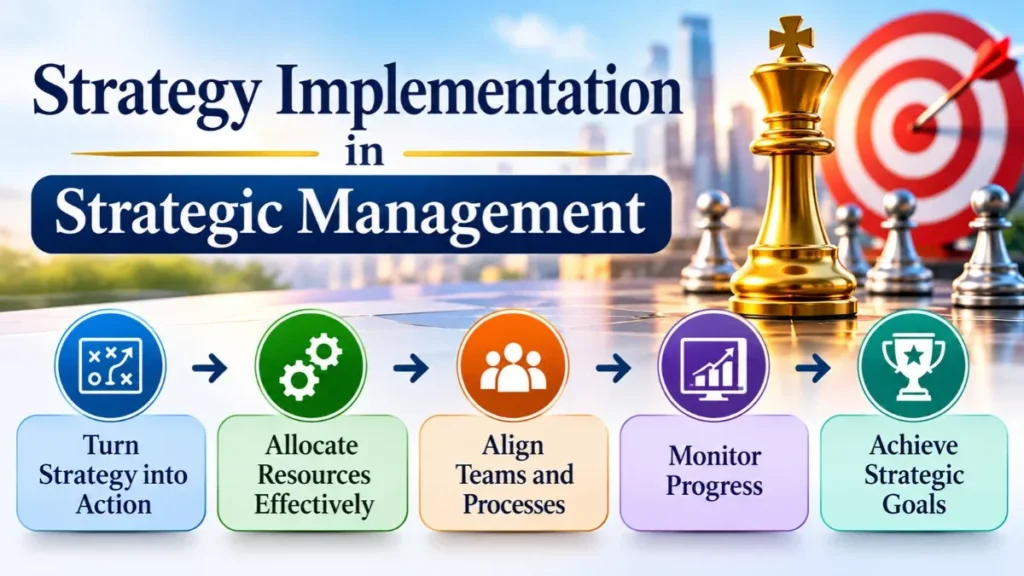
Strategy Implementation in Strategic Management – Turning Strategic Plans into Measurable Results
A well-designed strategy delivers nothing until it is executed. This guide explains what strategy implementation is, the key elements and frameworks behind it, a practical step-by-step process, and how organizations overcome the most common obstacles.
What Is Strategy Implementation in Strategic Management?
Strategy implementation is the stage of the strategic management process in which an organization converts its chosen strategy into concrete actions, structures, budgets, and routines that produce measurable results. If strategy formulation answers the question “Where do we want to go, and why?”, implementation answers “How exactly will we get there, who will do what, and by when?”
In practice, implementation means aligning the entire organization around the strategy. It involves allocating resources, designing the right structure, building supportive systems and culture, motivating people, and monitoring performance so the plan adapts to reality rather than gathering dust on a shelf.
Strategy implementation is the bridge between intention and outcome. Without it, even the most carefully formulated strategy remains an idea rather than a competitive advantage.
Strategy Formulation vs Strategy Implementation
The two stages are deeply connected, yet they demand very different skills. Formulation is analytical and conceptual; implementation is operational, human, and relentlessly practical. Understanding the contrast helps leaders give each stage the attention it deserves.
| Dimension | Strategy Formulation | Strategy Implementation |
|---|---|---|
| Focus | Positioning forces before the action | Managing forces during the action |
| Nature | Intellectual and analytical | Operational and action-oriented |
| Main skills | Vision, analysis, intuition | Leadership, coordination, motivation |
| Who is involved | Mostly top management | Managers and employees at every level |
| Core question | What should we do? | How do we do it well? |
| Coordination | Limited number of people | Many people across functions |
Why Is Strategy Implementation Important?
Many organizations invest heavily in planning, only to see results fall short because execution was treated as an afterthought. Effective implementation matters for several reasons:
- It creates real value. Competitive advantage comes from what an organization actually does, not from what it intends to do.
- It aligns people and priorities. A clear implementation plan ensures every department pulls in the same direction.
- It uses resources wisely. Budgets, talent, and technology are directed to the initiatives that matter most.
- It builds adaptability. Ongoing feedback during execution reveals what works and what must change.
- It strengthens credibility. Delivering on commitments builds trust with employees, investors, and customers.
Key Elements of Strategy Implementation
Successful execution rests on several interdependent building blocks. Weakness in any one of them can undermine the entire effort.
1. Leadership
Leaders set direction, communicate the “why,” model desired behavior, and remove obstacles that slow progress.
2. Organizational Structure
Roles, reporting lines, and decision rights must support the strategy rather than work against it.
3. Resource Allocation
Budgets, people, time, and technology are matched to strategic priorities instead of historical habits.
4. Culture and Values
Shared beliefs and norms shape everyday behavior. A strategy that clashes with culture rarely survives.
5. Policies and Processes
Clear procedures translate strategic intent into repeatable, consistent day-to-day actions.
6. Systems and Technology
Information, planning, and communication systems give managers the data to act and adjust quickly.
7. People and Incentives
The right skills, training, and reward systems motivate employees to pursue strategic goals.
8. Monitoring and Control
Performance metrics and review cycles track progress and trigger corrective action early.
Leading Strategy Implementation Frameworks and Models
Several well-established models help managers think systematically about execution. Each offers a different lens, and many organizations combine them.
The McKinsey 7S Framework
This model shows that effective organizations align seven interconnected elements: strategy, structure, systems, shared values, style, staff, and skills. The first three are often called “hard” elements, while the remaining four are “soft” elements. The framework reminds leaders that changing one element without adjusting the others creates misalignment.
The Balanced Scorecard
Developed by Robert Kaplan and David Norton, the Balanced Scorecard translates strategy into objectives and measures across four perspectives: financial, customer, internal processes, and learning and growth. It helps organizations communicate strategy clearly and monitor progress beyond financial results alone.
Kotter’s 8-Step Change Model
Because implementation almost always involves change, John Kotter’s model is widely used. It begins with creating urgency and building a guiding coalition, moves through communicating a vision and empowering action, and ends by anchoring new approaches in the culture.
Objectives and Key Results (OKRs)
OKRs connect ambitious objectives to a small set of measurable key results. They promote focus, transparency, and alignment from the executive team down to individual contributors.
Step-by-Step Strategy Implementation Process
While every organization is different, the following sequence provides a dependable roadmap for putting strategy into action.
Clarify the Strategy and Objectives
Translate the strategy into specific, measurable goals that everyone can understand. Ambiguity at the top multiplies into confusion below.
Communicate Widely and Repeatedly
Explain what the strategy is, why it matters, and what it means for each team. Two-way communication invites questions and surfaces concerns early.
Assign Ownership and Accountability
Every initiative needs a named owner, defined deliverables, and clear deadlines. Shared responsibility without ownership usually means no responsibility.
Align Structure, Systems, and Culture
Adjust reporting lines, processes, and technology so they enable the strategy. Address cultural barriers openly rather than hoping they fade.
Allocate Resources Strategically
Fund the priorities that drive the strategy, and be willing to stop or reduce activities that no longer fit.
Build Capabilities and Motivate People
Invest in training, hire for missing skills, and design incentives that reward the behaviors the strategy requires.
Monitor, Measure, and Adapt
Use key performance indicators and regular review meetings to track progress. Treat deviations as information and adjust the plan when conditions change.
Common Challenges in Strategy Implementation and How to Overcome Them
Even well-run organizations stumble during execution. Recognizing the typical obstacles makes them far easier to prevent.
| Challenge | Why It Happens | How to Address It |
|---|---|---|
| Poor communication | Strategy stays at the top and never reaches front-line teams | Use clear messaging, regular briefings, and feedback channels |
| Resistance to change | Employees fear loss of status, routine, or job security | Involve people early, explain benefits, and offer support and training |
| Weak leadership commitment | Leaders lose focus or send mixed signals | Visible sponsorship and consistent decisions that match stated priorities |
| Resource gaps | Budgets and talent remain tied to old priorities | Reallocate funding and staff to strategic initiatives |
| Misaligned incentives | Rewards encourage behavior that conflicts with the strategy | Link performance reviews and bonuses to strategic goals |
| Lack of measurement | No clear metrics or review rhythm | Adopt KPIs, dashboards, and scheduled performance reviews |
Role of Finance and Accounting in Strategy Implementation
Strategy is ultimately funded, tracked, and judged through numbers, which is why finance professionals are central to execution. Accountants and finance teams translate strategic intent into measurable commitments and keep the organization honest about progress.
- Budgeting and resource alignment: Strategic priorities must appear in the budget. If a priority has no funding line, it is a wish rather than a plan.
- Performance measurement: Well-chosen KPIs and the financial perspective of a Balanced Scorecard connect daily activity to strategic outcomes.
- Variance analysis: Comparing actual results to plan highlights early where an initiative is drifting, so management can respond before small gaps become large ones.
- Internal controls and risk management: Sound controls protect assets, support reliable reporting, and reduce the chance that execution risks go unnoticed.
- Capital allocation: Investment appraisal helps decide which initiatives deserve limited capital and which should be paused or stopped.
Treat the finance function as a strategic partner during execution, not just a reporting department. Timely, reliable management information is often what allows leadership to adjust course with confidence.
Critical Success Factors for Effective Strategy Implementation
Research and practice point to a consistent set of habits among organizations that execute well:
- Simplicity and focus: A small number of clear priorities beats a long list of competing initiatives.
- Strong, visible leadership: Executives who actively champion the strategy inspire commitment throughout the organization.
- Cross-functional collaboration: Breaking down silos allows departments to coordinate rather than compete.
- Empowered employees: People closest to customers and operations need the authority to act on the strategy.
- Continuous learning: Regular reflection turns early mistakes into lasting improvements.
- Flexibility: Plans are guides, not scripts. Successful organizations adjust as markets and conditions evolve.
Measuring Strategy Implementation Success – KPIs and Performance Metrics
What gets measured gets managed. A balanced set of indicators shows whether the strategy is moving from paper to practice. Useful measures typically include:
- Milestone completion: Are key initiatives on schedule and within budget?
- Financial performance: Revenue growth, profitability, and return on investment against targets.
- Customer outcomes: Satisfaction, retention, and market share.
- Operational efficiency: Cycle times, quality levels, and cost per unit.
- People indicators: Employee engagement, skill development, and turnover.
Review these indicators on a consistent schedule, and use the findings to refine both the implementation plan and, when necessary, the strategy itself. This feedback loop is what makes strategic management a living, continuous process.
Frequently Asked Questions
What is strategy implementation in strategic management?
Strategy implementation is the process of turning a chosen strategy into action through structure, resources, leadership, systems, culture, and performance monitoring so that the organization achieves its strategic objectives.
What is the difference between strategy formulation and implementation?
Formulation is about deciding what the organization should do and where it should compete. Implementation is about executing those decisions through people, processes, and resources. The first is largely analytical, while the second is operational and behavioral.
Why do many strategies fail during implementation?
Common causes include unclear communication, resistance to change, insufficient resources, weak leadership commitment, misaligned incentives, and the absence of reliable performance measures.
What are the main steps in implementing a strategy?
Clarify objectives, communicate the strategy, assign ownership, align structure and culture, allocate resources, build capabilities and incentives, and continuously monitor and adapt performance.
Which frameworks support strategy implementation?
Popular options include the McKinsey 7S Framework, the Balanced Scorecard, Kotter’s 8-Step Change Model, and OKRs. Each helps align people, processes, and performance measures with strategic goals.
What role do leaders play in strategy implementation?
Leaders provide direction, communicate the vision, allocate resources, model desired behavior, and hold people accountable. Their visible commitment is among the strongest predictors of execution success.
Conclusion
Strategy implementation is where strategic management proves its worth. A sound strategy needs aligned leadership, a supportive structure, adequate resources, an enabling culture, motivated people, and disciplined monitoring to become reality. Organizations that treat execution as seriously as planning, and that remain willing to learn and adapt, are far better placed to turn ambition into sustainable competitive advantage.
Whether you are a student of strategic management, a manager leading change, or an executive shaping the future of your company, mastering implementation is the surest way to ensure that your best ideas deliver results.
References and Further Reading
- Kaplan, R. S., & Norton, D. P. (1992). “The Balanced Scorecard: Measures That Drive Performance.” Harvard Business Review.
- Kaplan, R. S., & Norton, D. P. (1996). The Balanced Scorecard: Translating Strategy into Action. Harvard Business School Press.
- Kotter, J. P. (1996). Leading Change. Harvard Business School Press. See also the 8-Step Process for Leading Change at Kotter Inc.
- Peters, T. J., & Waterman, R. H. (1982). In Search of Excellence. Harper & Row. Overview of the framework: “Enduring Ideas: The 7-S Framework,” McKinsey Quarterly.
- Doerr, J. (2018). Measure What Matters. Portfolio/Penguin (OKRs).
This article is provided for educational and general informational purposes. It does not constitute professional accounting, financial, or legal advice. Please consult a qualified professional regarding your specific circumstances.

(Qualified) Chartered Accountant – ICAP
Master of Commerce – HEC, Pakistan
Bachelor of Accounting (Honours) – AeU, Malaysia