What is the purpose of a mission statement? A mission statement defines an organization’s core purpose, explains what it aims to achieve, and communicates the value it provides to customers, employees, and other stakeholders.
Beyond simply describing a business, it provides strategic direction, guides decision-making, aligns employees with shared objectives, and helps shape long-term business goals. Understanding the importance of a mission statement can help organizations build a clear identity, maintain focus, and make decisions that support their overall vision.
Last Updated – October, 2026
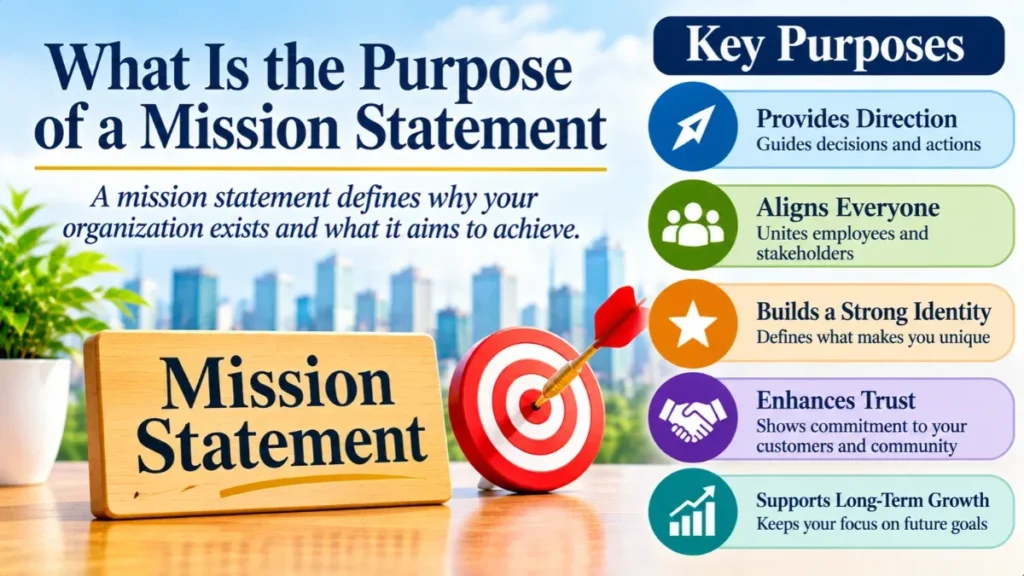
A mission statement is a short declaration of why an organization exists, what it does, and who it serves. Its purpose is to give everyone, from the newest hire to the loudest critic, a clear reason to believe in the work and a clear test for every decision that follows.
What Is the Purpose of a Mission Statement?
A mission statement is a concise, present-tense summary of an organization’s fundamental reason for being. It answers three practical questions: What do we do? Who do we do it for? Why does it matter? Businesses, nonprofits, schools, and government agencies all use them, and even individuals and teams write personal or departmental versions.
Unlike a slogan, which is built to be catchy, or a business plan, which is built to be detailed, a mission statement is built to be clear. It usually runs one to two sentences and stays stable for years, even as products, markets, and leadership change.
Quick Answer
- Direction: It points the whole organization at one goal.
- Decisions: It filters choices, so the team knows what to say yes and no to.
- Identity: It tells customers, employees, and partners what you stand for.
The 6 Key Functions of a Mission Statement
A well-written mission statement does far more than decorate an “About Us” page. Here are the six jobs it performs inside a healthy organization.
One goal for every team.
A filter for every yes or no.
Purpose beyond the paycheck.
What you are, and are not.
Words matched by actions.
A yardstick beyond revenue.
1. It gives the organization a sense of direction
Growing organizations tend to drift. New products, new hires, and new markets all pull attention in different directions. A mission statement acts like a compass, it does not list every step, but it makes sure every step points the same way. For example, a clinic whose mission is affordable primary care has a clear reason to open a branch in an underserved area, and a clear reason to decline a lucrative cosmetic-services line.
2. It simplifies decision-making
Should we launch this feature? Enter that market? Accept this partnership? A strong mission turns these debates into a simple filter. If an opportunity strengthens the mission, it deserves serious consideration. If it pulls away from it, the answer is usually no, even when the money looks attractive. A practical habit is to put the mission at the top of every proposal template, with one line explaining how the proposal supports it.
3. It inspires and aligns employees
People do their best work when they understand why it matters. A shared mission gives employees a common language, reduces internal conflict about priorities, and helps recruiters attract candidates who genuinely fit the culture. Asking staff to explain the mission in their own words is a simple health check: if the answers differ widely, the mission is not yet shared.
4. It communicates your value to customers
Buyers rarely read a mission statement before purchasing, yet it quietly shapes the brand they experience. It influences tone, service standards, and product choices, and when customers do look for it, it tells them what they can expect from you. A bakery promising “fresh, local, no preservatives” attracts a different customer from one promising “cheapest in town,” even if both sell bread.
5. It sets you apart from competitors
Two companies can sell nearly the same product and still be very different. Mission is where that difference becomes visible, whether it is a commitment to sustainability, affordability, craftsmanship, or access. The clearest differences show up in trade-offs the organization is willing to make, such as paying more for ethical sourcing or limiting growth to protect quality.
6. It creates a standard for accountability
Because the mission is public, it invites everyone to hold you to it. That pressure is healthy. It encourages leaders to review their choices, report honestly, and correct course when actions drift from words. Publishing an annual update that shows where money and effort went, measured against each part of the mission, turns a statement into evidence.
Benefits of Having a Mission Statement in an Organization
A mission statement is usually treated as a branding exercise, but it has a direct financial role as well. Budgets, investment decisions, and performance targets all reflect what an organization believes is worth paying for, and the mission is where that belief is written down.
How a Mission Statement Guides Business Decisions and Strategy
Budgeting and capital allocation. When resources are limited, the mission helps decide which projects receive funding first and which are postponed or dropped.
Performance measurement. Targets and KPIs are more meaningful when they are tied to the mission. A nonprofit, for example, may track program impact alongside income, while a retailer may track customer retention alongside margin.
Stakeholder confidence. Lenders, investors, and donors look for consistency between what an organization says it does and where its money actually goes. A mission that is reflected in the numbers supports credibility.
Risk and discipline. A clear mission makes it easier to refuse opportunities that look profitable but sit outside the organization’s core purpose, which are often the ones that stretch cash flow and management attention.
In short, a mission statement that never influences a budget meeting is probably not working yet. The strongest ones are visible in the financial plan as well as the brand.
Mission Statement vs Vision Statement vs Core Values
These three terms are often mixed up, but each does a different job. Think of the mission as today, the vision as tomorrow, and the values as how you behave along the way.
| Element | Core Question | Time Focus | Typical Length |
|---|---|---|---|
| Mission Statement | Why do we exist and what do we do? | Present | 1 to 2 sentences |
| Vision Statement | What future are we working toward? | Future | 1 to 2 sentences |
| Core Values | What principles guide our behavior? | Always | 3 to 7 short statements |
What Makes a Good Mission Statement?
Effective mission statements share a handful of traits. Use these as a checklist when you draft or review your own.
- Clear: Anyone can understand it on first read, with no jargon.
- Concise: Short enough to remember and repeat from memory.
- Specific: It names what you do and who you serve, rather than offering vague promises.
- Purpose-driven: It explains the impact you want to create, not just the product you sell.
- Authentic: It reflects how you truly operate, so employees believe it.
- Durable: Broad enough to survive new products, yet focused enough to guide action.
Real-World Mission Statement Examples
The examples below are quoted from each organization’s own website, so you can check the wording at the source. Mission statements do get revised over time, so use the linked pages for the current version.
GoogleMission: to organize the world’s information and make it universally accessible and useful.
Source: About Google. Why it works: it names a clear action and a broad audience.
MicrosoftMission: to empower every person and every organization on the planet to achieve more.
Source: Microsoft About. Why it works: it focuses on the customer’s outcome rather than the software.
PatagoniaStated purpose: We’re in business to save our home planet.
Source: Patagonia Ownership. Why it works: it is bold and direct, and it clearly shapes the company’s product and business choices.
How to Write an Effective Mission Statement
You do not need a branding agency to write a strong one. Work through these steps with your leadership team, and invite input from people across the organization.
- Clarify your purpose. Ask why the organization exists beyond making money. What problem would remain unsolved if you disappeared?
- Identify who you serve. Name your primary audience: customers, patients, students, members, or communities.
- Define what you do. Describe your main products, services, or activities in plain language.
- State the impact. Capture the change or benefit you create for the people you serve.
- Draft, then trim. Combine the pieces into one or two sentences, then cut every word that does not earn its place.
- Test and refine. Share it with employees and customers. If they cannot explain it back in their own words, simplify it.
Simple Template
“We [what you do] for [who you serve] so that [the impact you create].”
Common Mission Statement Mistakes to Avoid
- Buzzword overload. Phrases like “world-class,” “innovative,” and “synergy” say nothing specific.
- Being too long. If nobody can recall it, nobody can use it.
- Focusing only on profit. Money is an outcome, not a reason people rally around.
- Writing it and forgetting it. A mission that lives only on a poster changes nothing. Reference it in hiring, planning, budgeting, and reviews.
- Copying a competitor. A borrowed mission sounds hollow because it is not yours.
Frequently Asked Questions
What is the main purpose of a mission statement?
The main purpose is to communicate why an organization exists and to guide its actions. It aligns employees, informs decisions, and tells customers and stakeholders what the organization stands for.
How long should a mission statement be?
Most effective mission statements are one to two sentences, often under 30 words. The goal is for people to remember it without looking it up.
What is the difference between a mission and a vision statement?
A mission statement describes what the organization does today and why. A vision statement describes the future the organization hopes to help create. The mission is the path, and the vision is the destination.
How often should a mission statement be updated?
A mission should be stable, so it rarely changes. Review it every few years or after a major shift such as a merger, new market, or change in audience, and update it only if it no longer describes your work accurately.
Do small businesses and startups need a mission statement?
Yes. For a small team, a mission is even more valuable because it keeps limited time and money focused on what matters most, and it helps early hires understand what they are building.
Final Thoughts
The purpose of a mission statement is to turn an abstract idea of “why we exist” into something people can read, remember, and act on. It gives direction to strategy, meaning to daily work, and credibility to your brand. Keep it clear, keep it honest, and keep using it, and it will repay the effort many times over.
Ready to Write Yours?
Start with one question: what difference do we make, and for whom? Your answer is the first draft of your mission.

(Qualified) Chartered Accountant – ICAP
Master of Commerce – HEC, Pakistan
Bachelor of Accounting (Honours) – AeU, Malaysia