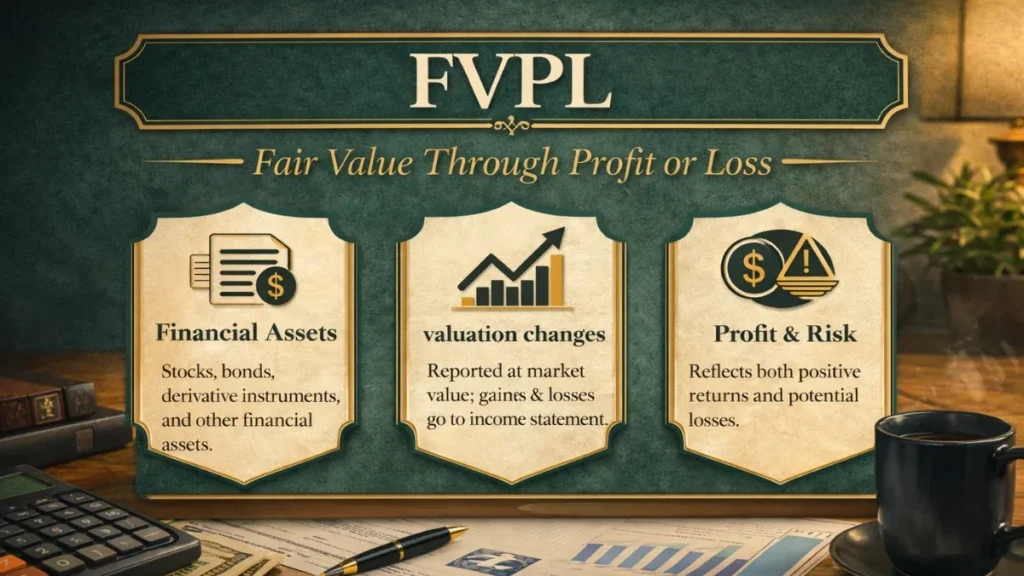
FVPL also referred as Fair Value Through Profit and Loss is a key classification under IFRS 9 used for financial assets and liabilities measured at fair value. All gains and losses are recognized directly in “profit or loss”, impacting earnings immediately.
Last Updated – April, 2026
What is FVPL in Accounting?
A definitive guide to Fair Value Through Profit and Loss; classification criteria, measurement rules, journal entries, and practical examples.
What Is FVPL (Fair Value Through Profit and Loss)?
A financial asset or liability measured at its current fair market value on the balance sheet, where all changes in that fair value are recognized directly in the profit or loss (income statement) for the period.
Fair Value Through Profit and Loss is one of three measurement categories introduced under IFRS 9 – Financial Instruments, which became mandatory on 1 January 2018. It replaced the more complex classification system under the former standard, IAS 39.
When an asset is classified at Fair Value Through Profit and Loss, the balance sheet always reflects its current fair market value. Any gain or loss from period-to-period movements in that value passes directly to net income, making earnings more sensitive to market fluctuations than other classification methods.
When Is a Financial Asset Classified as FVPL?
Under IFRS 9 – Financial Instruments, a financial asset is classified at Fair Value Through Profit and Loss unless it qualifies for measurement at amortized cost or FVOCI (Fair Value Through Other Comprehensive Income). Classification depends on two tests: the SPPI (Solely Payments of Principal and Interest) test and the business model assessment. Failing either test results in automatic Fair Value Through Profit and Loss classification.
Investments acquired primarily to sell or repurchase in the near term e.g., equities, bonds, or derivatives held for active trading purposes.
Debt instruments whose cash flows do not represent solely payments of principal and interest cannot qualify for amortized cost or FVOCI, and default to FVPL.
All derivative financial instruments; interest rate swaps, forwards, options, currency contracts are measured at Fair Value Through Profit and Loss unless designated as hedging instruments.
Entities may irrevocably designate an otherwise qualifying asset at Fair Value Through Profit and Loss to eliminate or significantly reduce an “accounting mismatch” with a related liability.
All equity investments default to Fair Value Through Profit and Loss unless the entity makes an irrevocable election to present fair value changes in OCI (available only for non-trading equities).
Debt instruments held under a “residual” business model, neither hold-to-collect nor hold-to-collect-and-sell must be measured at Fair Value Through Profit and Loss.
How Are FVPL Assets Measured?
Initial Recognition
On the date a financial asset is first recognized, it is measured at its fair value, which is typically the transaction price (the amount paid). Crucially, any transaction costs (broker commissions, transfer taxes, etc.) are expensed immediately to profit or loss. They are not added to the asset’s carrying amount.
Subsequent Measurement
At each reporting date, the asset is remeasured at its current fair value. The difference between the new fair value and the previous carrying amount is recognized as a gain or loss in profit or loss.
Dividends received on equity instruments measured at Fair Value Through Profit and Loss are recognized in profit or loss when the right to receive payment is established. Interest on FVPL debt instruments is also recognized through profit or loss.
Fair Value Measurement Hierarchy (IFRS 13)
IFRS 13 establishes a three-level hierarchy for determining fair value:
| Level | Input Type | Example |
|---|---|---|
| Level 1 | Quoted prices in active markets for identical assets | Listed share prices on a stock exchange |
| Level 2 | Observable inputs other than Level 1 prices | Interest rates, yield curves, credit spreads from market data |
| Level 3 | Unobservable inputs based on entity’s own assumptions | Discounted cash flow models for illiquid assets |
FVPL Accounting Explained: Journal Entries with Examples
XYZ Ltd. purchases 1,000 shares of ABC Corp. on 1 November for $10 per share ($10,000 total), intending to sell them within weeks. Broker commission: $200. At 31 December (year-end), ABC Corp. shares trade at $13 per share (fair value = $13,000).
Step 1 – Initial Purchase (1 November)
Step 2 – Year-End Remeasurement (31 December)
Fair value increased from $10,000 to $13,000, an unrealized gain of $3,000.
Step 3 – Disposal (Future Date)
If shares are sold for $14,000 when carrying amount is $13,000, the realized gain of $1,000 is recognized in profit or loss.
FVPL vs FVOCI vs Amortized Cost
Understanding how Fair Value Through Profit and Loss differs from the other two measurement categories is essential for financial analysis and exam preparation.
| Feature | FVPL | FVOCI | Amortized Cost |
|---|---|---|---|
| Balance Sheet Value | Fair value | Fair value | Amortized cost |
| Fair Value Changes | Profit or Loss (P&L) | Other Comprehensive Income (OCI) | Not recognized |
| Transaction Costs | Expensed immediately | Capitalized (added to asset) | Capitalized (amortized) |
| Earnings Volatility | High | Medium (deferred) | Low |
| Impairment (ECL) | Not applicable | Required for debt instruments | Required (3-stage model) |
| Reclassification | Allowed if business model changes (debt only) | Allowed if business model changes | Allowed if business model changes |
| Typical Assets | Trading securities, derivatives, equity investments | Bonds held for collection & sale, some equities | Loans, receivables, bonds held to maturity |
Decision Tree – How to Classify a Financial Asset: Step-by-Step
Follow this sequential decision process under IFRS 9 classification rules to determine whether a financial asset should be measured at Fair Value Through Profit and Loss.
- Is it an equity instrument?
Distinguish between equity (shares/stocks) and debt instruments. Equity instruments that don’t meet the definition of a financial liability or equity instrument always default to FVPL, unless the FVOCI election is made for non-trading equity.
→ Equity without FVOCI election = FVPL - Does it pass the SPPI Test?
For debt instruments: do contractual cash flows consist solely of payments of principal and interest on the principal outstanding? If the instrument includes features that expose the holder to equity-like or other risks, it fails this test.
→ Fails SPPI = FVPL (mandatory) - Assess the Business Model
Three possible business models: (a) Hold to collect contractual cash flows → Amortized Cost; (b) Hold to collect and sell → FVOCI; (c) Any other model, including trading → FVPL. This assessment is made at a portfolio level, not instrument-by-instrument.
→ Trading/Other business model = FVPL - Consider the Fair Value Option
Even if an instrument would otherwise qualify for amortized cost or FVOCI, an entity may irrevocably designate it at FVPL at inception if doing so eliminates or significantly reduces an accounting mismatch that would otherwise arise.
→ FVO election = FVPL
Frequently Asked Questions
-
What does FVPL stand for?
FVPL stands for Fair Value Through Profit and Loss. It is an accounting measurement category under IFRS 9 in which financial assets or liabilities are carried at fair value on the balance sheet, and all changes in that fair value are recognized directly in the profit or loss (income statement) each reporting period.
-
What is the difference between FVPL and FVTPL?
FVPL and FVTPL (Fair Value Through Profit and Loss) and (Fair Value Through Profit or Loss) are identical concepts, simply two abbreviations for the same accounting classification. Some textbooks and professionals use FVTPL, while others use the shorter form FVPL. The meaning, accounting treatment, and requirements are exactly the same under IFRS 9.
-
Why do FVPL investments cause earnings volatility?
Because every change in fair value, whether a gain or loss flows directly to the income statement each period. If a company holds $50 million in FVPL equities and market prices drop 10%, a $5 million loss hits profit or loss immediately. This makes net income sensitive to market movements, which is why analysts often adjust for Fair Value Through Profit and Loss gains/losses when assessing underlying business performance.
-
Are derivatives always classified at FVPL?
Yes, all derivative financial instruments are measured at Fair Value Through Profit and Loss under IFRS 9, with one exception: derivatives that are designated and effective hedging instruments in a qualifying hedge relationship. In a cash flow hedge, the effective portion of the hedge gain/loss is deferred in OCI rather than recognized in profit or loss.
-
Can a FVPL asset be reclassified to amortized cost?
Reclassification is only possible for debt instruments, and only when the entity changes its business model for managing financial assets, which IFRS 9 expects to be rare. Equity instruments designated at FVPL or the FVOCI election cannot be reclassified. When a reclassification occurs, the fair value at the reclassification date becomes the new carrying amount.
-
Do FVPL assets require an impairment assessment?
No. The IFRS 9 expected credit loss (ECL) impairment model applies only to financial assets measured at amortized cost and FVOCI debt instruments. Since FVPL assets are already remeasured to fair value each period and any credit deterioration is reflected in their market price, a separate impairment calculation is not required.

(Qualified) Chartered Accountant – ICAP
Master of Commerce – HEC, Pakistan
Bachelor of Accounting (Honours) – AeU, Malaysia