IFRS 9 is a key accounting standard that governs the classification, measurement, and impairment of financial assets and liabilities. It introduces the ‘expected credit loss model’, improving how businesses recognize risk and report financial performance.
Understanding IFRS 9 is essential for accurate financial reporting and compliance in modern accounting.
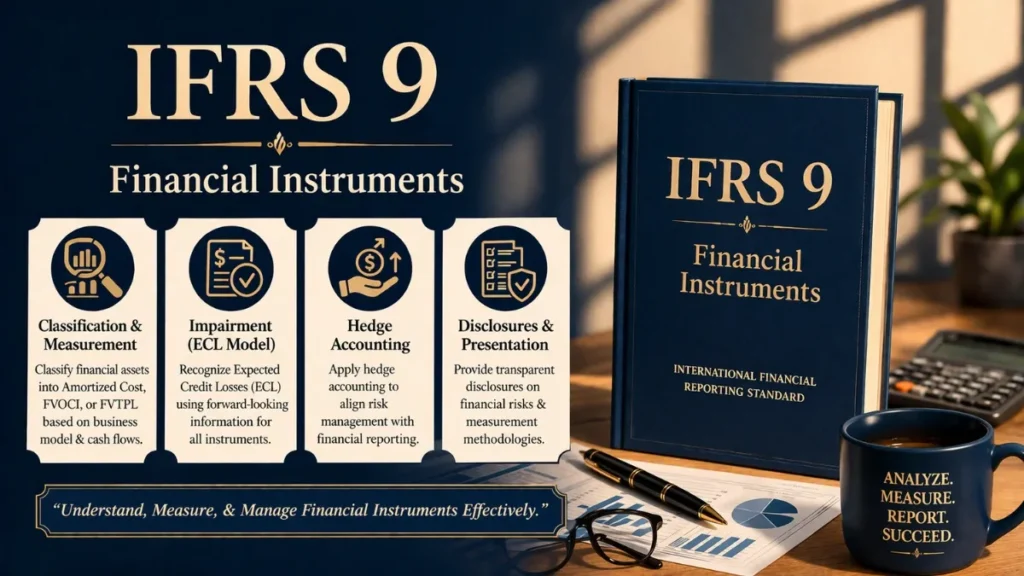
What is IFRS 9?
IFRS 9 Financial Instruments is the IASB’s response to the 2008 global financial crisis; a complete overhaul of how entities recognise, measure, and disclose financial assets, financial liabilities, and some contracts to buy or sell non-financial items.
Issued in July 2014 and mandatory for annual periods beginning on or after 1 January 2018, IFRS 9 replaced the widely-criticised IAS 39. Its three pillars; classification and measurement, impairment, and hedge accounting are designed to produce financial statements that better reflect an entity’s actual risk management activities and the economics of financial instruments.
The standard is of central importance to banks, insurers, asset managers, and any entity that holds significant financial assets. Its Expected Credit Loss (ECL) model, in particular, represented a paradigm shift from the “incurred loss” approach under IAS 39, accelerating recognition of credit deterioration.
An entity shall classify financial assets based on its business model for managing financial assets and the contractual cash flow characteristics of the financial asset, not on legal form or intent at inception alone.
Why IFRS 9 Financial Instruments is important
The global financial crisis exposed fundamental weaknesses in IAS 39 particularly its “too little, too late” approach to loan-loss provisions. Regulators and investors demanded earlier recognition of credit deterioration. IFRS 9 addresses this by requiring entities to recognise a loss allowance equal to 12-month or lifetime expected credit losses depending on credit quality.
Beyond impairment, the classification model is simpler: instead of four categories under IAS 39, IFRS 9 uses three primary measurement bases i.e. amortised cost, fair value through other comprehensive income (FVOCI), and fair value through profit or loss (FVPL).
Scope of IFRS 9 (What is Included & Excluded)
IFRS 9 applies to all entities that prepare financial statements in accordance with IFRS. It covers virtually all financial instruments, with a few important exclusions.
Items Within Scope
| Category | Examples | Relevant Pillar |
|---|---|---|
| Financial assets | Trade receivables, loans, bonds, equity investments, derivatives | Classification, Measurement, Impairment |
| Financial liabilities | Borrowings, trade payables, issued bonds, financial guarantee contracts | Classification, Measurement |
| Derivatives | Interest rate swaps, FX forwards, commodity futures, options | All three pillars |
| Loan commitments | Undrawn credit facilities not measured at FVTPL | Impairment |
| Contract assets | IFRS 15 contract assets for financing component | Impairment |
Items Outside Scope
The following are explicitly excluded from IFRS 9 and governed by separate standards:
| Item | Applicable Standard |
|---|---|
| Subsidiaries, associates, JVs | IFRS 10, IAS 27, IAS 28 |
| Employee benefit plan assets | IAS 19 |
| Insurance contracts | IFRS 17 (with some overlay) |
| Share-based payment instruments | IFRS 2 |
| Leases receivable/payable | IFRS 16 (impairment of lease receivables: IFRS 9) |
| Own equity instruments | IAS 32 |
Insurers applying IFRS 17 may also be subject to the IFRS 9 classification overlay for financial assets backing insurance liabilities, with a temporary exemption for some insurers that expired for periods beginning on or after 1 January 2023.
Classification of Financial Assets (Business Model & SPPI Test)
Under IFRS 9, the classification of a financial asset is determined at initial recognition by applying a two-step test. Unlike IAS 39 which relied heavily on management intent and legal form, IFRS 9 looks to the objective of the business model and the contractual cash flow characteristics of the asset.
The SPPI Test Explained
An instrument passes the SPPI test if the contractual terms give rise, on specified dates, to cash flows that are solely payments of principal (the original amount lent) and interest on the principal outstanding (compensation for time value of money, credit risk, liquidity risk, and other basic lending risks).
Features that typically fail the SPPI test include: leverage, equity-linked returns, inverse floating rates, multi-currency features, and returns tied to the performance of an underlying pool without pass-through conditions. Convertible bonds, for instance, typically fail SPPI and are measured at FVTPL.
Where a feature modifies the time value of money element such as interest resetting less frequently than every year, an entity must assess whether the modification is significant. A de minimis modification may still pass SPPI, but a significant one causes FVTPL measurement.
Classification of Financial Liabilities
The classification of financial liabilities changed less dramatically from IAS 39. Financial liabilities are generally measured at amortised cost unless they are:
- Designated at FVTPL under the fair value option
- Held for trading (including derivatives)
- Arising from a transfer of financial assets that do not qualify for derecognition
- Financial guarantee contracts or loan commitments at below-market rates
- Contingent consideration of an acquirer in a business combination
The key change for liabilities designated at FVTPL is that own credit risk changes are presented in OCI rather than profit or loss, avoiding the counterintuitive outcome where an entity gains from its own creditworthiness deteriorating.
Measurement of Financial Instruments (Amortized Cost, FVOCI, FVPL)
Initial Measurement
All financial assets and liabilities are initially measured at Fair Value. For instruments not classified at FVTPL, directly attributable transaction costs are added to (for assets) or deducted from (for liabilities) the fair value on initial recognition.
Entities may choose, as an accounting policy, to recognise financial assets using either the trade date or the settlement date. The policy must be applied consistently within each category of financial assets.
Subsequent Measurement – Key Bases
| Classification | Interest / Dividends | Fair Value Changes | Impairment |
|---|---|---|---|
| Amortised Cost | P&L (EIR method) | N/A (held at AC) | ECL in P&L |
| FVOCI – Debt | P&L (EIR method) | OCI (recycled to P&L on derecognition) | ECL in P&L |
| FVOCI – Equity | P&L (dividends) | OCI (NOT recycled – ever) | No ECL required |
| FVTPL | P&L | P&L immediately | No separate ECL |
The Effective Interest Rate (EIR) Method
Amortised cost instruments recognise interest income or expense using the Effective Interest Rate (EIR) method, the rate that exactly discounts estimated future cash flows to the gross carrying amount at initial recognition. The EIR considers fees, transaction costs, premiums, and discounts as part of the integral calculation.
ACt = ACt-1 + Interest Income − Cash Received
// Where:
Interest Income = ACt-1 × EIR
// EIR: rate that discounts all future cash flows to opening gross carrying amount
Fair Value Measurement Hierarchy
When measuring at fair value, entities must use the IFRS 13 fair value hierarchy – prioritising Level 1 (quoted prices in active markets), then Level 2 (observable inputs), and finally Level 3 (unobservable inputs) only when the others are unavailable.
Reclassification
Reclassification of financial assets is required (not optional) when, and only when, an entity changes its business model for managing those assets. This is expected to be a rare occurrence. Reclassification takes effect from the first day of the next reporting period and is applied prospectively. Financial liabilities cannot be reclassified.
Impairment – IFRS 9 Expected Credit Loss (ECL) Model Explained
The ECL model is arguably the most impactful aspect of IFRS 9. It fundamentally changed how entities provision for credit losses from incurred to expected, incorporating forward-looking macroeconomic information.
The ECL model applies to financial assets measured at amortised cost and FVOCI (debt), lease receivables, trade receivables, contract assets, and certain loan commitments and financial guarantee contracts.
The Three-Stage Model
What is ECL?
ECL is a probability-weighted estimate of credit losses over the expected life of the financial instrument. It is computed as:
// PD = Probability of Default
// LGD = Loss Given Default (1 − Recovery Rate)
// EAD = Exposure at Default
// DF = Discount Factor (to present value using EIR)
Significant Increase in Credit Risk (SICR)
Determining whether a SICR has occurred is a matter of judgement, using all reasonable and supportable information available. IFRS 9 provides a rebuttable presumption that a SICR has occurred when contractual payments are more than 30 days past due.
Quantitative factors to consider include changes in internal credit grades, credit default swap spreads, and external credit ratings. Qualitative factors include deterioration in the borrower’s financial position, significant adverse changes in the regulatory, economic, or technological environment, and early warning indicators from credit risk management systems.
If a financial asset has low credit risk at the reporting date (broadly, investment-grade equivalent), an entity may assume no SICR has occurred and apply 12-month ECL. This is an accounting policy choice applied instrument-by-instrument.
Simplified Approach
For trade receivables and contract assets that do not contain a significant financing component, entities are required to apply the simplified approach recognising a loss allowance equal to lifetime ECL from initial recognition, without tracking stages. A practical expedient i.e. a provision matrix based on historical loss rates, adjusted for forward-looking information is commonly used.
Forward-Looking Information
Unlike IAS 39, IFRS 9 explicitly requires entities to incorporate forward-looking macroeconomic information into ECL estimates, including multiple probability-weighted economic scenarios (e.g., base, optimistic, adverse). This can significantly increase both the complexity and the volatility of provisions.
Write-offs and Recoveries
An entity shall directly reduce the gross carrying amount of a financial asset when there is no reasonable expectation of recovery, a write-off. Subsequent recoveries are recognised as a reversal of impairment in profit or loss.
Credit-Impaired Assets Purchased or Originated (POCI)
Financial assets that are credit-impaired at initial recognition (POCI) follow special accounting, they are initially recognised at fair value (with no separate loss allowance) and subsequent ECL changes (positive or negative) are recognised in profit or loss using a credit-adjusted EIR.
IFRS 9 Hedge Accounting Explained (Types, Rules)
IFRS 9’s hedge accounting model was redesigned to better align financial reporting with risk management activities. It relaxed several of the IAS 39 requirements, particularly the strict 80–125% effectiveness threshold while introducing new concepts around rebalancing and discontinuation.
Qualifying Criteria
A hedging relationship qualifies for hedge accounting if and only if all of the following conditions are met:
| Criterion | Requirement under IFRS 9 |
|---|---|
| Eligible components | Both the hedged item and hedging instrument must be eligible |
| Formal designation | Formally designated and documented at inception, including the risk management objective and strategy |
| Effectiveness | There is an economic relationship between the hedged item and the hedging instrument |
| Credit risk | Credit risk does not dominate the value changes from the economic relationship |
| Hedge ratio | The designated hedge ratio equals the ratio used for risk management purposes (no deliberate weighting for ineffectiveness) |
Types of Hedge Relationships
Fair Value Hedge
Hedges the exposure to changes in fair value of a recognised asset or liability or an unrecognised firm commitment. Both the hedging instrument and the hedged item’s designated risk are remeasured at fair value through profit or loss. The net effect in P&L represents hedge ineffectiveness.
Cash Flow Hedge
Hedges the exposure to variability in cash flows attributable to a particular risk associated with a recognised asset/liability or a highly probable forecast transaction. The effective portion of the hedging instrument’s gain or loss is recognised in OCI (in a separate cash flow hedge reserve); the ineffective portion goes to P&L. Amounts deferred in OCI are reclassified to P&L when the hedged item affects P&L.
Net Investment Hedge
Hedges the foreign currency risk of a net investment in a foreign operation. Accounting is similar to a cash flow hedge, the effective portion is in OCI and reclassified to P&L on disposal of the foreign operation.
Rebalancing
A key innovation in IFRS 9 is the concept of rebalancing: when the hedge ratio changes for risk management purposes, an entity adjusts the designated amount of the hedged item or the hedging instrument without discontinuing the entire relationship. This avoids the all-or-nothing discontinuation required under IAS 39.
When to Discontinue
Hedge accounting must be discontinued prospectively only when the hedging relationship ceases to meet the qualifying criteria for example, when the hedging instrument expires, is sold, or terminated, or when the economic relationship no longer exists. Voluntary discontinuation is not permitted under IFRS 9 where the risk management objective remains unchanged, another significant departure from IAS 39.
IFRS 9 includes an accounting policy choice to continue using IAS 39’s hedge accounting requirements for fair value macro hedges (portfolio hedging of interest rate risk). A separate standard for macro hedging is still under development by the IASB.
Derecognition of Financial Assets and Liabilities
Derecognition of Financial Assets
An entity shall derecognise a financial asset when, and only when:
- The contractual rights to the cash flows expire, or
- The entity transfers the financial asset and the transfer qualifies for derecognition.
A transfer qualifies for derecognition when the entity transfers substantially all the risks and rewards of ownership. If the entity retains substantially all risks and rewards, it continues to recognise the asset. When the entity neither transfers nor retains substantially all risks and rewards, derecognition depends on whether the entity retains control.
When an entity retains a portion of the risks and rewards (e.g., a guarantee on transferred receivables), it recognises a continuing involvement asset and liability. The continuing involvement asset is measured at the lower of the carrying amount and the maximum exposure to loss.
Derecognition of Financial Liabilities
A financial liability is derecognised when it is extinguished i.e., when the obligation specified in the contract is discharged, cancelled, or expires. A significant modification of a financial liability (change in terms) is accounted for as an extinguishment of the original liability and recognition of a new liability.
The 10% test (net present value of new cash flows compared to old) is commonly used in practice, though IFRS 9 requires a qualitative assessment of whether the modification is substantial. A modification gain or loss on derecognition is recognised in profit or loss.
IFRS 9 Disclosure Requirements
IFRS 7 Financial Instruments: Disclosures was substantially amended to align with IFRS 9. The aim is to enable users of financial statements to evaluate the significance of financial instruments to financial position and performance, and the nature and extent of risks arising from financial instruments.
Quantitative Credit Risk Disclosures
Entities must disclose:
- Credit risk exposure and concentration information
- Gross carrying amounts by credit quality (internal or external ratings)
- Reconciliation of loss allowance by class and stage (including write-offs and recoveries)
- Assumptions and methods used to estimate ECL
- Inputs, assumptions, and estimation techniques for forward-looking information
- Sensitivity of ECL to changes in macroeconomic scenarios
Hedge Accounting Disclosures
For each type of hedge relationship, entities must disclose the risk management strategy, the effect of the hedging relationship on financial position and performance, and the source of hedge ineffectiveness. New tabular disclosures are required, including a breakdown of OCI movements in the cash flow hedge reserve and cost of hedging reserve.
Fair Value Disclosures (IFRS 13)
For instruments measured at or disclosed at fair value, entities must disclose the level in the fair value hierarchy, and for Level 3 instruments, a full reconciliation of opening and closing balances, significant transfers, and sensitivity analysis to unobservable inputs.
Transition from IAS 39 to IFRS 9 (Key Changes Explained)
General Transition Approach
IFRS 9 is applied retrospectively, but without restating comparative information (unless an entity chooses to restate for classification and measurement). The cumulative effect of initially applying IFRS 9 is adjusted in the opening balance of retained earnings (or other equity component) at the date of initial application.
Key Transition Choices
| Area | Choice Available |
|---|---|
| Comparative periods | May or may not restate comparatives; if not, differences disclosed in note |
| Business model assessment | Based on facts and circumstances at date of initial application |
| FVOCI equity election | Irrevocable election made at transition date for existing equity investments |
| Fair value option for liabilities | Designation may be made or revoked at date of initial application |
| Hedge accounting | Can apply IFRS 9 hedge accounting from transition date; existing IAS 39 relationships qualifying under IFRS 9 can continue |
| Macro hedge (IAS 39 option) | Continue IAS 39 for portfolio/macro fair value hedges i.e. policy choice |
The transition to IFRS 9 typically results in a reduction in equity for financial institutions due to higher impairment provisions under the ECL model vs IAS 39’s incurred loss model. Regulatory capital frameworks (Basel III) contain specific transitional arrangements to phase in the capital impact over 5 years.
Frequently Asked Questions
IAS 39 used an incurred loss model for impairment, recognising losses only when there was objective evidence of impairment after the triggering event. IFRS 9 replaced this with the expected credit loss (ECL) model, which requires entities to recognise 12-month ECL from day one and lifetime ECL when credit risk has significantly increased. IFRS 9 also simplified classification (from four to three categories), aligned hedge accounting with risk management, and changed how own credit risk affects P&L for liabilities designated at FVTPL.
12-month ECL is the expected credit loss resulting from default events possible within 12 months of the reporting date, it is the portion of lifetime ECL attributable to defaults within the next year. Lifetime ECL represents the expected credit losses that result from all possible default events over the expected life of the financial instrument. Stage 1 assets use 12-month ECL; Stage 2 and Stage 3 assets use lifetime ECL.
IFRS 9 is a full IFRS standard applicable to entities that prepare financial statements in accordance with IFRS. Small and medium-sized entities using the IFRS for SMEs standard are subject to Section 11 and 12 of that standard, not IFRS 9. However, jurisdictions may require or permit full IFRS for certain categories of SMEs, in which case IFRS 9 would apply.
The business model assessment is made at a portfolio level i.e., for groups of assets managed together, not instrument by instrument. Evidence includes how performance is reported to management, how risks are managed, and how managers are compensated. Sales activity is an important consideration: infrequent sales for liquidity or credit risk management can be consistent with a “hold to collect” model, but frequent or high-volume sales would generally indicate a different model. The assessment is fact-specific and requires significant judgement.
Yes, but only for financial assets and only when there is a change in the entity’s business model for managing those assets. Reclassifications are expected to be rare. Financial liabilities cannot be reclassified. When a reclassification does occur, it is applied prospectively from the reclassification date (the first day of the next reporting period), with no restatement of prior recognised gains, losses, or interest.
IFRS 9 does not prescribe a specific number of scenarios. Entities must incorporate reasonable and supportable information about past events, current conditions, and forecasts of future economic conditions. In practice, many banks use three probability-weighted scenarios (base, upside, downside) calibrated to macroeconomic variables such as GDP growth, unemployment rates, property prices, and interest rates. The weighting and design of scenarios are subject to judgement and should reflect the entity’s specific credit risk profile.
The main changes include: (1) removal of the 80–125% bright-line effectiveness test, replaced by a qualitative “economic relationship” requirement; (2) the concept of rebalancing i.e. allowing adjustments to the designated hedge ratio without full discontinuation; (3) prohibition on voluntary discontinuation when the risk management objective and hedge relationship remain unchanged; (4) expanded eligibility of hedged items (e.g., aggregated exposures, net positions for FX risk); (5) new accounting for the time value of options and forward points (cost of hedging reserve in OCI); and (6) enhanced disclosure requirements.

(Qualified) Chartered Accountant – ICAP
Master of Commerce – HEC, Pakistan
Bachelor of Accounting (Honours) – AeU, Malaysia