ISA 210 – Agreeing the Terms of Audit Engagements deals with the auditor’s responsibilities in agreeing the terms of the audit engagement with management and where appropriate those charged with governance.
Last Updated – May, 2026
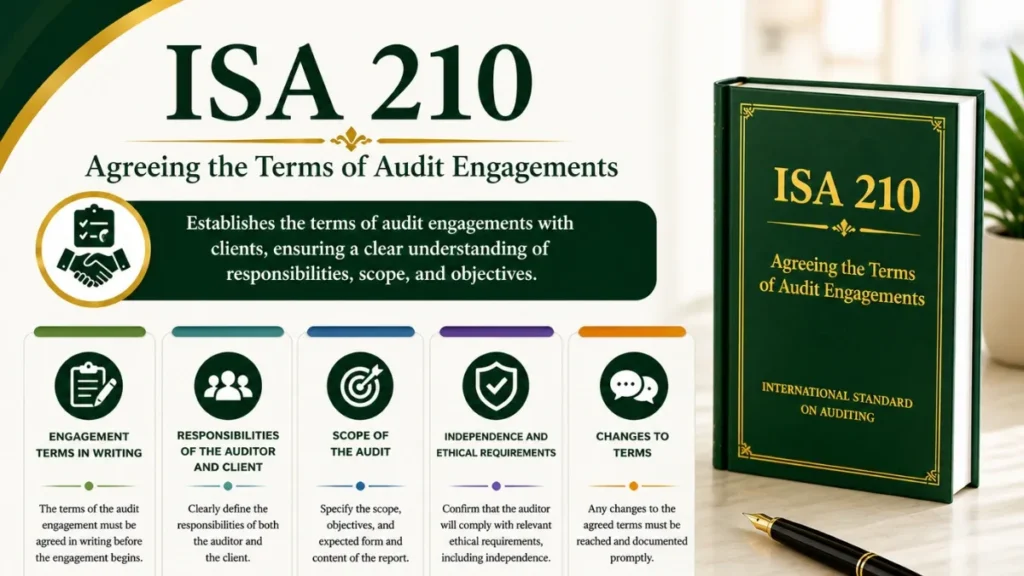
ISA 210 Agreeing the Terms of Audit Engagements
A practitioner’s complete reference: preconditions, engagement letters, recurring audits, and everything in between.
What Is ISA 210?
ISA 210, Agreeing the Terms of Audit Engagements, is an International Standard on Auditing issued by the International Auditing and Assurance Standards Board (IAASB). It establishes the auditor’s responsibilities when agreeing the terms of an audit engagement with management and, where appropriate, those charged with governance.
“The objective of the auditor is to accept or continue an audit engagement only when the basis upon which it is to be performed has been agreed, through establishing whether the preconditions for an audit are present and confirming that there is a common understanding between the auditor and management.”
ISA 210 is part of the broader suite of ISAs that govern audit quality from engagement acceptance through reporting. It works closely with ISA 220 (Quality Management for an Audit of Financial Statements), ISA 300 (Planning an Audit of Financial Statements), and ISQM 1 (Quality Management for Firms).
Primary Objective
Confirm preconditions exist and establish a common understanding of engagement terms before work begins.
Engagement Letter
Document the agreed terms in writing to prevent future misunderstandings between auditor and client.
Scope Clarity
Define the financial reporting framework, responsibilities, and limits of the audit engagement clearly.
Legal Protection
Agreed terms protect both auditor and management in the event of disputes about responsibilities.
Preconditions for an Audit Under ISA 210
ISA 210 requires the auditor to determine whether the preconditions for an audit are present before accepting the engagement. These are fundamental conditions that must be met for the audit to be conducted in accordance with ISAs.
The Two Core Preconditions
The standard identifies two essential preconditions the auditor must evaluate:
Precondition 1: An Acceptable Financial Reporting Framework
Management must have used an acceptable financial reporting framework in the preparation of the financial statements. The auditor assesses the acceptability of the framework applied (e.g., IFRS, national GAAP) considering:
• The nature of the entity and its purpose (e.g., whether it is a listed company or government entity)
• The nature of the financial statements
• Whether law or regulation prescribes the applicable framework
Precondition 2: Agreement on Management’s Responsibilities
Management must acknowledge and understand its responsibilities for:
• The preparation of financial statements in accordance with the applicable financial reporting framework, including where relevant their fair presentation
• Internal control necessary to enable the preparation of financial statements free from material misstatement
• Providing the auditor with access to all relevant information, additional information, and unrestricted access to persons within the entity
When Preconditions Are Not Met
If the preconditions for an audit are not present, the auditor shall discuss the matter with management. Unless required by law or regulation to accept the engagement, the auditor shall not accept it. If an audit is required by law or regulation even where preconditions cannot be met, the auditor must evaluate the effect on the auditor’s report.
Audit Engagement Letter
ISA 210 requires the auditor to agree on the terms of the audit engagement with management or those charged with governance, as appropriate. These terms must be recorded in an audit engagement letter or other suitable form of written agreement.
What Must the Engagement Letter Include?
The engagement letter should address the following key matters:
- The objective and scope of the audit of the financial statements
- The responsibilities of the auditor and reference to applicable standards
- Management’s responsibilities as identified in ISA 210
- Identification of the applicable financial reporting framework for the preparation of the financial statements
- Reference to the expected form and content of any reports to be issued by the auditor, and a statement that there may be circumstances in which a report may differ
- Arrangements regarding the planning and performance of the audit, including composition of the engagement team
- The basis on which fees are computed and any billing arrangements
- A request for management to acknowledge receipt of the engagement letter and to agree to the terms of the engagement
An engagement letter is more than a formality, it is the foundation of a professional relationship, delineating accountability and protecting the integrity of the audit process.
Signed vs. Unsigned Audit Engagement Letters
While the standard requires terms to be in writing, it is best practice for management to sign and return a copy of the engagement letter to confirm agreement. If management refuses to sign, this may raise questions about their commitment to their responsibilities, which the auditor must carefully evaluate.
Key Requirements of ISA 210
The table below summarises the principal requirements of ISA 210 and whether they are definitive requirements or application guidance:
| Paragraph | Requirement | Type |
|---|---|---|
| Para. 6 | Establish the objective: determine whether preconditions are present and confirm common understanding | Requirement |
| Para. 7 | Determine acceptability of the financial reporting framework | Requirement |
| Para. 8 | Obtain management’s agreement of its responsibilities in writing | Requirement |
| Para. 9 | Do not accept the engagement if preconditions are absent (unless required by law) | Requirement |
| Para. 10 | Agree on audit terms and record in an engagement letter or other written agreement | Requirement |
| Para. 11 | Include specific matters in the engagement letter (objective, scope, responsibilities, framework) | Requirement |
| Para. 12-13 | For recurring audits, assess whether the engagement letter needs to be revised | Requirement |
| Para. 14-17 | Evaluate requests to change terms and determine whether they are justified | Requirement |
| A1-A23 | Application and Other Explanatory Material throughout | Guidance |
Recurring Audit Engagements
For recurring audits, where the auditor has performed the audit in a prior period, ISA 210 does not require a new engagement letter to be issued for each period. However, the auditor must assess at the start of each recurring audit whether circumstances require the terms of the engagement to be revised, and whether there is a need to remind management of the existing terms.
When to Issue a New or Updated Engagement Letter
The auditor should consider sending a new engagement letter or updating the existing one when any of the following apply:
- There is any indication that management misunderstands the objective and scope of the audit
- Any revised or special terms of the engagement are necessary
- There has been a recent change of senior management or significant change in ownership
- There has been a significant change in the nature or size of the entity’s business
- There has been a change in legal or regulatory requirements affecting the entity
- There has been a change in the financial reporting framework adopted in the preparation of financial statements
If none of these factors are present, the auditor may simply refer the client to the existing engagement letter and confirm that its terms remain applicable for the current period.
Changes in Audit Engagement Terms
ISA 210 addresses a particularly sensitive situation: what happens when management requests a change in the terms of the engagement, potentially seeking a less demanding engagement such as a review rather than an audit?
Evaluating the Request
The auditor must consider whether the request is reasonable. Legitimate reasons for a change include a change in circumstances affecting the need for the original engagement, or a misunderstanding about the nature of an audit. However, a change should not be made if the auditor cannot comply with the original agreed terms, or if the purpose appears to be to avoid an unfavourable audit opinion or to conceal information.
If a Change Cannot Be Justified
Where the auditor is unable to agree to a change and is not permitted to continue the original engagement, the auditor shall:
- Withdraw from the audit engagement where possible under applicable law or regulation
- Determine whether there is any obligation to report to other parties (e.g., regulators, shareholders) about the circumstances necessitating withdrawal
- Document the reasons for withdrawal and communicate appropriately with those charged with governance
ISA 210 Practitioner Checklist
Use this checklist at the start of each audit engagement to ensure compliance with ISA 210 requirements:
| Step | Action Required | Done? |
|---|---|---|
| 1 | Identify the applicable financial reporting framework and assess its acceptability | ☐ |
| 2 | Determine whether management acknowledges its responsibilities (preparation, internal control, access) | ☐ |
| 3 | Confirm there is no limitation on scope that would cause you to disclaim the audit | ☐ |
| 4 | Prepare or update the engagement letter with all required elements | ☐ |
| 5 | Obtain management’s signature or written acknowledgment of the engagement terms | ☐ |
| 6 | For recurring audits: assess whether the letter needs updating for changed circumstances | ☐ |
| 7 | Document the engagement terms and precondition evaluation in the audit file | ☐ |
| 8 | Ensure all ethical requirements (independence, conflicts of interest) have been addressed | ☐ |
Frequently Asked Questions

(Qualified) Chartered Accountant – ICAP
Master of Commerce – HEC, Pakistan
Bachelor of Accounting (Honours) – AeU, Malaysia