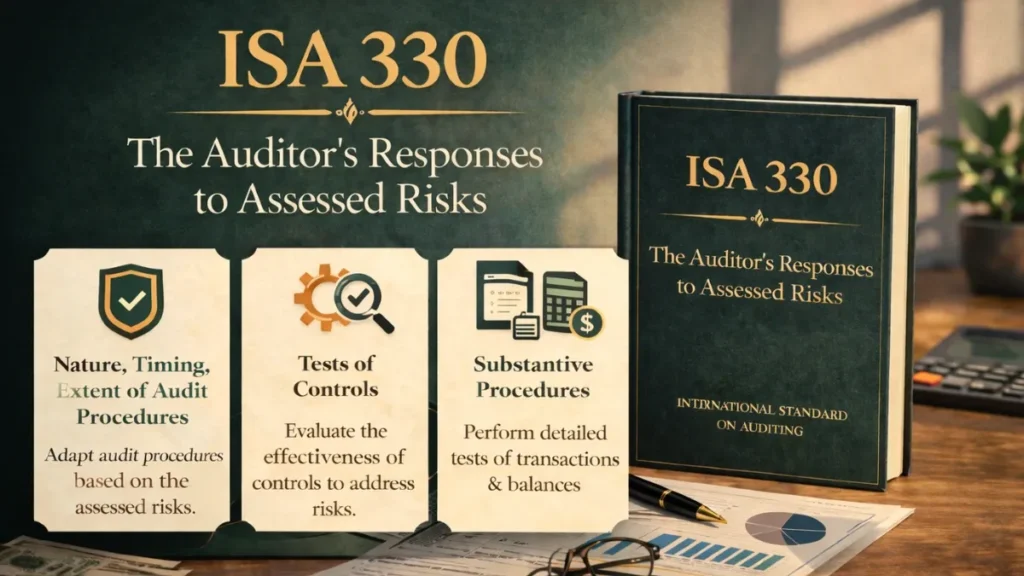
ISA 330 – The Auditor’s Responses to Assessed Risks focuses on how auditors ‘design’ and ‘implement’ procedures to address identified risks in financial statements. It requires appropriate responses through tests of controls and substantive procedures to obtain sufficient audit evidence.
Last Updated – April, 2026
What is ISA 330?
ISA 330, titled “The Auditor’s Responses to Assessed Risks,” is the International Standard on Auditing (ISA) issued by the International Auditing and Assurance Standards Board (IAASB). It forms a critical bridge between risk assessment governed by ISA 315 and the execution of audit procedures designed to address those risks.
In essence, ISA 330 answers the central question every auditor faces after completing risk assessment: What should I do about it? The standard mandates that auditors design and perform audit procedures whose nature, timing, and extent are directly responsive to the assessed risks of material misstatement at both the financial statement level and the assertion level.
In practice, the link between ISA 315 risk assessment and ISA 330 responses is where audit quality is won or lost. A well-documented risk assessment that doesn’t translate into a differentiated audit programme offers false assurance. The standard’s real value is forcing auditors to justify why each procedure was chosen, not just what was done.
Understanding ISA 330 is essential for audit professionals, finance students, and anyone involved in external or internal auditing. It governs the practical day-to-day decisions auditors make when gathering evidence, testing controls, and drawing conclusions about financial statements.
Objective of ISA 330
The stated objective of ISA 330 is straightforward but profound in its implications: the auditor’s goal is to obtain sufficient appropriate audit evidence regarding the assessed risks of material misstatement through the design and implementation of appropriate responses to those risks.
ISA 330 operates at two distinct levels. At the financial statement level, auditors must design overall responses that address pervasive risks, those affecting many assertions across the financial statements. At the assertion level, auditors must design further audit procedures tailored to each specific assessed risk.
Key Requirements of ISA 330
ISA 330 imposes a set of specific, non-negotiable requirements that govern how every auditor must approach the design and performance of audit procedures. These requirements are not optional enhancements, they are the minimum standard every engagement must meet to achieve compliance with the ISAs.
1. Overall Responses Must Be Designed
The auditor must design and implement overall responses to address assessed risks of material misstatement at the financial statement level. These are pervasive in nature and shape the general conduct of the entire engagement, including staffing decisions, the degree of professional scepticism applied, and the predictability of procedures selected.
2. Further Audit Procedures Must Be Risk-Linked
For each assessed risk at the assertion level, the auditor must design and perform further audit procedures, comprising tests of controls and/or substantive procedures whose nature, timing, and extent directly respond to the nature and magnitude of the risk. Generic programmes that are not tied to specific assessed risks do not satisfy ISA 330.
3. Substantive Procedures Are Always Required
Regardless of the assessed level of control risk, even where controls are considered highly effective, ISA 330 mandates that substantive procedures be performed for all material classes of transactions, account balances, and disclosures. This is one of the most commonly tested requirements in professional examinations and one of the most frequently misunderstood in practice.
4. Controls Over Significant Risks Must Be Tested in the Current Period
Where the auditor intends to rely on controls that address a significant risk, those controls must be tested in the current audit period. There is no provision under ISA 330 to carry forward reliance on prior-period evidence for significant risk controls, the risk environment may have changed, and reliance must be freshly established each year.
5. Inquiry Alone Is Insufficient for Tests of Controls
ISA 330 is explicit that inquiry, on its own, does not provide sufficient audit evidence about the operating effectiveness of a control. The auditor must supplement inquiry with at least one of the following: inspection of documents, observation of the control in operation, or reperformance of the control by the auditor.
6. Comprehensive Documentation Is Mandatory
ISA 330 requires the auditor to document the overall responses to assessed risks, the nature, timing, and extent of further audit procedures, the results obtained, and where prior-period control evidence is relied upon, the basis for that reliance. The documentation standard is that an experienced auditor with no prior connection to the engagement must be able to understand exactly what was done and why.
Overall Responses to Assessed Risks
ISA 330 requires auditors to design overall responses to address risks at the financial statement level. These responses reflect the auditor’s professional judgment about the overall risk profile of the engagement and are not tied to specific assertions.
Common overall responses include modifying the nature, timing, and extent of further audit procedures; increasing the unpredictability of selected procedures; assigning more experienced staff or those with specialized skills to higher-risk areas; and paying enhanced attention to the selection of accounting policies or adequacy of disclosures.
| Response Type | Description | When Applied |
|---|---|---|
| Staff Assignment | Assigning more experienced auditors or specialists to high-risk areas | Pervasive financial statement risks; fraud risk |
| Increased Unpredictability | Varying the nature, timing, and extent of procedures beyond what is predictable | When the auditor suspects management override or fraud |
| Year-End Focus | Performing more substantive procedures at period end rather than interim | When risks increase near year-end |
| Heightened Professional Skepticism | Greater scrutiny of management representations and documentation | Elevated fraud risk or complex judgment areas |
Further Audit Procedures under ISA 330
At the heart of ISA 330 is the concept of further audit procedures, the specific work the auditor performs to respond to assessed risks at the assertion level. These procedures are distinct from risk assessment procedures (which merely gather information about risks) in that they are designed to obtain audit evidence about whether material misstatements exist.
ISA 330 specifies that further audit procedures consist of tests of controls and substantive procedures. The nature, timing, and extent of these procedures are determined by the auditor’s judgment, considering the assessed risk level, the characteristics of the area being tested, and the intended purpose of the procedure.
Nature, Timing, and Extent – The Three Dimensions of Audit Procedure Design
Nature
- The type of procedure (inspection, observation, inquiry, confirmation, recalculation, reperformance, analytical)
- More reliable procedures (e.g., external confirmation) are used for higher-risk assertions
- Determines whether the procedure is a test of controls or substantive test
Timing
- When procedures are performed, at interim or at period end
- Higher risk generally requires period-end testing
- If interim testing is used, additional “roll-forward” work is needed
Extent
- The quantity of work; sample sizes, number of items tested
- Higher assessed risk demands larger samples and broader coverage
- Influenced by tolerable misstatement and expected error rates
Linkage to Risk
- All three dimensions must respond to the specific nature of the assessed risk
- Risk of management override may change timing requirements
- Subjectivity and complexity affect nature of procedures selected
Tests of Controls under ISA 330
Tests of controls are audit procedures designed to evaluate the operating effectiveness of controls in preventing or detecting and correcting material misstatements at the assertion level. Under ISA 330, the auditor is required to perform tests of controls when the risk assessment assumes the controls are operating effectively, or when substantive procedures alone cannot provide sufficient appropriate audit evidence.
It is important to distinguish between two aspects of internal controls: design and implementation (addressed by ISA 315 during risk assessment) and operating effectiveness (addressed by ISA 330 through tests of controls). A well-designed control that is not consistently applied offers little audit assurance.
Designing Tests of Controls
When designing tests of controls, the auditor must consider the nature of the control, the frequency of its operation, the consistency of its application, the personnel involved, and the period of intended reliance. A control that operates monthly will generally require fewer tests than one that operates daily, though the auditor must still gather enough evidence to support reliance across the entire audit period.
A common pitfall I see is auditors treating a single walkthrough as a test of operating effectiveness. ISA 330 is clear: a walkthrough establishes design and implementation. Operating effectiveness requires you to test how that control actually ran i.e. repeatedly, consistently, across the full period. The frequency of the control directly determines your minimum sample size.
Using Audit Evidence from Prior Periods
ISA 330 permits auditors to use evidence about controls obtained in prior audits, subject to important constraints. The auditor must evaluate whether there have been any changes to the control or the environment in which it operates. In any event, ISA 330 requires the auditor to test controls at least once every third audit, and more frequently when there are significant changes or high-risk situations.
Substantive Procedures under ISA 330
Substantive procedures are audit procedures designed to detect material misstatements at the assertion level. ISA 330 mandates that the auditor design and perform substantive procedures for all material classes of transactions, account balances, and disclosures regardless of the assessed risk. This is a non-negotiable requirement: even where controls are assessed as highly effective, substantive procedures must still be performed.
Two Types of Substantive Procedures
Substantive Analytical Procedures
Involve evaluating financial information through analysis of plausible relationships among financial and non-financial data. Effective for high-volume, predictable transactions. The auditor must develop an expectation precise enough to identify a misstatement that, individually or in aggregate, could be material.
Tests of Details
Involve directly examining specific transactions, account balances, or disclosures. More appropriate for assertions related to completeness, existence, valuation, rights and obligations, and presentation. External confirmations, vouching, and tracing are common tests of details.
Substantive Procedures at Period End vs. Interim
While ISA 330 permits substantive procedures to be performed at an interim date, doing so increases the risk that misstatements existing at period end will not be detected. When interim substantive testing is chosen, the auditor must perform additional procedures to cover the “rollforward period” — the time between interim testing and the period end.
Addressing Significant Risks under ISA 330
ISA 330 imposes special requirements for significant risks, those identified under ISA 315 as requiring special audit consideration. For significant risks, the auditor must perform substantive procedures that are specifically responsive to the risk. In many cases, this means tests of details rather than relying solely on analytical procedures.
Where the auditor plans to rely on controls over a significant risk, the auditor must test those controls in the current period. There is no option to rely on evidence from prior periods for controls over significant risks.
Common significant risks include revenue recognition, management estimates, related party transactions, complex accounting treatments, and areas with significant management judgment. The audit response in each case must be directly tailored to the specific nature of the risk identified.
Revenue recognition remains the most frequently cited significant risk across engagements globally, and for good reason. The combination of management judgment, varied performance obligations, and variable consideration means that analytical procedures alone rarely provide the level of persuasive evidence ISA 330 demands for significant risks. Tests of details, confirmations, contract review, cut-off testing are almost always required.
Practical Example of ISA 330
To understand how ISA 330 works in practice, consider a real-world audit scenario involving a manufacturing company with a significant inventory balance. This example walks through how an auditor applies ISA 330’s requirements from risk assessment response through to evidence evaluation.
The Scenario
During risk assessment under ISA 315, the auditor identifies a high risk of material misstatement in inventory valuation. The company holds a large volume of slow-moving raw materials, and management applies significant judgment in determining net realisable value (NRV) write-downs. This risk is classified as a significant risk due to the subjectivity involved and the magnitude of the balance.
Step 1 – Overall Response (Financial Statement Level)
In response to the pervasive risk environment, the engagement partner assigns a senior manager with manufacturing sector experience to lead the inventory work. The team also decides to increase the unpredictability of procedures by performing an unannounced inventory count observation, rather than the previously scheduled date to reduce the risk of management manipulation.
Step 2 – Tests of Controls
The auditor identifies that management operates a monthly NRV review control, where the Finance Director signs off on a slow-moving inventory report prepared by the inventory controller. The auditor designs a test of controls to evaluate whether this control operated effectively throughout the year. The test involves: (a) inquiry of the inventory controller and Finance Director about the review process; (b) inspection of 12 signed-off monthly reports to confirm the sign-off occurred; and (c) reperformance of the NRV calculation for a sample of items to confirm the review was substantive and not merely perfunctory. Inquiry alone would not have been sufficient under ISA 330.
Step 3 – Substantive Procedures
Because this is a significant risk, the auditor cannot rely solely on the controls test, substantive procedures specifically responsive to the NRV risk are mandatory. The auditor designs the following:
- Substantive analytical procedure: Comparing the current year write-down percentage against prior years and industry benchmarks to assess whether management’s estimate appears reasonable.
- Test of details: Selecting a sample of slow-moving inventory lines and independently recalculating the NRV by reference to post-year-end sales invoices, current purchase costs, and scrap quotes obtained directly from third-party suppliers.
- External confirmation: Obtaining direct confirmation of consignment inventory balances held at third-party warehouses to address the existence and completeness assertions.
Because the risk is assessed as high, procedures are performed at period end rather than at an interim date, consistent with ISA 330’s guidance that higher risk warrants period-end substantive testing.
Step 4 – Evaluating Results and Documenting
The test of details reveals that management’s NRV write-down is understated by a material amount for three product lines where post-year-end sales prices fell significantly below carrying value. The auditor documents the finding, discusses it with management, and obtains an adjusting journal entry before the financial statements are finalised. The entire audit response, from the risk assessment linkage to the procedures performed, results obtained, and conclusion reached is documented in the audit file in sufficient detail to satisfy ISA 330’s documentation requirements.
This scenario illustrates the most important discipline ISA 330 demands: every procedure must be traceable back to a specific assessed risk. The auditor didn’t test inventory controls because it was “standard programme”, they tested them because the risk assessment identified a specific control relevant to the NRV risk. That traceability is what distinguishes a compliant, high-quality audit from one that merely generates a lot of paper.
Evaluating Sufficiency and Appropriateness of Audit Evidence
After performing audit procedures, ISA 330 requires the auditor to evaluate whether the audit evidence obtained is sufficient and appropriate to support the conclusions reached and the auditor’s report. This evaluation requires professional judgment that integrates findings from all procedures performed.
Where audit evidence suggests that a material misstatement may exist, the auditor must perform additional procedures to determine whether a misstatement actually exists. If the auditor concludes that procedures have not provided sufficient appropriate evidence, they must modify the audit approach; extending procedures, performing alternative tests, or reconsidering the ability to issue an unmodified audit opinion.
Documentation Requirements Under ISA 330
ISA 330 sets clear documentation requirements that form an essential part of audit quality. The auditor must document all of the following elements:
| Documentation Requirement | Description |
|---|---|
| Overall Responses | The overall responses to address assessed risks at the financial statement level |
| Nature, Timing, and Extent | The nature, timing, and extent of further audit procedures and their linkage to the assessed risks at the assertion level |
| Results of Procedures | The results of audit procedures and the audit evidence obtained |
| Reliance on Prior Year Evidence | If controls tested in prior periods are relied upon, the conclusions reached and the basis for those conclusions |
| Departure from Presumed Risk | Where substantive procedures alone are used for classes of transactions with a high volume of routine transactions, the rationale for this conclusion |
Relationship with Other ISAs
ISA 330 does not operate in isolation. It sits within a framework of related standards that together govern the complete audit response process. Understanding these relationships is critical for applying ISA 330 effectively.
| Standard | Relationship to ISA 330 |
|---|---|
| ISA 315 | Identifying and Assessing Risks of Material Misstatement (ISA 315) – provides the risk assessment that ISA 330 responds to |
| ISA 240 | The Auditor’s Responsibilities Relating to Fraud (ISA 240) – ISA 330 requires specific responses to fraud risks identified |
| ISA 500 | Audit Evidence (ISA 500) – defines what constitutes sufficient appropriate evidence as required by ISA 330 |
| ISA 520 | Analytical Procedures (ISA 520) – governs the performance of substantive analytical procedures under ISA 330 |
| ISA 530 | Audit Sampling (ISA 530) – governs sample selection when ISA 330 requires tests of details |
| ISA 230 | Audit Documentation (ISA 230) – supplements ISA 330’s specific documentation requirements |
Relationship between ISA 315 and ISA 330
Of all the relationships within the ISA framework, none is more operationally important than the link between ISA 315 (Identifying and Assessing the Risks of Material Misstatement) and ISA 330 (The Auditor’s Responses to Assessed Risks). These two standards function as a sequential, inseparable pair and understanding how they interact is fundamental to understanding how a modern risk-based audit works.
ISA 315: The Diagnostic Standard
ISA 315 governs the first half of the audit process: understanding the entity, its environment, and its internal controls, and using that understanding to identify and assess where material misstatements could exist. The output of ISA 315 work is a set of assessed risks of material misstatement at both the financial statement level and the assertion level for each material class of transactions, account balance, and disclosure.
Critically, ISA 315 (Revised 2019) introduced the concept of the spectrum of inherent risk, requiring auditors to assess not merely whether a risk exists, but how far along the spectrum from lower to higher it sits. This more granular assessment feeds directly into the calibration of ISA 330 responses.
ISA 330: The Response Standard
ISA 330 picks up exactly where ISA 315 ends. It requires the auditor to take each assessed risk produced by ISA 315 and design a procedure or combination of procedures, specifically calibrated to address it. The higher the inherent risk assessed under ISA 315, the more persuasive and extensive the ISA 330 response must be.
This linkage is not merely conceptual, it must be explicitly documented. The auditor’s working papers must demonstrate a clear, traceable connection between each ISA 315 assessed risk and the ISA 330 procedures designed to respond to it. A procedure performed without a documented risk linkage does not satisfy ISA 330, regardless of its quality.
The Sequential Workflow
| Stage | Standard | What the Auditor Does |
|---|---|---|
| 1. Understand | ISA 315 | Obtain understanding of the entity, its environment, internal controls, and information system |
| 2. Identify | ISA 315 | Identify events, conditions, or circumstances that could lead to material misstatement |
| 3. Assess | ISA 315 | Assess the risks identified, including evaluating the design and implementation of relevant controls |
| 4. Respond (Overall) | ISA 330 | Design overall responses to address financial statement level risks |
| 5. Respond (Assertion) | ISA 330 | Design further audit procedures i.e. tests of controls and/or substantive procedures, linked to each assessed assertion-level risk |
| 6. Evaluate | ISA 330 | Evaluate whether sufficient appropriate audit evidence has been obtained and document conclusions |
The ISA 315–ISA 330 relationship is the spine of the entire audit. In my experience, the most effective way to test whether this link is working is to pick any procedure in the audit programme and ask: “Which specific assessed risk does this respond to, and why was this procedure chosen over an alternative?” If the engagement team can’t answer that question cleanly, the risk-response linkage has broken down, and the audit file will not withstand regulatory scrutiny.
Frequently Asked Questions
ISA 330 establishes how auditors must respond to the risks of material misstatement identified during the risk assessment phase of an audit. Its core purpose is to ensure that audit procedures are specifically designed to address each identified risk, resulting in sufficient appropriate audit evidence to support the auditor’s opinion.
No. ISA 330 explicitly requires that substantive procedures be performed for all material classes of transactions, account balances, and disclosures, irrespective of the assessed level of control risk. Even where controls are assessed as highly effective, some substantive work remains mandatory, though the nature and extent of that work will be reduced.
Tests of controls evaluate whether internal controls are operating effectively throughout the audit period. Substantive procedures directly detect material misstatements in financial statement figures or disclosures. Both types are “further audit procedures” under ISA 330, but they serve different purposes and cannot substitute for each other in every circumstance.
For significant risks, ISA 330 requires that the auditor perform substantive procedures specifically responsive to the risk in the current period. Reliance on prior-year evidence for controls over significant risks is not permitted. In most cases, tests of details (rather than analytical procedures alone) will be required to address significant risks adequately.
ISA 330 requires documentation of: (1) overall responses to financial statement level risks; (2) the nature, timing, and extent of further audit procedures and their linkage to assessed risks; (3) the results of those procedures; and (4) the conclusions reached where the auditor relies on controls tested in prior periods. Documentation must be sufficient to enable an experienced auditor with no previous connection to the engagement to understand the work performed.
ISA 315 and ISA 330 work as a sequential pair. ISA 315 requires the auditor to identify and assess risks of material misstatement through understanding the entity and its environment. ISA 330 then requires the auditor to design and perform further audit procedures specifically responsive to those assessed risks. Without ISA 315 risk assessment, ISA 330 responses cannot be properly designed.

(Qualified) Chartered Accountant – ICAP
Master of Commerce – HEC, Pakistan
Bachelor of Accounting (Honours) – AeU, Malaysia