Lease modification as per IFRS 16 refers to changes made to the terms and conditions of a lease contract after its inception.
These changes can result from negotiations between the lessor and the lessee or due to changes in laws and regulations. For example, lease modifications include changes in ‘Lease Term‘, changes in ‘Rent Payments‘, and changes in the ‘Scope‘ of the lease.
Last Updated – March, 2026
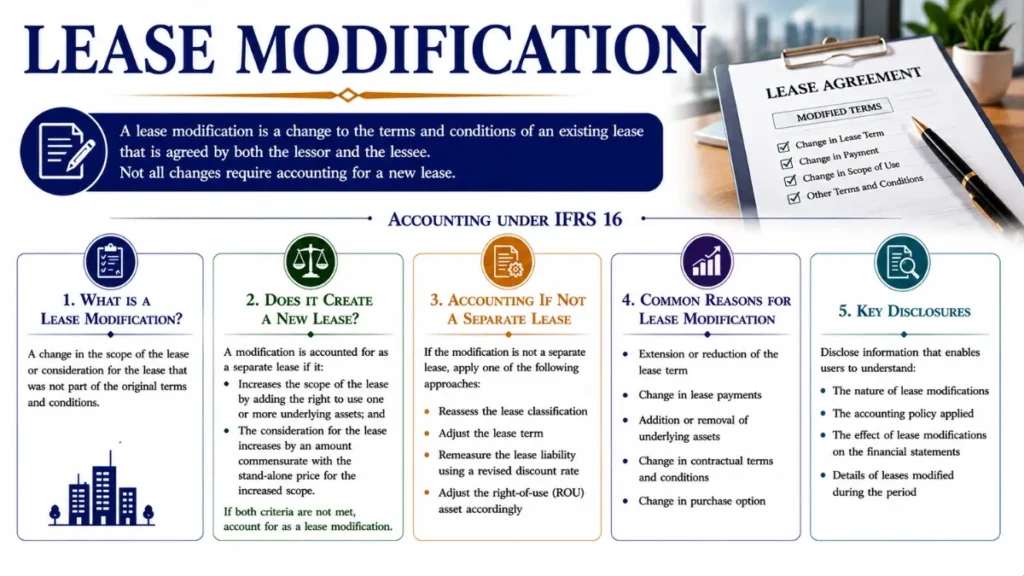
Lease Modifications under IFRS 16
From definition and recognition criteria to remeasurement mechanics, journal entries, worked examples, and disclosure obligations.
1. What Is a Lease Modification?
A lease modification is defined under IFRS 16 as a change in the scope of a lease, or the consideration for a lease, that was not part of the original terms and conditions of the lease (IFRS 16, paragraph 45).
A lease modification is a change in the scope of a lease, or the consideration for a lease, that was not part of the original terms and conditions of the lease. Examples include adding or terminating the right to use one or more underlying assets, or extending or shortening the contractual lease term.
Why Lease Modifications Arise in Practice
Lease modifications occur for numerous commercial reasons. A lessee may need additional warehouse space as its business expands, or may wish to surrender floors in an office building during a downturn. Rent holidays negotiated with landlords, extensions to avoid the cost of relocation, or renegotiated payment profiles following a change in credit risk, all fall squarely within the IFRS 16 modification framework.
Scope Changes
Adding or removing underlying assets, floors, parking bays, or equipment from the lease arrangement.
Term Changes
Extending or shortening the lease term, including the exercise or waiver of extension and termination options.
Consideration Changes
Revising lease payments, including changes to variable-to-fixed conversions, rent-free periods, or payment timing.
Not every change in lease payments constitutes a modification. Changes resulting from the remeasurement triggers already specified in IFRS 16 paragraphs 40–43, such as a revised residual value guarantee, a change in index or rate, or reassessment of options are remeasurements, not modifications, and follow a different accounting pathway.
2. How to Identify a Lease Modification
The first analytical step when a change to lease terms is agreed is to determine whether the change constitutes a modification at all, or whether it should instead be treated as a remeasurement under the standard’s existing provisions, or as a separate new lease from the outset.
The Two-Element Test
For a change to be classified as a lease modification under IFRS 16, it must affect either:
- 1The Scope of the Lease
This includes any change to the nature, quantity, or identity of the underlying assets the lessee has the right to use, as well as changes to the lease term that are negotiated rather than arising from the exercise of a pre-existing option.
- 2The Consideration for the Lease
This captures changes to the lease payments agreed between the parties, whether by reducing, increasing, restructuring, or deferring amounts, provided such changes were not contemplated in the original lease terms.
Lessee negotiates an additional two years beyond the original term at a new market rate; lessee surrenders two floors of a five-floor office lease; lessee and lessor agree to convert variable lease payments to a fixed monthly amount; lessor grants a permanent rent reduction.
Lessee reassesses whether a renewal option will be exercised (IFRS 16.40); lease payments change because the linked CPI index is updated (IFRS 16.42); a residual value guarantee is revised (IFRS 16.42). These are remeasurements, not modifications and the lease liability is remeasured using the original discount rate (or revised rate where specified).
3. Separate Lease vs Not a Separate Lease
Once a change is confirmed to be a lease modification, the next critical determination is whether that modification should be accounted for as a separate, new lease or as an adjustment to the existing lease. This distinction has profoundly different accounting consequences.
The Two-Condition Test for a Separate Lease
Under IFRS 16 paragraph 44, a modification is accounted for as a separate new lease only if both of the following conditions are satisfied:
The commensurate test requires significant judgement. Lessees must assess whether the price of the additional right of use approximates what a landlord or lessor would charge for it on a standalone basis, after adjusting for volume discounts, tenant incentives, or market conditions specific to the transaction. There is no bright-line threshold.
If Both Conditions Are Met: Separate New Lease
When a modification qualifies as a separate new lease, the entity simply applies the normal commencement-date accounting to the newly added asset. The original lease continues to be accounted for under its existing terms, without adjustment. This is the simplest outcome.
If Either Condition Fails: Not a Separate Lease
If the modification does not qualify as a separate new lease, either because it does not add new assets, or because the pricing is not commensurate, the lessee must apply one of three accounting pathways depending on the nature of the modification. These are covered in sections 4, 5, and 6 below.
4. Lessee Accounting for Lease Modifications
For modifications that are not treated as separate leases, a lessee accounts for the modification at the effective date of the modification that is, the date on which both parties agree to the modification. The core mechanics involve:
- 1Remeasuring the lease liability
The lease liability is remeasured using a revised discount rate typically the lessee’s incremental borrowing rate at the modification date. The revised liability reflects revised lease payments over the revised lease term.
- 2Adjusting the right-of-use (ROU) asset
The corresponding debit or credit is recorded against the right-of-use asset, except in the case of a full or partial decrease in scope, where a gain or loss is recognised in profit or loss.
- 3Reassessing the lease classification (IFRS 16.46(b))
Where a modification is not a separate lease and would not have changed the original classification, there is no reclassification requirement. However, for certain finance-to-operating or operating-to-finance reclassifications triggered by modifications, specific guidance applies.
| Modification Type | Discount Rate Used | ROU Asset | P&L Impact |
|---|---|---|---|
| Separate new lease (adds assets, commensurate price) | Rate at modification date | New ROU asset recognised | None at modification |
| Full decrease in scope | Revised IBR at modification date | Derecognised in full | Gain or loss recognised |
| Partial decrease in scope | Revised IBR at modification date | Reduced proportionally | Gain or loss on derecognised portion |
| All other modifications (increase in scope or consideration) | Revised IBR at modification date | Increased by adjustment amount | None at modification |
5. Modifications That Decrease the Scope
Modifications that reduce the scope of the lease whether by shortening the lease term, surrendering part of the asset, or both require the most careful accounting. Under IFRS 16 paragraph 46(a), before making any other adjustment, the lessee must recognise a gain or loss in profit or loss reflecting the partial or full termination.
Step-by-Step: Partial Decrease in Scope
- 1Determine the proportion of scope surrendered
Express the reduction as a proportion of the original asset e.g., surrendering 2 of 5 floors = 40% reduction. For term reductions, calculate the proportion of remaining lease term eliminated.
- 2Reduce the carrying amounts proportionally
Reduce both the right-of-use asset and the lease liability by the proportion surrendered, calculated before any remeasurement adjustment.
- 3Recognise the gain or loss
The difference between the reduction in lease liability and the reduction in ROU asset is the gain (or loss) on modification, recognised immediately in profit or loss.
- 4Remeasure the remaining lease liability
Remeasure the residual lease liability using a revised discount rate (revised IBR at the modification effective date) and adjust the residual ROU asset accordingly.
Gain (Loss) = Reduction in lease liability − Reduction in ROU asset
Where the reduction in lease liability exceeds the reduction in ROU asset, a gain arises. Where the carrying amount of the ROU asset surrendered exceeds the liability reduction, a loss arises.
Full Termination (Full Decrease in Scope)
A full lease termination before the end of the lease term is treated as a special case of a decrease in scope. The lessee derecognises both the right-of-use asset and the lease liability in their entirety, and recognises the net difference as a gain or loss in profit or loss on the termination date. Any lease incentives, prepayments, or accruals relating to the terminated lease are also derecognised.
6. Modifications That Increase the Scope
All modifications that are not (a) separate new leases and (b) not a full or partial decrease in scope fall within the residual category under IFRS 16 paragraph 46(b). This includes:
- Extensions of the lease term (not originally included in options)
- Increases in the scope of the lease where pricing is not commensurate (so it fails the separate-lease test)
- A combined increase in scope and reduction in consideration
- Modifications that only change the lease payments (e.g., rent reductions or increases)
Accounting Treatment
For these modifications, the lessee remeasures the lease liability at the modification effective date using the revised incremental borrowing rate, reflecting the revised lease payments over the revised remaining lease term. The entire adjustment to the lease liability is recorded as a corresponding adjustment to the right-of-use asset. No gain or loss is recognised in profit or loss at the modification date itself.
For modifications other than decreases in scope, all adjustment goes to the ROU asset. Profit or loss is unaffected at the modification date. The revised carrying amount then depreciates over the revised remaining lease term.
7. Lessor Accounting for Lease Modifications
Lessor accounting for lease modifications differs depending on whether the original lease was classified as a finance lease or an operating lease at commencement.
Finance Leases (Lessor)
Under IFRS 16 paragraph 79, for a finance lease modification that is a separate new lease, the lessor accounts for the modification as a new lease from the effective date. For all other finance lease modifications, the lessor applies the derecognition and measurement requirements of IFRS 9 Financial Instruments to the net investment in the lease.
| Original Lease Type | Modification Qualifies as Separate Lease | Modification Does NOT Qualify as Separate Lease |
|---|---|---|
| Finance Lease | New lease from effective date | Apply IFRS 9 derecognition / modification principles to the net investment |
| Operating Lease | New lease from effective date | Account for as new operating lease from effective date; any prepaid or accrued lease payments treated as part of new lease payments |
Operating Leases (Lessor)
For operating lease modifications that do not qualify as separate leases, the lessor accounts for the modification as a new lease from the effective date of the modification (IFRS 16.87). Any prepaid or accrued lease payments relating to the original lease are treated as part of the new lease payments. The lessor then recognises lease income on the modified lease on a straight-line basis (or another systematic basis) over the new lease term.
Intermediate Lessors in Sublease Arrangements
Where an intermediate lessor has both a head lease (as lessee) and a sublease (as lessor), a modification to the head lease is accounted for separately. The intermediate lessor assesses whether the head lease modification results in a remeasurement of the ROU asset and lease liability (as a lessee), and separately whether the sublease needs to be modified or reclassified. These two assessments are performed independently.
8. Lease Modification Worked Examples with Journal Entries
Scenario: On 1 January 20X1, Lessee Ltd entered a five-year lease for an office building. Annual lease payments are CU 100,000, payable in arrears. The incremental borrowing rate (IBR) at commencement was 5% per annum. On 1 January 20X3 (the start of Year 3), Lessee and Lessor agree to extend the lease by an additional two years (to 31 December 20X7) at the same annual rental of CU 100,000. The revised IBR at 1 January 20X3 is 6%.
Carrying amounts immediately before modification (1 Jan 20X3):
Lease liability (before mod): CU 185,941 (PV of 3 remaining payments at 5%)ROU asset (before mod): CU 218,846 (cost CU 432,948 less 2 yrs depreciation)Step 1 – Remeasure lease liability at 1 Jan 20X3:
Revised payments: 5 payments of CU 100,000 (Years 3–7)Discounted at revised IBR of 6%: PV = CU 421,236Increase in lease liability: CU 421,236 − CU 185,941 = CU 235,295Step 2 – Adjust ROU asset by same amount:
| Account | Debit (CU) | Credit (CU) |
|---|---|---|
| Right-of-Use Asset | 235,295 | — |
| Lease Liability | — | 235,295 |
The revised ROU asset of CU 454,141 is depreciated over the revised remaining lease term of five years (20X3–20X7). No gain or loss is recognised in profit or loss.
Scenario: Lessee Corp leases five floors of a building for seven years. On the modification date, the carrying amounts are: Lease Liability CU 2,400,000; ROU Asset CU 2,100,000. Lessee negotiates a surrender of two floors (40% of scope) effective immediately. The reduction in lease payments reduces the lease liability (remeasured at the revised IBR) by CU 1,050,000 for the surrendered portion.
Step 1 – Proportional reduction in carrying amounts (40%):
Reduction in Lease Liability (40% × 2,400,000) = CU 960,000Reduction in ROU Asset (40% × 2,100,000) = CU 840,000Gain = CU 960,000 − CU 840,000 = CU 120,000Step 2 – Journal entry at modification date (scope reduction):
| Account | Debit (CU) | Credit (CU) |
|---|---|---|
| Lease Liability | 960,000 | — |
| Right-of-Use Asset | — | 840,000 |
| Gain on Lease Modification (P&L) | — | 120,000 |
Step 3 – Remeasure residual lease liability (60% retained) at revised IBR:
Residual Lease Liability before remeasurement: CU 1,440,000 (60% × 2,400,000)Revised PV of future payments for 3 retained floors = CU 1,480,000 (assumed)Adjustment: CU 40,000 increase → debit ROU Asset, credit Lease Liability| Account | Debit (CU) | Credit (CU) |
|---|---|---|
| Right-of-Use Asset | 40,000 | — |
| Lease Liability | — | 40,000 |
The gain on the scope reduction (CU 120,000) is presented as a separate line within operating income or other income, depending on the entity’s accounting policy and materiality.
Scenario: Lessee plc has an existing five-year office lease. In Year 2, it agrees with the same landlord to lease an additional adjacent unit for three years, at a monthly rental of CU 8,000. This rate is verified to be the current market rate for that unit in isolation. Both conditions for a separate new lease are met.
Accounting: Lessee plc accounts for the new unit as a completely independent lease. It recognises a new ROU asset and a new lease liability at the commencement of the additional unit’s lease, measured as the present value of the 36 monthly payments of CU 8,000 discounted at the IBR on that date. The original lease accounting is not altered in any way. No modification analysis is required for the original lease.
9. Disclosure Requirements
IFRS 16 requires lessees and lessors to provide disclosures that enable users of financial statements to assess the effect of leases, including modifications on the entity’s financial position, financial performance, and cash flows.
Lessee Disclosures (Quantitative)
| Disclosure Item | Relevant Paragraph | Notes |
|---|---|---|
| Additions to ROU assets | IFRS 16.53(h) | Include additions arising from modifications |
| Gains or losses on disposal or derecognition of ROU | IFRS 16.53(h) | Captures scope reduction gains/losses |
| Maturity analysis of lease liabilities | IFRS 16.58 / IFRS 7.39 | Reflect revised payment profile post-modification |
| Short-term / low-value / variable lease expense | IFRS 16.53(b–d) | Any reclassification post-modification |
| Total cash outflow for leases | IFRS 16.53(g) | Include any modification-related payments |
Qualitative Disclosures
Where modifications are significant, entities should disclose the nature and terms of the modification, the key assumptions made (particularly the revised IBR), and any significant judgements for instance, whether a modification met the criteria to be treated as a separate new lease. Such qualitative disclosures are required to the extent they are material to understanding the financial statements.
Lessor Disclosures
Lessors disclose a maturity analysis of lease payments receivable (IFRS 16.94 for finance leases; IFRS 16.97 for operating leases). Post-modification payment profiles must be reflected in these analyses. For significant modifications to finance leases that are not separate new leases, the IFRS 9 impairment disclosures relating to the net investment in the lease also become relevant.
10. Common Errors & Pitfalls
One of the most frequently encountered errors is treating a reassessment of a lease term option (IFRS 16.40) as a modification. If a lessee reassesses that it will exercise a renewal option it had previously not included in the lease term, this is a remeasurement not a modification. The IBR used is the revised rate at the date of remeasurement, but the accounting pathway is different: the adjustment always goes to the ROU asset, and there is never a gain or loss.
Some practitioners incorrectly apply the original discount rate when remeasuring the lease liability following a modification. IFRS 16 is clear: for modifications that are not separate leases, the revised incremental borrowing rate at the modification effective date is used. The only circumstance where the original rate is relevant to modifications is in measuring the net investment under IFRS 9 for finance lease lessor modifications.
When a modification both decreases scope and changes consideration, some preparers apply the remeasurement adjustment before recognising the gain or loss. The correct sequence under IFRS 16.46(a) is: (1) proportionally reduce carrying amounts and recognise the gain or loss first, then (2) remeasure the residual lease liability at the revised IBR and adjust the residual ROU asset.
The effective date of a modification is the date on which both parties agree to the modification, not the date the revised payment schedule begins. Where there is a gap between agreement and commencement of revised payments, the modification accounting is applied at the agreement date, and the revised payments are accrued accordingly.
Entities that are intermediate lessors in sublease arrangements must separately assess each modification, once as a lessee (for the head lease) and once as a lessor (for the sublease). A modification to the head lease does not automatically require a modification to the sublease, and vice versa. Each assessment follows its own pathway independently.
11. Frequently Asked Questions
12. Key Takeaways
IFRS 16 Lease Modifications – At a Glance
- A modification is a change in scope or consideration not in the original lease terms.
- Distinguish modifications from remeasurements triggered by original terms.
- A separate new lease requires both additional assets AND commensurate pricing.
- All modifications use the revised IBR at the modification effective date.
- Scope reductions always require a gain or loss in profit or loss.
- For other modifications, all adjustments go to the ROU asset, no P&L impact.
- Perform scope-reduction adjustments before remeasurement of residual balance.
- Lessor treatment differs for finance vs operating leases.
- Intermediate lessors must assess head lease and sublease modifications independently.
- Disclosures must reflect the revised payment profile in the maturity analysis.

(Qualified) Chartered Accountant – ICAP
Master of Commerce – HEC, Pakistan
Bachelor of Accounting (Honours) – AeU, Malaysia