ISA 810 (Revised) – Engagements to Report on Summary Financial Statements deals with the auditor’s responsibilities relating to an engagement to report on ‘summary financial statements’ derived from financial statements audited in accordance with ISAs by that same auditor.
Last Updated – August, 2026
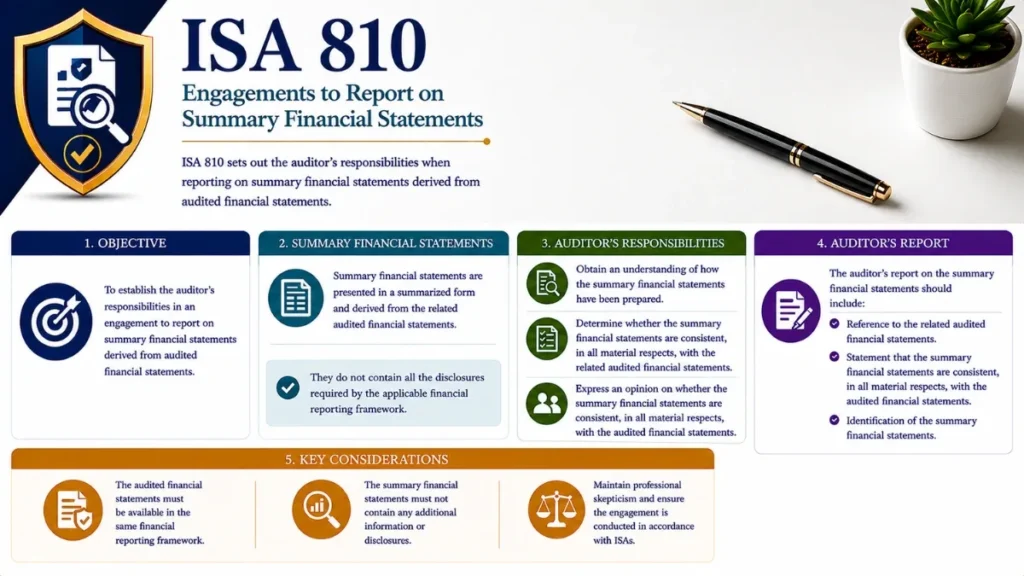
International Standard on Auditing
ISA 810
Engagements to Report on Summary Financial Statements
Not every reader of a company’s accounts wants or needs the full audited financial statements. ISA 810 is the standard that lets an auditor put their name to a shorter, condensed version of those accounts, without pretending it’s a second audit. Here’s exactly what it requires, in the order an auditor actually applies it.
- Issuing Body
- IAASB (IFAC)
- Effective Date (Revised)
- Periods ending on/after 15 Dec 2016
- Local Equivalent
- e.g., SA 810 (India), HKSA 810
- Companion Standards
- ISA 700, ISA 701, ISA 805
§1
What Is ISA 810?
Companies routinely publish a condensed version of their financial statements; a summary annual report for shareholders, a snapshot for lenders, or a highlights page in an investor presentation. These summary financial statements are shorter and less detailed than the full audited set, and by themselves they don’t tell a reader whether they can be trusted.
ISA 810 (Revised) titled Engagements to Report on Summary Financial Statements issued by IAASB exists to close that gap. It sets out what an auditor must do before agreeing to report on a summary version of financial statements they’ve already audited, and how that report should be worded. The engagement is deliberately narrow: the auditor is not forming a fresh opinion on whether the summary presents a “true and fair view.” Instead, they’re reporting on whether the summary is a fair, consistent derivation of the audited financial statements it comes from.
That distinction matters. A reader who sees an auditor’s name attached to a summary report might reasonably assume it carries the same weight as a full audit opinion. ISA 810 is built, in large part, to prevent that misunderstanding.
§2
Objective of ISA 810
The standard frames the auditor’s job as three sequential objectives, and each one has to be satisfied before moving to the next:
- Determine whether it is appropriate to accept or continue an engagement to report on summary financial statements.
- Where the engagement is accepted, form an opinion on the summary financial statements, based on evaluating the conclusions drawn from the evidence obtained.
- Express that opinion clearly, through a written report that also explains the basis for it.
Auditor’s Note
Notice what’s missing: nowhere does the objective mention re-auditing the underlying figures. The evidence has already been gathered during the original audit. ISA 810 is about evaluating and communicating, not re-verifying.
§3
Definitions and Key Terms
ISA 810 rely on three defined terms throughout. Getting these straight makes the rest of the standard much easier to follow.
Applied Criteria
The basis management used to prepare the summary for example, a policy that says “summary figures will mirror the audited statement of financial position and income statement line items, condensed under agreed headings.”
Audited Financial Statements
The full set of financial statements that the same auditor has already audited under the ISAs, and from which the summary is drawn.
Summary Financial Statements
Historical financial information derived from the audited statements, containing materially less detail, while still identifying itself clearly as a summary.
§4
Scope and Effective Date
ISA 810 (Revised) was updated to keep pace with the IAASB’s broader overhaul of auditor reporting. When ISA 700 (Revised) and the new ISA 701 introduced more transparent, informative audit reports including the reporting of Key Audit Matters, the IAASB revisited ISA 810 to make sure summary-statement reports reflected that same transparency.
- January 2015The IAASB issues its new and revised suite of auditor reporting standards, including ISA 700 (Revised) and ISA 701.
- August 2015Limited conforming amendments to ISA 810 are exposed for public comment.
- December 2015The IAASB approves ISA 810 (Revised).
- 15 December 2016ISA 810 (Revised) becomes effective, for engagements to report on summary financial statements for periods ending on or after this date.
- 1 April 2024India’s ICAI brings its equivalent, the revised SA 810, into effect for engagements beginning on or after this date, one example of how jurisdictions adopt and localise the standard.
Many national standard-setters, India’s ICAI and Hong Kong’s HKICPA among them, issue their own version of ISA 810 with local footnotes and guidance. The core requirements travel largely unchanged; the surrounding explanatory material is often tailored to the local market.
§5
When Does ISA 810 Apply?
ISA 810 engagements come up in a fairly predictable set of situations:
- A listed company wants to include condensed financial highlights in a shareholder-facing annual review, alongside or instead of the full statutory accounts.
- A group entity needs to submit summarised figures to a regulator, tax authority, or joint-venture partner that doesn’t require the full statement set.
- Management wants an auditor’s name attached to summary numbers used in an investor presentation, press release, or lending covenant pack.
- A parent company needs summarised subsidiary financials for consolidation reporting to a head office in another jurisdiction.
In every case, the common thread is the same: someone wants credibility attached to a shortened set of numbers, without commissioning an entirely separate audit or review.
§6
Engagement Acceptance and Requirements
Before agreeing to the engagement, the auditor works through a short checklist.
- Same auditor. The engagement is only available to the auditor who audited the underlying financial statements, not a different firm reviewing someone else’s audit.
- Acceptable criteria. The criteria management applied to build the summary must be acceptable in the circumstances, and adequately disclosed so a reader understands the basis of preparation.
- Access to the full report. The auditor needs to have access to or the reasonable expectation of obtaining the auditor’s report on the full financial statements.
- Nature of the underlying opinion. If the audit opinion on the full financial statements was qualified, adverse, disclaimed, or included an emphasis-of-matter or key audit matters, the auditor considers whether it’s still appropriate to accept the summary engagement, and how that will be reflected in the new report.
§7
Forming the Opinion & Auditor’s Report
Once accepted, the auditor’s procedures focus on whether the summary is consistent with the audited financial statements, not on re-testing the balances themselves. Broadly, that means checking that:
- The summary figures agree, or reconcile, to the corresponding figures in the audited financial statements.
- The applied criteria have been used consistently throughout the summary.
- The summary contains the information necessary and isn’t misleading in its level of aggregation or omission given the applied criteria.
- Any events or amendments after the date of the original auditor’s report that would affect the summary have been appropriately handled.
What the auditor’s report on the summary contains
An ISA 810 report follows a fairly fixed shape: a title identifying it as an independent auditor’s report, an addressee, an opinion paragraph stating whether the summary is consistent, in all material respects, with the audited financial statements (or fairly summarises them, depending on the applied criteria), a basis-for-opinion statement, a clear reference to the auditor’s report on the full financial statements and its date, and critically a statement making clear that the summary should be read alongside that full report and does not substitute for it.
Auditor’s Note
If the underlying audit report was modified say, a qualified opinion, the ISA 810 report has to say so, and explain what that means for the summary. Silence on this point is exactly the kind of gap ISA 810 is designed to prevent.
§8
ISA 810 vs Related Auditing Standards
ISA 810 sits inside a family of standards that govern different aspects of auditor reporting.
| Standard | What It Governs | Relationship to ISA 810 |
|---|---|---|
| ISA 700 (Revised) | Forming and reporting the opinion on a full set of general-purpose financial statements. | Produces the audit report that ISA 810’s summary report is derived from. |
| ISA 701 | Communicating Key Audit Matters in the auditor’s report. | Its transparency reforms are the reason ISA 810 was revised in 2015–16. |
| ISA 805 | Audits of a single financial statement, or a specific element, account, or item. | Different scope entirely, ISA 805 narrows the audit itself; ISA 810 summarises an audit already completed. |
| ISA 810 | Reporting on summary financial statements derived from an already-audited set. | The subject of this guide. |
§9
Common ISA 810 Issues and Challenges
- Implying a broader opinion than intended. Loose wording in a summary report can make readers think the auditor has re-audited the numbers, rather than simply checked consistency.
- Undisclosed criteria. If the basis for preparing the summary isn’t clearly disclosed alongside it, readers have no way to judge whether the condensation is reasonable.
- Timing mismatches. The summary engagement usually runs close to, or immediately after, the underlying audit leaving little room to properly consider subsequent events if the two aren’t sequenced carefully.
- Distribution without the full report. If management plans to circulate the summary without making the full auditor’s report available on request, the auditor needs to address that before signing off.
- Carrying forward a modified opinion. A qualification, key audit matter, or emphasis of matter in the original report has to be reflected, not just placed in the summary report.
§10
Frequently Asked Questions
Is an ISA 810 engagement the same thing as an audit?
No. The underlying financial statements have already been audited. The ISA 810 engagement checks whether the summary is a consistent, fair derivation of that audited set, it doesn’t re-test the numbers from scratch.
Can a different audit firm report on the summary financial statements?
No. ISA 810 is only available to the same auditor who audited the full financial statements the summary is derived from.
How is ISA 810 different from ISA 805?
ISA 805 governs audits of a single financial statement or a specific line item. ISA 810 doesn’t involve auditing anything new, it governs reporting on a condensed version of statements that were already fully audited.
What happens if the original audit opinion was qualified?
The auditor has to consider whether accepting the summary engagement is still appropriate, and if so, the summary report must clearly reflect the modification, it can’t be presented as if the underlying opinion were clean.
Does India follow ISA 810 exactly?
India’s ICAI issues its own version, SA 810, which mirrors the core requirements of ISA 810 (Revised) with local application guidance. Its most recent revision applies to engagements for periods beginning on or after 1 April 2024.
Can summary financial statements be used to replace the full annual report?
No. ISA 810 reports are written to make clear the summary should be read together with not instead of the full audited financial statements and the auditor’s report on them.
§11
Key Takeaways
- ISA 810 governs reporting on a condensed version of financial statements the same auditor has already audited, it is not a second audit.
- Before accepting, the auditor checks that the applied criteria are acceptable and that the underlying audit report is available.
- The resulting report must clearly reference the full audited financial statements and reflect any modification in the original opinion.
- The revised standard, effective for periods ending on or after 15 December 2016, was updated to keep pace with more transparent audit reporting under ISA 700 (Revised) and ISA 701.
- Local equivalents such as India’s SA 810 apply the same core logic with jurisdiction-specific guidance layered on top.

(Qualified) Chartered Accountant – ICAP
Master of Commerce – HEC, Pakistan
Bachelor of Accounting (Honours) – AeU, Malaysia