In a sale and leaseback transaction, an entity (the seller-lessee) sells an asset to another entity (the buyer-lessor), which then leases the asset back to the seller-lessee.
Sale and leaseback a concept which explains that such transaction is accounted for as a ‘sale‘ of an underlying asset and a ‘leaseback‘ of that underlying asset only if the initial transaction qualifies as a sale in accordance with IFRS 15 (Revenue from Contracts with Customers).
Last Updated – September, 2026
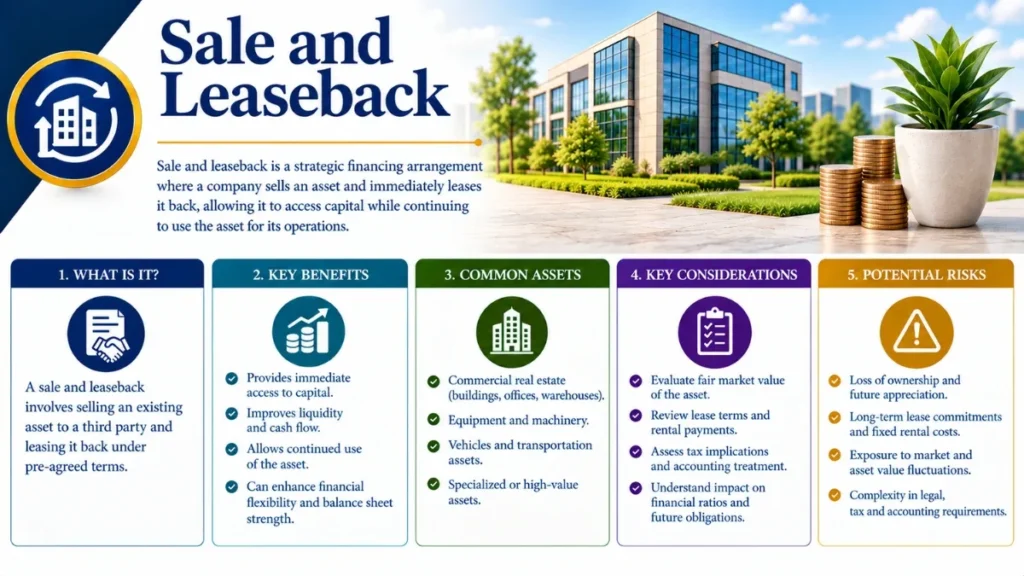
Sale and Leaseback – Unlock Capital From Assets You Already Own
A comprehensive, expert-level resource on sale and leaseback transactions; covering structure, benefits, tax implications, accounting standards, sector applications, and everything finance professionals need to know.
01 — Definition
What Is a Sale and Leaseback?
A sale and leaseback (SLB), also written as “sale-leaseback” is a two-part financial transaction in which the owner of an asset sells it to a third party and simultaneously enters into a lease agreement to continue using that same asset for an agreed term.
In simple terms, a sale and leaseback occurs when a business sells an asset it owns, most commonly property or equipment to an investor, and simultaneously enters a lease agreement to continue occupying or using that same asset. The seller receives an immediate capital sum; the buyer receives a long-term, contractually secured income stream. Ownership transfers, but operational use does not.— Jhanzayb (ACA), Chartered Accountant · based on IFRS 16 and FASB ASC 842 framework principles
In plain terms: you sell an asset you own but keep using it as a tenant. The transaction converts a fixed, illiquid asset into liquid working capital without interrupting your operations.
Sale and leaseback transactions are most commonly used in commercial real estate (offices, warehouses, factories, retail stores), but they also apply to high-value equipment such as aircraft, ships, railway carriages, data-centre hardware, and medical imaging devices.
Key Parties Involved
Seller-Lessee
The company or individual that originally owns the asset. They receive the sale proceeds and then pay rent under the lease. Their primary motivation is capital release while retaining operational use.
Buyer-Lessor
The investor or entity that purchases the asset and becomes the landlord. Their primary motivation is a secure, long-term income stream backed by a creditworthy tenant and a tangible asset.
Quick Distinction
A sale and leaseback differs from a traditional mortgage or secured loan because ownership genuinely transfers. It also differs from operating a leased asset from day one because the seller starts as the owner and converts to tenant status.
02 — Process
How Does a Sale and Leaseback Work? (Step by Step)
While every deal has its own nuances, the anatomy of a sale and leaseback follows a recognisable six-step sequence from initial valuation to ongoing lease operation.
Triple Net (NNN) Leases – The Most Common Structure
In commercial real estate SLB transactions, the triple net lease (NNN) is the predominant structure. Under NNN terms, the tenant is responsible for property taxes, building insurance, and maintenance, in addition to base rent. This passes virtually all costs to the tenant, making income highly predictable for the investor.
Lease Term Norms by Asset Class
Commercial real estate: 10–25 years · Industrial/logistics: 10–20 years · Aircraft: 8–15 years · Medical equipment: 3–7 years · IT hardware: 2–5 years
03 — Seller Benefits
Key Benefits of Sale and Leaseback for Sellers
For the business selling the asset, a well-structured sale and leaseback can unlock substantial financial, strategic, and operational advantages often superior to traditional debt financing.
The seller receives 100% of the asset’s fair market value as a lump sum, far more than refinancing, which is capped at 60–75% LTV.
The asset is derecognised, improving ROA, ROE, and debt-to-equity ratios under qualifying structures.
Freed capital can fund R&D, acquisitions, debt repayment, or shareholder returns yielding higher returns than passive ownership.
Unlike outright disposal, a leaseback guarantees the business retains full use of the asset, critical for properties housing core operations.
SLBs provide off-bank-market financing, valuable when credit conditions are tight, rates are elevated, or covenant headroom is limited.
Lease payments are fully deductible operating expenses in many jurisdictions, replacing less efficient depreciation and interest deductions.
Focus Capital on Core Competencies
One of the most strategically compelling arguments for a sale and leaseback is the opportunity cost of capital locked in non-core assets. A manufacturing company’s core competency is making products, not managing property. By converting owned real estate into a managed lease, leadership can allocate capital toward activities that generate competitive advantage and superior returns.
This principle underpinned some of the most well-known corporate SLB programmes: major retailers monetising their store portfolios, airlines selling and leasing back their fleets, and banks divesting branch networks, all while retaining full operational use.
04 — Investor Perspective
Why Investors Pursue Sale and Leaseback Deals
Sale and leaseback transactions have become a preferred strategy for institutional investors, REITs, and family offices seeking stable, long-duration income streams with tangible collateral.
Predictable Long-Term Income
SLBs with creditworthy tenants and long lease terms offer bond-like predictability. Rent is contractually fixed with scheduled escalations, and the tenant, who sells because they need the asset has strong incentives to honour the lease.
Tangible Asset Security
Unlike corporate bonds or loans, SLB investors own the physical asset outright. In a default scenario, the investor can re-let or sell the property/equipment, providing a hard-asset backstop.
Inflation-Linked Returns
Most long-dated SLB leases include rent review mechanisms; fixed annual uplifts, CPI-linkage, or open-market reviews, protecting investors against inflation over 10–25 year terms.
Portfolio Diversification
SLBs span retail, logistics, healthcare, aviation, data centres and more, enabling diversified income portfolios with different tenant, sector, and geographical exposures.
05 — Risk Analysis
Risks and Drawbacks of Sale and Leaseback
Sale and leaseback is a powerful tool, but not without meaningful downsides. Understanding the risk profile from both sides is essential before proceeding.
Risks for the Seller-Lessee
- HighLoss of Asset Ownership & UpsideOnce sold, any future capital appreciation belongs to the buyer. Sellers transacting at a market trough may forgo substantial gains, a significant opportunity cost in high-growth property markets.
- HighLong-Term Rental ObligationsThe lease creates a fixed, long-dated liability. If the business downsizes or relocates, it may be locked into rent on space it no longer needs, with break clauses typically expensive or absent.
- MediumRent Escalation RiskOpen-market rent reviews can result in significantly higher occupancy costs if asset values rise. Sellers should negotiate rent caps and favourable review structures upfront.
- MediumUndervaluation at ClosingIf the asset sells below fair market value due to urgency or weak negotiating position, the seller permanently forfeits value. Independent valuation and competitive bidding are essential safeguards.
- LowReputational Signal RiskA large SLB can be interpreted by analysts as a sign of balance sheet stress, particularly if proceeds service existing debt. Clear communication of strategic intent is vital.
Risks for the Buyer-Lessor
- HighTenant Credit RiskThe entire value proposition depends on the tenant making rent. If the seller-lessee defaults or restructures, the investor faces re-letting risk in an asset that may be highly specialist and difficult to reposition.
- MediumAsset Specificity RiskHighly specialised assets (bespoke production facilities, specialist data centres) have limited alternative use. If the tenant vacates, exit options are narrow and values may be deeply discounted.
- MediumInterest Rate RiskWhere the investor uses leverage, rising interest rates increase financing costs, compressing net yield if rents cannot be increased proportionately.
Critical Structuring Consideration
Sellers should always model the full present value of future rent obligations against the capital received. In rising rate environments, the NPV of long-dated lease commitments can significantly exceed the apparent sale proceeds, making the effective cost of capital higher than it initially appears.
06 — Accounting Standards
Accounting Treatment Under IFRS 16 and ASC 842
The accounting for sale and leaseback transactions changed fundamentally with IFRS 16 (issued by IASB) and ASC 842 (US GAAP). Correct treatment depends on whether the transfer qualifies as a “sale” under IFRS 15 / ASC 606.
Scenario A: Transfer Qualifies as a Sale
- Derecognise the asset – remove it from the balance sheet at its carrying amount.
- Recognise a right-of-use (ROU) asset – measured as the proportion of the previous carrying amount retained through the leaseback.
- Recognise a lease liability – at the present value of future lease payments.
- Recognise a gain or loss – but only on the portion effectively transferred to the buyer (not the retained ROU portion).
- Ongoing – amortise the ROU asset and unwind the lease liability using the effective interest method.
Scenario B: Transfer Does NOT Qualify as a Sale
- Retain the asset – continue to recognise the full asset on the balance sheet.
- Recognise a financial liability – the cash received is treated as a secured borrowing, not sale proceeds.
- No gain or loss is recognised at the point of the transaction.
- Ongoing – payments are split into interest expense and principal repayment under the effective interest method.
When Does a Transfer Qualify as a Sale?
Under IFRS 15 and ASC 606, a sale is recognised when control of the asset passes to the buyer. Control does not transfer if the buyer-lessor holds a repurchase option at a below-market price, if the seller retains substantively all risks and rewards of ownership, or if the leaseback is a finance lease and the seller’s ROU asset represents substantially all of the asset’s fair value.
IFRS vs US GAAP Differences
While both frameworks align broadly on recognition principles, there are nuanced differences in lease classification, measurement of the ROU asset in a failed-sale leaseback, and transitional provisions. Entities reporting under both should consult their auditors for transaction-specific treatment.
07 — Tax Implications
Sale and Leaseback Tax Implications and Treatment
Tax treatment varies significantly by jurisdiction and transaction structure. The following represents general principles, professional tax advice is essential for any specific transaction.
For the Seller-Lessee
Capital Gains Tax
The sale typically triggers a capital gains event. The gain equals the sale price less the asset’s tax base. In many jurisdictions, gains on commercial property are taxed at reduced rates or qualify for rollover relief if proceeds are reinvested.
Deductible Lease Payments
Post-sale, lease payments are typically fully deductible as operating expenses, replacing less favourable depreciation deductions. For entities in high tax brackets, this can significantly improve after-tax cash flow.
VAT / Sales Tax
In many jurisdictions, the sale of commercial property is subject to VAT or transfer taxes. Careful structuring, including VAT option to tax elections can mitigate this cost.
For the Buyer-Lessor
Rental Income Taxation
Rent received is taxable income, offset by allowable deductions including acquisition financing interest, depreciation/capital allowances on the purchased asset, and property management costs.
Capital Allowances
In many jurisdictions, the buyer can claim capital allowances on the purchase price, providing tax depreciation deductions that shelter a portion of rental income, significantly affecting after-tax yield.
Exit Taxation
At lease end or upon subsequent sale, the buyer-lessor faces capital gains tax on appreciation. This should be factored into the underwriting of expected total returns at acquisition.
08 — Comparative Analysis
Sale and Leaseback Vs Alternative Financing Options
Understanding where sale and leaseback sits in the corporate financing toolkit helps businesses select the right tool for their specific capital needs and strategic objectives.
| Criterion | Sale & Leaseback | Mortgage / Secured Loan | Outright Sale | Equity Issuance |
|---|---|---|---|---|
| Capital Released | 100% of fair value | 50–75% of value (LTV) | 100% of sale price | Variable |
| Continued Operational Use | Yes | Yes | No | Yes |
| Debt on Balance Sheet | Lease liability (IFRS 16) | Yes — full loan | None | None |
| Asset Ownership Retained | No | Yes | No | Yes |
| Capital Appreciation Upside | Forfeited | Retained | Forfeited | Retained |
| Transaction Speed | 3–6 months | 4–12 weeks | 3–9 months | 3–6 months |
| Covenant Flexibility | High | Low | High | High |
| Suitable for Distressed Situations | Yes | Partial | Yes | Partial |
The primary differentiator of sale and leaseback is its ability to unlock 100% of an asset’s value while preserving operational continuity, a combination unavailable through any other financing mechanism. The trade-off is the permanent loss of ownership and a long-term lease obligation.
09 — Sector Applications
Sale and Leaseback Across Industries
Sale and leaseback transactions are executed across virtually every capital-intensive sector. The structure adapts to the specific characteristics of each asset class.
Real Estate Sale and Leaseback – The Dominant Category
Commercial real estate accounts for the majority of SLB transaction volume by value. Within real estate, industrial and logistics assets particularly large-scale distribution centres are the fastest-growing SLB category, driven by e-commerce growth and the strategic importance of last-mile fulfilment networks.
Equipment Sale and Leaseback
Equipment SLBs are structurally similar but have shorter lease terms and require careful consideration of technological obsolescence. In aviation, dedicated Aircraft Leasing Companies (ALCOs) purchase aircraft from airlines and lease them back, representing a multi-hundred-billion-dollar global industry.
10 — Deal Structure
How to Structure a Sale and Leaseback Deal
Successful sale and leaseback execution requires careful attention to six core structural elements, each of which materially affects the economics, risk profile, and strategic outcome.
1. Lease Type
Triple Net (NNN): Tenant pays all opex, most common in commercial SLBs, maximises investor appeal. Gross Lease: Landlord pays most costs, less common, more appropriate for shorter-term situations. Finance Lease: Mirrors ownership, increasingly rare post-IFRS 16 due to balance sheet impact.
2. Lease Term & Break Options
Longer terms command higher prices from investors but increase the seller’s long-term obligation. Break options provide flexibility but typically require a financial penalty and will reduce the price achieved.
3. Rent Review Mechanism
Fixed annual uplifts (e.g., 2% p.a.) provide certainty; CPI-linked reviews protect against inflation; open-market reviews offer fairness but uncertainty. Sellers should avoid uncapped open-market reviews in high-growth markets.
4. Purchase Options / ROFR
Sellers may negotiate a right of first refusal (ROFR) or a purchase option at lease end, allowing re-acquisition at a pre-agreed or market price. This preserves optionality while monetising the asset today.
5. Repair & Maintenance Obligations
Clearly defining maintenance responsibilities and incorporating a Schedule of Condition, protects both parties. Sellers should understand their dilapidations liability at lease expiry and budget accordingly.
6. Change-of-Control Provisions
Leases should address M&A scenarios including step-in rights, consent requirements, and guarantor obligations in the event of a change in the seller-lessee’s credit quality.
Seller Best Practice: Run a Competitive Process
Sellers achieve materially better pricing with a structured, competitive process with multiple credible bidders. Even a small improvement in cap rate say, from 5.25% to 5.00% translates to a 5% increase in proceeds on the same asset, representing millions on larger transactions.
11 — FAQs
Frequently Asked Questions
Any asset with significant value, long remaining useful life, and clear operational necessity to the seller is a potential SLB candidate. The most common are owner-occupied commercial real estate (offices, warehouses, factories, retail), aircraft, rolling stock, medical equipment, and data-centre infrastructure. The asset must be integral to the seller’s operations, independently marketable, and of sufficient value to justify transaction costs.
Pricing is driven primarily by the capitalisation rate (cap rate), the initial annual rent divided by the sale price. A lower cap rate implies a higher price. Cap rates are influenced by the creditworthiness of the tenant-seller, the lease term and structure, asset quality and location, the interest rate environment, and investor demand. For investment-grade corporate tenants with long NNN leases on prime assets, cap rates can be well below 5%; for weaker credits or shorter structures, rates of 7–9%+ are common.
The impact depends on how proceeds are used and the overall leverage profile post-transaction. Rating agencies model lease obligations under IFRS 16 / ASC 842 as debt-equivalent. If proceeds repay existing financial debt, the net leverage impact may be neutral or positive. If proceeds fund acquisitions or shareholder returns while the lease liability adds to total obligations, leverage metrics may deteriorate. Most investment-grade corporates engage rating agencies proactively before completing significant SLB transactions.
Not automatically, the sale is a permanent legal transfer of ownership. However, sellers can negotiate a purchase option at lease inception, giving them the right (but not obligation) to re-acquire the asset at lease expiry or at specified points during the term. A right of first refusal (ROFR) on any subsequent sale by the investor is a softer alternative. In practice, most SLB sellers do not exercise buyback options, as capital has typically been redeployed into higher-return activities by the time the option crystallises.
While large transactions dominate the headlines, sale and leaseback is increasingly accessible to mid-market businesses. A thriving market of specialist SLB investors and regional property investors has developed specifically to service SME transactions in the £1m–£20m range. Key requirements are a quality asset, demonstrable earnings ability to service rents, and ideally an audited financial track record.
At lease expiry, the seller-lessee typically has several options: negotiate a new lease with the existing owner (often at prevailing market rents), vacate and surrender the asset, exercise a pre-agreed purchase option to re-acquire the asset, or negotiate a lease extension. The seller should plan for lease expiry from the outset, particularly for mission-critical assets where vacancy would be operationally unacceptable.
Ready to Explore a Sale and Leaseback?
Whether you’re a business owner looking to unlock capital or an investor seeking stable long-term income, understanding the full picture is essential before proceeding.
Read the Full Guide View FAQs
(Qualified) Chartered Accountant – ICAP
Master of Commerce – HEC, Pakistan
Bachelor of Accounting (Honours) – AeU, Malaysia