IAS 38 – Intangible Assets explains the ‘accounting criteria’ for intangible assets, which are non-monetary assets that are without physical substance and identifiable (either being separable or arising from contractual or other legal rights).
Last Updated – June, 2026
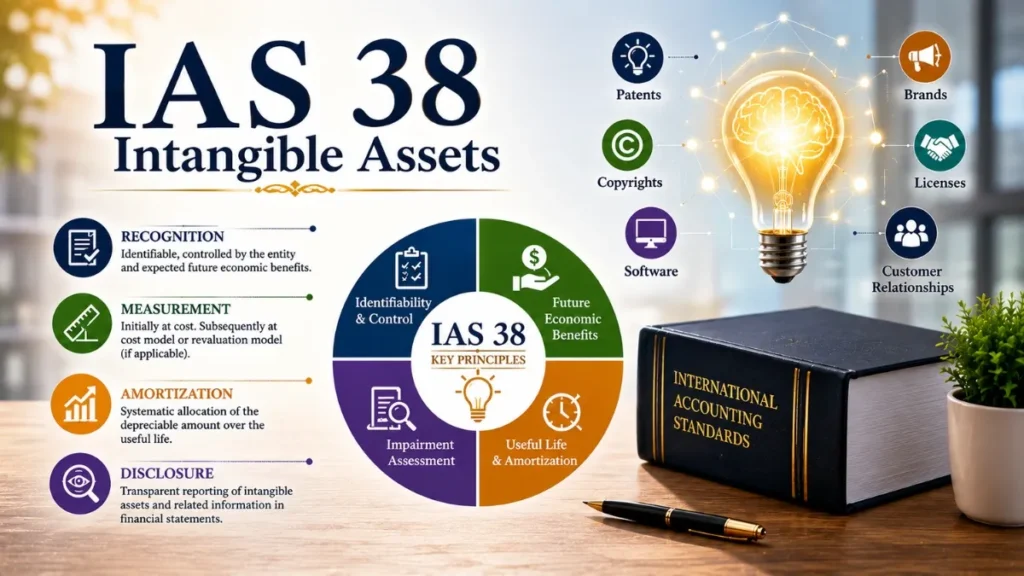
IAS 38 – Intangible Assets
The Complete Practical Guide
A practitioner’s guide to recognising and measuring intangible assets, distinguishing research from development, applying amortisation rules, and satisfying disclosure requirements under IAS 38.
What Is IAS 38? (Objective and Scope)
IAS 38 Intangible Assets was issued by the International Accounting Standards Board (IASB) and prescribes the accounting treatment for intangible assets that are not dealt with specifically in another IFRS standard. Its primary objective is to ensure that an entity recognises an intangible asset only when specified criteria are met, thereby preventing overstatement of assets and providing users of financial statements with relevant, faithfully represented information.
Scope of IAS 38
The standard applies to all intangible assets except:
- Intangible assets within the scope of another standard (e.g., financial instruments under IFRS 9, intangible assets held for sale under IFRS 5)
- Goodwill acquired in a business combination (IFRS 3)
- Deferred acquisition costs and intangible assets arising from an insurer’s contractual rights under insurance contracts (IFRS 17)
- Non-current intangible assets classified as held for sale (IFRS 5)
- Mineral rights and expenditure on exploration for or development of minerals, oil, natural gas, and similar non-regenerative resources
IAS 38 also applies to advertising, training, start-up, and research and development costs, many of which fail the recognition criteria and must be expensed immediately.
Definition of an Intangible Asset Under IAS 38
IAS 38 defines an intangible asset as an identifiable, non-monetary asset without physical substance. All three characteristics must be present simultaneously.
Identifiability
The asset is separable (can be sold, transferred, licensed, rented, or exchanged individually or with a related contract) or arises from contractual or other legal rights, regardless of whether those rights are transferable or separable from the entity or from other rights and obligations.
Non-Monetary
The asset does not consist of, or is not represented by, money or rights to receive a fixed or determinable number of monetary units. This distinguishes intangibles from financial assets.
Lack of Physical Substance
The asset has no tangible, physical form. Examples include patents, copyrights, customer lists, software, and licences. An asset that happens to be embodied in a physical form (e.g., software on a disc) is assessed by reference to which component is more significant.
“An intangible asset is an identifiable non-monetary asset without physical substance.” IAS 38, paragraph 8
The Concept of Control
Beyond the definition, an entity must also control the asset, meaning it has the power to obtain future economic benefits and restrict others from accessing those benefits. Control typically arises from legal rights (patents, licences) but can also stem from other means, such as trade secrecy or confidentiality agreements.
Importantly, skilled staff, customer relationships not protected by legal rights, and a market share arising from general reputation are usually not controlled under IAS 38 because the entity cannot reliably restrict others from accessing similar benefits.
Recognition Criteria for Intangible Assets
An intangible asset is recognised in the financial statements if, and only if, both of the following conditions are met:
✓ Condition 1 – Probable Future Economic Benefits
- Economic benefits flow from the use or disposal of the asset
- Benefits can be revenues, cost savings, or other advantages
- Management assesses probability using reasonable and supportable assumptions
✓ Condition 2 – Reliable Measurement of Cost
- The cost can be measured reliably
- Externally acquired assets generally satisfy this
- Internally generated assets face higher scrutiny
Internally Generated Intangible Assets
Internally generated goodwill is never recognised as an asset. More broadly, costs incurred in the following activities are expensed as incurred and may not be recognised as intangible assets at a later date:
✗ Not Recognised – Always Expensed
- Internally generated brands, mastheads, publishing titles
- Customer lists
- Items similar in substance to internally generated goodwill
- Start-up costs (pre-opening, pre-operating)
- Training costs
- Advertising and promotional costs
- Relocation and reorganisation costs
✓ May Be Recognised – Development Phase
- Technical feasibility of completing the asset is demonstrated
- Intention to complete and use or sell the asset
- Ability to use or sell the asset
- Asset will generate probable future economic benefits
- Adequate technical, financial, and other resources exist
- Expenditure attributable to the asset can be reliably measured
Once expenditure on an intangible item has been expensed under IAS 38, it cannot be reinstated as an asset even if the recognition criteria are subsequently met. The prohibition is irrevocable.
Initial Measurement of Intangible Assets
An intangible asset is initially measured at cost. How cost is determined depends on how the asset is acquired.
| Acquisition Route | Cost Basis | Key Notes |
|---|---|---|
| Separate Purchase | Purchase price + directly attributable preparation costs | Includes import duties; excludes training and general overheads |
| Business Combination (IFRS 3) | Fair value at acquisition date | Recognised separately from goodwill if identifiability criteria are met |
| Government Grant (IAS 20) | Fair value or nominal amount plus directly attributable expenditure | Entity has a policy choice |
| Exchange of Assets | Fair value of asset given up (unless commercial substance absent) | If no commercial substance, carrying amount of asset given up is used |
| Internally Generated | Sum of expenditure from the date criteria are first met | Only development-phase costs; research-phase costs always expensed |
Directly Attributable Costs
Costs that are directly attributable and included in initial measurement comprise:
- Costs of employee benefits arising directly from bringing the asset to its working condition
- Professional fees incurred directly to bring the asset to its working condition
- Costs of testing whether the asset is functioning properly
Costs such as administration and general overhead, inefficiencies, operating losses, and staff training are excluded from the cost of an intangible asset.
Subsequent Measurement Models
After initial recognition, an entity must choose either the Cost Model or Revaluation Model as its accounting policy and apply it consistently across a class of intangible assets.
Cost Model (Default)
- Carry the asset at cost less accumulated amortisation and accumulated impairment losses
- Simple and widely used
- No need for an active market
Revaluation Model (Permitted)
- Carry at a revalued amount, fair value at date of revaluation less subsequent amortisation and impairment
- Only permitted where an active market exists for the intangible asset
- Active markets for intangible assets are rare in practice
- Revaluations must be made with sufficient regularity
In practice, the Revaluation Model is rarely used for intangible assets because an active market; one with homogeneous items, willing buyers and sellers, and publicly available prices seldom exists for items like patents, brand names, or proprietary software.
Useful Life & Amortisation of Intangible Assets
IAS 38 requires an entity to assess the useful life of each intangible asset, whether it is finite or indefinite. This assessment profoundly affects the subsequent accounting treatment.
Finite Useful Life Intangible Assets
Where the useful life is finite, the asset is amortised over that period. The depreciable amount (cost or revalued amount less any residual value) is allocated on a systematic basis reflecting the pattern in which the asset’s future economic benefits are expected to be consumed. Methods include the straight-line method, the diminishing balance method, and the units-of-production method.
The residual value of a finite-life intangible asset is assumed to be zero unless a third party is committed to purchasing the asset at the end of its life, or there is an active market from which a residual value can be estimated and that market will likely exist at the end of the useful life.
Indefinite Useful Life Intangible Assets
An intangible asset has an indefinite useful life when there is no foreseeable limit to the period over which the asset is expected to generate net cash inflows. Such assets are:
- Not amortised
- Tested for impairment annually, and whenever there is an indication of impairment, in accordance with IAS 36
- Subject to annual reassessment, if the useful life is no longer indefinite, the change is accounted for as a change in accounting estimate (IAS 8)
| Aspect | Finite Useful Life | Indefinite Useful Life |
|---|---|---|
| Amortisation | Yes – systematic over useful life | No |
| Impairment testing | When indication exists (IAS 36) | Mandatory annual test (IAS 36) |
| Useful life review | Reviewed at each financial year-end | Reassessed annually |
| Residual value | Assessed; usually nil | Not applicable |
| Common examples | Patents, licences with fixed terms, customer lists, software | Brands with perpetual renewal, perpetual licences (rare) |
Amortisation Period and Method
The amortisation period begins when the asset is available for use and ceases at the earlier of the date the asset is classified as held for sale under IFRS 5 or is derecognised. The amortisation method and period are reviewed at each financial year-end. Any change is treated as a change in accounting estimate.
Impairment Requirements for Intangible Assets
IAS 38 requires intangible assets to be assessed for impairment in accordance with IAS 36 Impairment of Assets. IAS 36 requires an entity to estimate the recoverable amount of an asset whenever there is an indication that the asset may be impaired.
For intangible assets with an indefinite useful life or those not yet available for use, impairment testing is mandatory at least annually, regardless of indicators.
Recoverable Amount
The recoverable amount is the higher of:
- Fair value less costs of disposal – the price obtainable from an arm’s length transaction between knowledgeable, willing parties, less disposal costs
- Value in use – the present value of estimated future cash flows from continued use and ultimate disposal of the asset
If the carrying amount exceeds the recoverable amount, an impairment loss is recognised immediately in profit or loss (unless the asset is carried at a revalued amount, in which case the loss is treated as a revaluation decrease first).
Derecognition of Intangible Assets
An intangible asset is derecognised:
- On disposal (including sale, donation, or lease under IFRS 16 finance lease), or
- When no future economic benefits are expected from its use or disposal
The gain or loss on derecognition is the difference between the net disposal proceeds (if any) and the carrying amount of the asset. It is recognised in profit or loss at the time of derecognition and is not classified as revenue (unless the asset was held for sale in the ordinary course of business, in which case IFRS 15 applies).
The date of disposal of an intangible asset is determined using the same criteria as for revenue recognition under IFRS 15 for the sale of goods. This ensures consistency across standards.
Disclosure Requirements
IAS 38 imposes extensive disclosure obligations, grouped by class of intangible asset. A class is a grouping of assets of a similar nature and use (e.g., brand names, patents, licences, software). Disclosures differ between finite-life and indefinite-life intangibles.
Primary Disclosures
- Whether useful lives are finite or indefinite, and if finite, the useful lives or amortisation rates used
- Amortisation methods used for finite-life intangibles
- Gross carrying amount and accumulated amortisation (including impairment losses) at the beginning and end of the period
- A reconciliation of the carrying amount at the beginning and end of the period, showing additions, retirements and disposals, impairment losses, reversals, net exchange differences, and other changes
Additional Disclosures
- If an intangible asset is assessed as having an indefinite useful life: the carrying amount and reasons supporting that assessment
- Description, carrying amount, and remaining amortisation period of any individually material intangible asset
- Intangible assets acquired by way of a government grant and initially recognised at fair value: fair value initially recognised, carrying amount, and whether the cost or revaluation model is used
- The existence and carrying amounts of intangible assets with restricted title and carrying amounts pledged as security
- Amount of contractual commitments for the acquisition of intangible assets
- Aggregate amount of research and development expenditure recognised as an expense during the period
Practical Examples of IAS 38
Example 1 – Software Acquired Separately
A manufacturing entity purchases enterprise resource planning (ERP) software for $500,000. Installation, configuration, and testing costs of $40,000 are directly attributable to bringing the software to its working condition. General IT staff time of $15,000 relates to training.
Accounting treatment: The intangible asset is recognised at $540,000 ($500,000 + $40,000). The $15,000 training cost is expensed as incurred because it does not form part of the cost of the asset.
Example 2 – Internally Generated Development Project
A pharmaceutical entity incurs $1.2 million on a research project (screening compounds) and $3.8 million on a development project (final clinical trials for a drug that has received regulatory clearance to proceed, with technical and commercial feasibility established).
Accounting treatment: The $1.2 million research-phase expenditure is expensed. The $3.8 million development-phase expenditure meets the six criteria in IAS 38.57 and is capitalised as an intangible asset, amortised over its useful life once available for use.
Example 3 – Brand Acquired in a Business Combination
Entity A acquires Entity B in a business combination. Entity B’s brand is not recognised in Entity B’s own financial statements (as it was internally generated). However, at the acquisition date the brand is separable, it can be licensed independently and its fair value can be measured reliably at $8 million.
Accounting treatment: Under IFRS 3, Entity A recognises the brand as a separate intangible asset at $8 million, reducing the residual amount allocated to goodwill accordingly. If the brand is assessed as having an indefinite useful life, it is not amortised but tested annually for impairment.
Example 4 – Website Development Costs
An entity develops its e-commerce website in stages: planning (feasibility studies), application and infrastructure development (HTML coding, software acquisition), graphical design, and content development.
Accounting treatment: Planning stage costs are expensed. Application and infrastructure development costs (writing code, purchasing and integrating software) meet the development-phase criteria and are capitalised. Graphical design and content that generates directly attributable revenues may also be capitalised. Ongoing maintenance and operating costs are expensed as incurred.
Research Costs vs Development Costs
One of the most practically significant distinctions in IAS 38 is between research and development activities. Costs arising from the research phase are always expensed; costs from the development phase may be capitalised when all six criteria are satisfied.
| Dimension | Research Phase | Development Phase |
|---|---|---|
| Definition | Original and planned investigation undertaken to gain new scientific or technical knowledge | Application of research findings to a plan or design for the production of new or substantially improved products |
| Capitalisation | Never – always expensed | Permitted when all six criteria in IAS 38.57 are met |
| Uncertainty | High – outcome is uncertain | Lower – entity has demonstrated technical and commercial feasibility |
| Examples | Laboratory research, searching for alternatives, evaluation of alternatives | Design of pre-production prototypes, design of tools using new technology, pilot plant construction |
If an entity cannot distinguish the research phase from the development phase of an internal project, IAS 38 requires the entity to treat all expenditure on that project as if it had been incurred in the research phase, meaning it is expensed in full.
The Six Steps Development-Phase Criteria
- Technical feasibility of completing the intangible asset so it will be available for use or sale
- Intention to complete the intangible asset and use or sell it
- Ability to use or sell the intangible asset
- How the intangible asset will generate probable future economic benefits including existence of a market or internal usefulness
- Availability of adequate technical, financial, and other resources to complete the development and to use or sell the asset
- Ability to reliably measure expenditure attributable to the intangible asset during its development
Key Takeaways – IAS 38 Intangible Assets at a Glance
- An intangible asset must be identifiable, non-monetary, and without physical substance
- Recognition requires probable economic benefits and reliable cost measurement
- Internally generated goodwill and brands are never recognised
- Research costs are always expensed; development costs may be capitalised if six criteria are met
- Initial measurement is at cost; subsequent measurement uses the cost or revaluation model
- Finite-life intangibles are amortised; indefinite-life intangibles are not but face annual impairment tests
- Expensed intangible costs cannot be reinstated as assets at a later date
- Extensive disclosures are required by class, separating finite from indefinite useful lives
Frequently Asked Questions
Can internally generated brands ever be recognised as intangible assets under IAS 38?
No. IAS 38 explicitly prohibits the recognition of internally generated brands, mastheads, publishing titles, customer lists, and similar items. The standard notes that the costs of developing these items cannot be distinguished from the cost of developing the business as a whole. However, a brand acquired in a business combination or purchased separately may be recognised if identifiability and cost criteria are met.
What is the difference between an indefinite useful life and an infinite useful life?
IAS 38 uses “indefinite” deliberately. An indefinite life means there is no foreseeable limit, not that the life is perpetual or infinite. The assessment must be revisited each reporting period. If conditions change, the asset’s useful life may become finite, triggering amortisation from that point.
How should an entity account for costs incurred after the development phase has begun but before the asset is available for use?
Once all six development-phase criteria are met, expenditure directly attributable to bringing the asset to its working condition is capitalised. Costs incurred before the criteria are first met, even on the same project must be expensed and cannot be retrospectively added to the asset’s cost.
Does IAS 38 apply to cryptocurrencies or digital assets?
Most cryptocurrencies do not meet the definition of cash (IAS 7) or financial instruments (IFRS 9). Where a holding is not inventory, IAS 38 has historically applied by default. The IASB issued narrow-scope amendments to IAS 38 (issued May 2024, effective for annual periods beginning on or after 1 January 2025) that require entities holding certain cryptocurrency assets to measure them at fair value through profit or loss (FVPL). Always verify the applicable effective date and transition provisions against the official IASB text before applying.
Under IAS 38, when does amortisation of a finite-life intangible asset begin?
Amortisation begins when the asset is available for use that is, when it is in the location and condition necessary for it to be capable of operating in the manner intended by management. It does not begin on the date of purchase or capitalisation if the asset has not yet been made ready.
Can an entity switch from the cost model to the revaluation model for intangible assets?
A change in accounting policy from the cost model to the revaluation model is permitted only if the change results in the financial statements providing reliable and more relevant information (IAS 8). The revaluation model requires an active market to exist for the class of intangible assets, which is uncommon in practice. If such a market does arise, a prospective change may be appropriate.
This guide is written by Jhanzayb (ACA), a Qualified Chartered Accountant, for educational and informational purposes. Always refer to the full text of IAS 38 as issued by the IASB and consult a qualified accountant for entity-specific guidance.

(Qualified) Chartered Accountant – ICAP
Master of Commerce – HEC, Pakistan
Bachelor of Accounting (Honours) – AeU, Malaysia