IAS 36 – Impairment of Assets explains the concept of impairment of assets which states that an entity’s assets are not carried at more than their recoverable amount (i.e. the higher of fair value less costs of disposal and value in use).
Last Updated – May, 2026
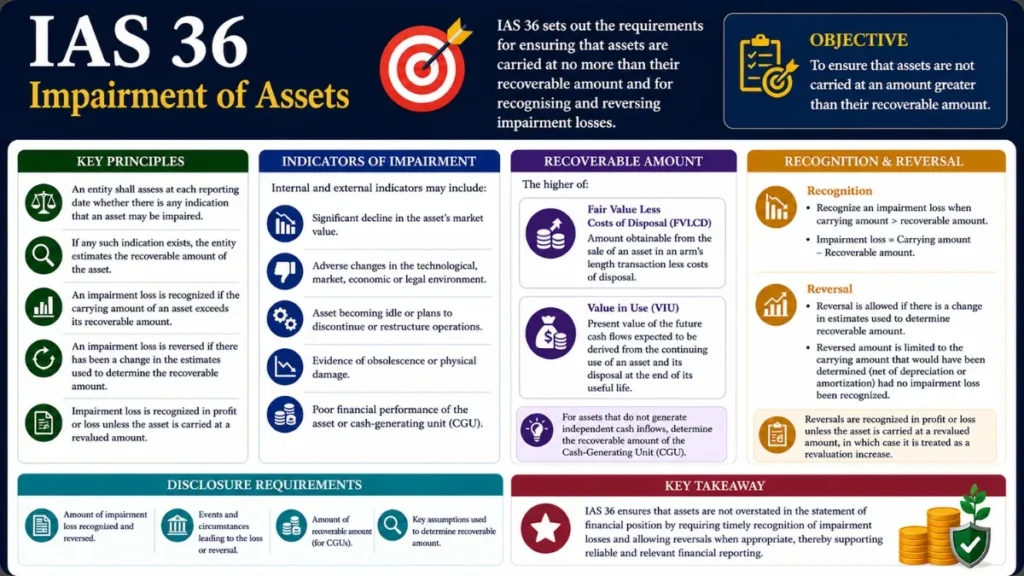
IAS 36 – Impairment of Assets
Objective & Overview of IAS 36
IAS 36 – Impairment of Assets is an International Financial Reporting Standard issued by the International Accounting Standards Board (IASB). Its primary objective is to ensure that an entity’s assets are never carried in the financial statements at more than their recoverable amount, the maximum economic benefit the entity can expect to derive from the asset through use or sale.
When the carrying amount of an asset exceeds what it can earn or be sold for, the asset is considered impaired. IAS 36 requires the entity to recognise an impairment loss, reducing the asset’s carrying amount to its recoverable amount immediately.
An entity must reduce the carrying amount of an asset to its recoverable amount the moment the carrying amount exceeds what the entity can recover, whether through continued use or through outright sale.
Beyond impairment testing mechanics, IAS 36 also prescribes rules for reversing previously recognised impairment losses, handling impairment at the CGU level, allocating goodwill from business combinations to CGUs, and the required financial statement disclosures.
Historical Development of IAS 36
Key Terms & Definitions in IAS 36
Before diving into the mechanics of IAS 36, it is essential to understand the precise definitions the standard uses.
The amount by which the carrying amount of an asset or CGU exceeds its recoverable amount. Recognised immediately in profit or loss, or in OCI for revalued assets.
The amount at which an asset is recognised in the balance sheet after deducting all accumulated depreciation or amortisation and accumulated impairment losses.
The higher of an asset’s Fair Value Less Costs of Disposal (FVLCOD) and its Value in Use. The benchmark against which carrying amount is compared to determine whether impairment exists.
The price receivable from selling the asset in an arm’s length transaction between knowledgeable, willing parties, less the incremental costs directly attributable to the disposal.
The present value of estimated future cash flows expected from continuing use of an asset in its current condition, including terminal value at disposal, discounted at a pre-tax rate.
The smallest identifiable group of assets generating independent cash inflows. Used when recoverable amount cannot be determined for an individual asset in isolation.
An asset other than goodwill that contributes to cash flows of multiple CGUs (e.g., head office, shared IT systems). Must be allocated to CGUs on a reasonable, consistent basis.
A pre-tax rate reflecting the time value of money and asset-specific risks. May be derived from WACC or market rates, adjusted for risks not already reflected in the cash flow estimates.
The reinstatement of a previously recognised impairment loss when circumstances have reversed. Permitted for most assets but strictly prohibited for goodwill under IAS 36.124.
Scope of IAS 36 – What Does It Apply to?
IAS 36 applies to all assets unless another standard already contains specific impairment requirements. This makes IAS 36 the default impairment standard across most non-financial, non-current assets on an entity’s balance sheet.
Assets Within Scope of IAS 36
- Property, Plant & Equipment (IAS 16)
- Intangible Assets (IAS 38)
- Goodwill from business combinations (IFRS 3)
- Right-of-use assets (IFRS 16)
- Investment property – cost model (IAS 40)
- Investments in subsidiaries (IFRS 10)
- Investments in associates (IAS 28)
- Interests in joint ventures (IFRS 11)
Assets Excluded from IAS 36 Scope
- Inventories – IAS 2
- Deferred tax assets – IAS 12
- Contract assets – IFRS 15
- Employee benefit assets – IAS 19
- Financial assets – IFRS 9
- Investment property – fair value model
- Biological assets at fair value (IAS 41)
- Non-current assets held for sale (IFRS 5)
Assets excluded from IAS 36 are not left unprotected. Each excluded category carries its own impairment-equivalent requirements, inventories are written down to net realisable value (IAS 2), and financial assets use the expected credit loss model (IFRS 9).
Indicators of Asset Impairment
At the end of each reporting period, an entity must assess whether there is any indication that an asset may be impaired. If no indicators exist, no formal test is required, except for three categories that must be tested annually regardless:
(1) Goodwill acquired in a business combination · (2) Intangible assets with indefinite useful lives · (3) Intangible assets not yet available for use. These three categories carry the highest risk of undetected impairment and require an annual test irrespective of any indicator.
For all other assets, indicators must be identified from external and internal sources. The following list from IAS 36 is non-exhaustive:
Significant Market Value Decline
A decline in the asset’s market value exceeding what is normally expected from the passage of time or routine use during the period.
Adverse Environment Changes
Significant adverse changes in the technological, market, economic, or legal environment in which the entity operates or the asset is employed.
Increased Market Interest Rates
Market interest rates have increased materially, likely raising the discount rate used in VIU calculations and thereby reducing recoverable amount.
Carrying Amount Exceeds Market Cap
The entity’s net assets carrying amount exceeds its market capitalisation, a signal that the market perceives lower asset values than those recorded on the books.
Climate & Sustainability Changes
New emissions legislation, voluntary decarbonisation commitments, or shifts in customer preference toward sustainable alternatives expected to materially reduce a CGU’s future cash flows.
Obsolescence or Physical Damage
Evidence that an asset has become obsolete or has sustained physical damage, reducing its capacity to generate economic benefits.
Adverse Changes in Planned Use
Plans to discontinue, idle, or restructure the operation to which the asset belongs, or to dispose of an asset earlier than previously expected.
Worse-than-Expected Performance
Internal reporting indicates actual cash flows or operating profits are significantly worse than budgeted, or forward forecasts show material deterioration versus prior estimates.
How to Calculate Recoverable Amount
The recoverable amount is the cornerstone measurement concept in IAS 36. It is defined as the higher of an asset’s Fair Value Less Costs of Disposal (FVLCOD) and its Value in Use (VIU).
An entity need not calculate both measures. If either FVLCOD or VIU alone exceeds the carrying amount, no impairment exists and the other measure need not be estimated.
Fair Value Less Costs of Disposal (FVLCOD)
The price receivable from selling the asset in an orderly transaction between market participants, less incremental disposal costs.
- → Measured per IFRS 13 Fair Value hierarchy
- → Disposal costs: legal fees, stamp duties, transaction taxes
- → Finance costs and income tax excluded from disposal costs
Value in Use (VIU)
The present value of future cash flows expected from an asset or CGU in its current condition, discounted at a pre-tax rate.
- → Uses entity-specific assumptions, not market participant view
- → Pre-tax discount rate specific to the asset or CGU
- → Nominal cash flows → nominal rate; real cash flows → real rate
Key Requirements for Value in Use Cash Flow Projections
Cash flow projections for VIU must:
- Be based on reasonable and supportable assumptions representing management’s best estimate
- Use the most recent management-approved financial budgets/forecasts, typically not exceeding five years
- Extrapolate beyond the budget period using a steady or declining growth rate (higher rates permissible only if objectively justified)
- Exclude cash flows from financing activities and income taxes
- Reflect the current condition of the asset, not future enhancements or uncommitted restructurings
Do not include in the VIU calculation cash flows from an uncommitted restructuring or capital expenditure that would enhance the asset beyond its current state. These are excluded until the entity has formally committed to the plan.
Cash-Generating Units (CGUs) & Goodwill Impairment Testing Under IAS 36
Many assets cannot generate cash flows independently. A Cash-Generating Unit (CGU) is the smallest identifiable group of assets that generates cash inflows largely independent of the cash inflows from other assets or groups. When recoverable amount cannot be determined for an individual asset, impairment testing is performed at the CGU level.
Identifying a CGU – Key Considerations
- 01 How management monitors operations (by product line, business unit, geography, etc.)
- 02 How management makes decisions about continuing or disposing of the entity’s assets and operations
- 03 Whether active markets exist for the outputs of a group of assets, indicating largely independent cash inflows
Allocating Goodwill to CGUs
Goodwill must be allocated to CGUs or groups of CGUs expected to benefit from the combination’s synergies.
Each CGU (or group of CGUs) allocated goodwill must represent the lowest level at which goodwill is monitored for internal management purposes, and must not be larger than an operating segment under IFRS 8 (before aggregation).
Impairment Testing Order for a CGU Containing Goodwill
- Calculate the carrying amount of the CGU including allocated goodwill and corporate assets
- Determine the recoverable amount – higher of FVLCOD and VIU
- If carrying amount exceeds recoverable amount, an impairment loss exists
- Reduce goodwill to zero first, then reduce other CGU assets pro rata by carrying amount
- No individual asset to be reduced below its own separately-determinable recoverable amount – the floor rule
- Any remaining unallocated loss is recognised as a liability only if another standard requires it
Corporate Assets
Corporate assets (e.g., head office building, shared IT) contribute to multiple CGUs and must be allocated to CGUs on a reasonable and consistent basis, typically by revenue or headcount before CGU-level tests are performed.
Recognition of Impairment Losses
An impairment loss arises when carrying amount exceeds recoverable amount.
Assets Measured at Cost Model
The impairment loss is recognised immediately in profit or loss. Future depreciation or amortisation is adjusted to allocate the revised carrying amount over the asset’s remaining useful life.
Revalued Assets (IAS 16 / IAS 38)
Treated as a revaluation decrease. First offsets any existing revaluation surplus in OCI; any excess is charged to profit or loss.
IAS 36 Impairment Testing Process
- 1
Check for Impairment Indicators
At each reporting date, assess external and internal indicators. Annual testing is mandatory for goodwill, indefinite-life intangibles, and intangibles not yet in use.
- 2
Determine the Asset or CGU Level
If the asset generates independent cash flows, test at asset level. Otherwise identify the smallest CGU with largely independent cash flows.
- 3
Calculate the Carrying Amount
Determine the asset’s or CGU’s carrying amount at the test date, including allocated goodwill and proportionate share of corporate assets.
- 4
Estimate the Recoverable Amount
Calculate FVLCOD and/or VIU. Take the higher. If either alone exceeds carrying amount, no impairment exists.
- 5
Recognise the Impairment Loss
If carrying amount exceeds recoverable amount, (recognise the difference) in profit or loss (cost model) or first against revaluation surplus in OCI (revaluation model).
- 6
Adjust Future Depreciation / Amortisation
Revise the depreciation or amortisation charge prospectively to allocate the revised carrying amount over the remaining useful life from the impairment date.
Reversal of Impairment Losses
At each reporting date, an entity must assess whether any impairment loss recognised in a prior period may no longer exist or may have decreased. If such indication exists, the entity must estimate the recoverable amount and recognise a reversal where appropriate.
| Asset Type | Reversal Permitted? | Recognised In | Maximum Reversal Ceiling |
|---|---|---|---|
| Individual assets – cost model | Yes | Profit or Loss | Carrying amount that would have been (net of depreciation) had no impairment been recognised |
| Revalued assets (IAS 16 / IAS 38) | Yes | OCI (to revaluation surplus); excess to Profit or Loss | Same depreciated historical cost ceiling |
| CGU assets (non-goodwill) | Yes | Profit or Loss – pro rata | No individual asset raised above its own recoverable amount |
| Goodwill | Never | N/A – prohibited | IAS 36.124 – reversal is absolutely prohibited |
IAS 36.124 strictly prohibits any reversal of impairment losses on goodwill. Any subsequent increase in recoverable amount represents newly generated internal goodwill, which IAS 38 prohibits from recognition. The impairment is therefore permanent and irreversible.
Disclosure Requirements Under IAS 36
IAS 36 requires substantial disclosures to enable users to evaluate the nature, magnitude, and key assumptions underlying impairment charges and reversals. Disclosures fall into three tiers.
For Each Class of Assets (IAS 36.126)
- The amount of impairment losses recognised in profit or loss and the relevant line items
- The amount of reversals of impairment losses recognised in profit or loss and the relevant line items
- Impairment losses on revalued assets recognised directly in OCI
- Reversals of impairment losses on revalued assets credited directly to OCI
For Material Individual Impairment Losses or Reversals (IAS 36.130)
- Description of the asset or CGU and the events and circumstances leading to the loss or reversal
- Amount of the loss or reversal and whether recoverable amount is FVLCOD or VIU
- If FVLCOD: basis for fair value determination and key assumptions applied
- If VIU: discount rate(s) applied in current and prior period estimations
- For CGUs: description, asset aggregation, and basis for CGU identification
CGUs with Goodwill or Indefinite-Life Intangibles (IAS 36.134–136)
- Carrying amount of goodwill and indefinite-life intangibles allocated to the CGU
- Basis on which recoverable amount was determined (FVLCOD or VIU) and the valuation method
- If VIU: projection period, terminal growth rate, and discount rate(s)
- If FVLCOD: valuation techniques and key inputs including IFRS 13 Level 3 inputs
- Sensitivity analysis: magnitude of change in a key assumption that would cause an impairment to arise
IAS 36 Testing Frequency Reference Table
| Asset | Applicable Standard | When to Test | Frequency |
|---|---|---|---|
| Goodwill (from business combination) | IFRS 3 / IAS 36 | Every year, regardless of indicators | Annual |
| Intangible assets – indefinite useful life | IAS 38 / IAS 36 | Every year, regardless of indicators | Annual |
| Intangible assets – not yet in use | IAS 38 / IAS 36 | Every year, regardless of indicators | Annual |
| Property, Plant & Equipment | IAS 16 / IAS 36 | Only when impairment indicators are present | Indicator-based |
| Right-of-use assets (leases) | IFRS 16 / IAS 36 | Only when impairment indicators are present | Indicator-based |
| Intangible assets – finite useful life | IAS 38 / IAS 36 | Only when impairment indicators are present | Indicator-based |
| Investments in subsidiaries, associates, JVs | IAS 36 | Only when impairment indicators are present | Indicator-based |
Frequently Asked Questions
What is the core objective of IAS 36?+
The primary objective of IAS 36 is to ensure that entities do not carry assets in their financial statements at more than their recoverable amount. When an asset’s carrying amount exceeds what can be recovered through continued use or sale, IAS 36 requires immediate recognition of an impairment loss. This preserves the accuracy of financial statements and gives stakeholders a true and fair view of the entity’s financial position.
Which assets must be tested for impairment every year?+
Three categories require annual impairment testing regardless of whether indicators exist: (1) goodwill acquired in a business combination, (2) intangible assets with indefinite useful lives, and (3) intangible assets not yet available for use. All other assets are formally tested only when specific internal or external impairment indicators are identified at the reporting date.
Can a goodwill impairment loss ever be reversed under IAS 36?+
No, never. IAS 36 paragraph 124 expressly prohibits any reversal of impairment losses on goodwill. Any subsequent increase in recoverable amount is deemed to represent newly generated internal goodwill, which IAS 38 prohibits from recognition. The impairment is therefore permanent and irreversible.
What is the difference between FVLCOD and Value in Use?+
FVLCOD is the exit price from selling the asset to a third party in an orderly market transaction, net of direct disposal costs, measured under IFRS 13. Value in Use (VIU) is the present value of future cash flows the specific entity expects from the asset’s continued use, based on entity-specific projections discounted at a pre-tax rate. VIU is more subjective as it relies on management’s internal forecasts rather than market participant assumptions.
How does climate change affect IAS 36 impairment testing?+
Although IAS 36 does not explicitly mention climate change, climate-related factors can trigger impairment indicators listed in the standard. New emissions legislation may raise operating costs, reducing a CGU’s projected cash flows. Voluntary decarbonisation commitments may lead to earlier asset retirements. Increasing climate risk premiums can raise the discount rate in VIU calculations, reducing recoverable amount. Entities in carbon-intensive industries must evaluate these factors carefully at each reporting date.
What is a Cash-Generating Unit and how is it identified?+
A CGU is the smallest identifiable group of assets generating cash inflows largely independent of other assets or groups. CGU identification is highly judgement-driven and should mirror how management monitors operations. In practice, a CGU may be a retail store, product line, business unit, or geographic segment. The defining criterion is independence of cash inflows.
When is it sufficient to calculate only FVLCOD or only VIU?+
IAS 36 does not require both measures in every case. If FVLCOD can be readily determined and exceeds the carrying amount, there is no impairment and VIU need not be calculated. If an asset is held purely for ongoing use with no plan to sell, VIU may be the more readily determinable measure. An entity calculates only whichever is clearly sufficient.

(Qualified) Chartered Accountant – ICAP
Master of Commerce – HEC, Pakistan
Bachelor of Accounting (Honours) – AeU, Malaysia