ISA 530 – Audit Sampling applies when the auditor has decided to use “audit sampling” in performing audit procedures.
Last Updated – April, 2026
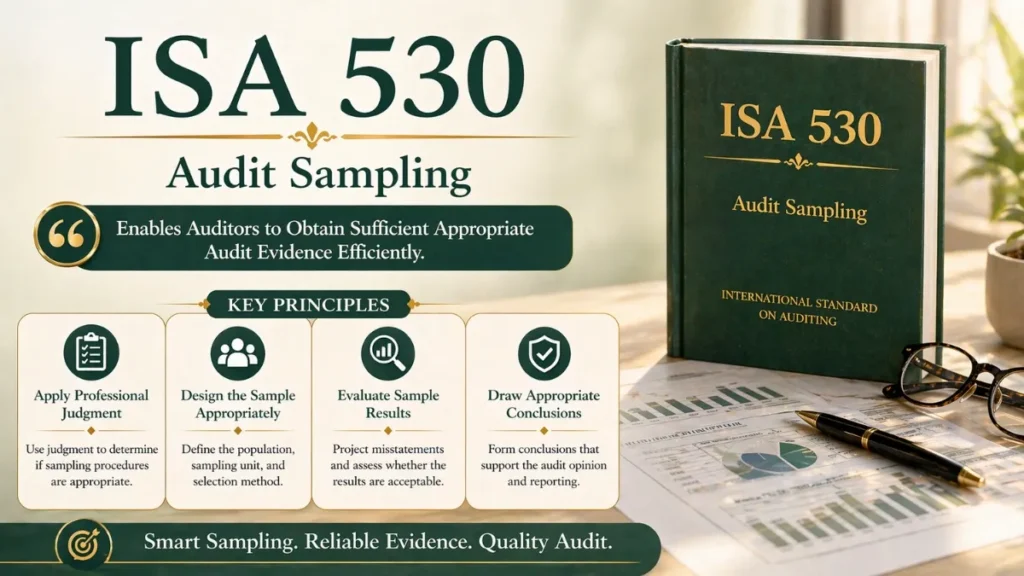
ISA 530
Audit Sampling
A practitioner-level guide covering sample design, size determination, selection methods, projecting misstatements, and evaluating results, everything auditors need to apply ISA 530 effectively.
ISA 530 governs what happens when an auditor tests a sample of items and draws conclusions about the entire population. Since examining every transaction is rarely practical, sampling is fundamental to auditing, and sampling introduces risk that must be rigorously managed.
01 — OVERVIEWWhat Is ISA 530?
ISA 530, titled “Audit Sampling,” is an International Standard on Auditing issued by the International Auditing and Assurance Standards Board (IAASB). It provides the conceptual framework and practical requirements for applying audit procedures to fewer than 100% of items in a population and projecting the findings to the full population.
The standard applies to both tests of controls, evaluating whether internal controls operated effectively and tests of details, testing whether financial statement balances are materially misstated. It does not apply to 100% examination (where every item is tested) or to selecting specific non-representative items.
ISA 530 Quick Reference
02 — TERMINOLOGYKey Definitions in ISA 530
ISA 530 paragraph 5 defines terms that have precise meanings. Understanding these distinctions is essential for correct application.
03 — DESIGNSample Design Under ISA 530
Before selecting a single item, the auditor must design the sample. ISA 530.6 requires the auditor to consider the purpose of the procedure and the characteristics of the population from which the sample will be drawn.
Defining the Population
The population must be complete and appropriate for the audit objective. This is a surprisingly common source of error. If the objective is to test whether accounts payable are complete (the completeness assertion), sampling from the recorded payables ledger tests only existence, not completeness. The correct population for a completeness test might be subsequent cash payments, receiving reports, or purchase orders.
Tests of Controls vs Tests of Details
Tests of Controls
- Did the control operate effectively?
- Sampling unit: a transaction or document
- Looking for deviations (control not performed)
- Result expressed as a deviation rate
- Compare against tolerable deviation rate
Tests of Details
- Is the monetary amount misstated?
- Sampling unit: monetary unit or transaction
- Looking for monetary misstatements
- Result projected as a monetary amount
- Compare against tolerable misstatement
04 — SIZINGDetermining Sample Size
ISA 530.7 requires the auditor to determine a sample size sufficient to reduce sampling risk to an acceptably low level. This is not a formulaic exercise, it requires judgment informed by specific quantitative factors.
Factors Affecting Sample Size
| Factor | Tests of Controls | Tests of Details |
|---|---|---|
| Higher risk / lower detection risk needed | ↑ Larger sample | ↑ Larger sample |
| Lower tolerable deviation / misstatement | ↑ Larger sample | ↑ Larger sample |
| Higher expected error in population | ↑ Larger sample | ↑ Larger sample |
| Greater population variability | — | ↑ Larger sample (unless stratified) |
| More reliance on other procedures | ↓ Smaller sample | ↓ Smaller sample |
| Population size (large populations) | Minimal effect above ~250 items | Minimal effect above ~250 items |
The Sample Size Formula (MUS)
For monetary unit sampling (MUS), a widely used formula for sample size is:
n = RF × BV / TM
Where:
RF = Reliability factor (from statistical tables; e.g., 3.0 at 95% confidence with 0 expected errors)
BV = Book value of the population
TM = Tolerable misstatement
05 — SELECTIONSample Selection Methods
ISA 530.A13 identifies the principal selection methods. The choice of method affects both the defensibility of the sample and its efficiency.
Random Selection
Every item in the population has a known, non-zero probability of selection. Generated using random number tables or software. Required for statistical sampling. Provides the highest degree of defensibility.
Systematic (Interval) Selection
The auditor calculates an interval (population ÷ sample size), selects a random starting point, then picks every nth item. Efficient for large populations, but be alert to patterns in the population that align with the interval, these create a biased sample.
Monetary Unit Sampling (MUS / PPS)
Each individual monetary unit (each £1 or $1) has an equal chance of selection, so larger-value items have a proportionally greater chance of inclusion. Particularly effective for tests of details. Widely used because it automatically focuses sampling on high-value items and allows relatively small samples to achieve high coverage by value.
Haphazard Selection
The auditor selects items without a structured technique but attempts to avoid bias. Acceptable for non-statistical sampling only. Must avoid selecting only easily accessible items, those at the top of a ledger, or transactions from a single period.
Block Selection
Selecting a contiguous block (e.g., all transactions from one week). Generally not appropriate for audit sampling under ISA 530 because it does not provide a representative sample of the full population, the conclusions cannot be reliably projected.
06 — EVALUATIONEvaluating Audit Sample Results
Analyse Each Deviation or Misstatement
ISA 530.12 requires the auditor to investigate the nature and cause of every deviation and misstatement found. The cause determines whether the finding is isolated or systemic. Common features among errors; all occurring in one branch, one product line, or one period, suggest the problem is concentrated, possibly requiring targeted additional testing in that stratum.
Projecting Misstatements to the Population
ISA 530.14 requires misstatements to be projected to the full population. Failing to do this is one of the most consequential errors in audit sampling and a recurring finding in regulator inspections.
(€5,000 / 30) × 3,000 = €500,000. This projected misstatement is compared against tolerable misstatement, not the individual error amount.Anomalous Misstatements
If a misstatement is demonstrably not representative of the population (an anomalous misstatement under ISA 530.13), the auditor may exclude it from the projection. However, this requires a high degree of certainty, the auditor must perform additional procedures to confirm the error is truly isolated. Anomalous misstatements are still included in the schedule of uncorrected misstatements (ISA 450) at their full amount.
Overall Evaluation
ISA 530.15 requires the auditor to evaluate whether sampling has provided a reasonable basis for conclusions about the tested population. The decision tree is straightforward:
| Result | Implication | Auditor’s Response |
|---|---|---|
| Projected misstatement ≤ Tolerable misstatement | Sample supports the conclusion | No further action on this population (subject to overall evaluation) |
| Projected misstatement > Tolerable misstatement | Sample does not support the conclusion | Request management correction; extend testing; or apply alternative procedures |
| Deviation rate > Tolerable deviation rate | Cannot rely on the control | Increase substantive testing; reassess risk; communicate to management |
07 — APPROACHESStatistical vs Non-Statistical Sampling
ISA 530 is neutral on which approach is superior. Both are acceptable provided they are properly designed. The choice depends on practical considerations; available tools, population size, and the need for quantified sampling risk.
| Feature | Statistical Sampling | Non-Statistical Sampling |
|---|---|---|
| Selection method | Random (mathematically determined) | Judgment-based (haphazard, systematic) |
| Sample size | Formula-based (e.g., MUS, attribute sampling) | Judgment-based, but must consider same risk factors |
| Evaluation | Quantifies sampling risk with confidence intervals | Qualitative judgment-based evaluation |
| Projection | Statistically calculated | Extrapolated by judgment (still required by ISA 530.14) |
| Defensibility | Objectively defensible, quantified | Depends heavily on documentation quality |
| Best suited for | Large populations; high-value assertions | Small populations; lower-risk assertions |
08 — CONTEXTISA 530 and Related Audit Standards
ISA 530 does not operate in isolation. Understanding how it connects to the broader ISA framework is essential for correct application.
| Related Standard | Connection to ISA 530 |
|---|---|
| ISA 500 – Audit Evidence | The general framework within which sampling operates; defines sufficiency and appropriateness of evidence |
| ISA 315 – Risk Identification | The assessed risks of material misstatement directly drive sample size and sampling approach |
| ISA 320 – Materiality | Performance materiality determines tolerable misstatement for sampling of details |
| ISA 330 – Responding to Risks | Audit sampling is one of the procedures performed in response to assessed risks |
| ISA 450 – Evaluation of Misstatements | Projected misstatements from sampling feed directly into the accumulated misstatements evaluated under ISA 450 |
09 — PITFALLSCommon Mistakes in ISA 530
Regulators including the PCAOB, FRC, AFM, and KPMG/Deloitte / major-firm inspection teams consistently flag the same categories of ISA 530 deficiencies.
Unjustified default sample sizes
Using a firm-standard of “25 items” or “30 items” without documenting how the size was determined or adjusted for the specific risk level and tolerable misstatement.
Failure to project misstatements
Treating a found misstatement as the total error rather than projecting it to the full population. This often leads to a significant understatement of the auditor’s best estimate of total misstatement.
Sampling from an incomplete population
Selecting from a population that has not been reconciled to the general ledger, or that excludes items meeting certain criteria, making projected conclusions invalid.
Weak documentation of anomalous treatment
Treating a misstatement as anomalous without performing sufficient additional procedures to confirm it is truly isolated, and without documenting that conclusion.
Not linking sampling results to overall audit conclusion
Completing the sampling procedure in isolation without evaluating whether the projected misstatement, combined with other identified misstatements, affects the overall conclusion on the financial statements.
10 — FAQFrequently Asked Questions

(Qualified) Chartered Accountant – ICAP
Master of Commerce – HEC, Pakistan
Bachelor of Accounting (Honours) – AeU, Malaysia