ISA 610 (Revised) – Using the Work of Internal Auditors deals with the external auditor’s responsibilities if using the work of internal auditors.
Last Updated – March, 2026
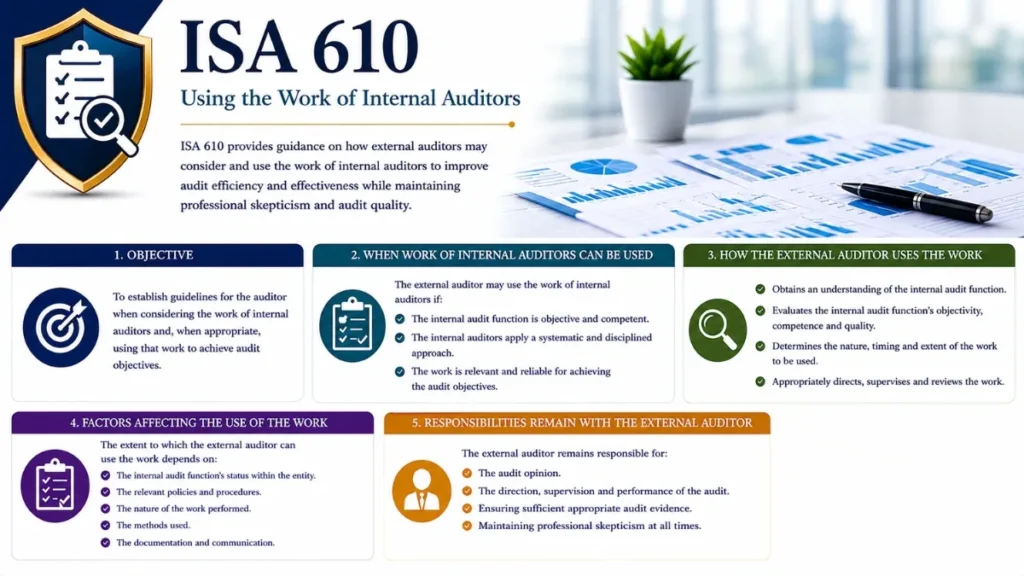
ISA 610 – Using the Work of Internal Auditors
A complete, authoritative guide to the external auditor’s responsibilities under ISA 610 (Revised 2013); scope, objectives, key requirements, direct assistance, and documentation.
What Is ISA 610?
International Standard on Auditing (ISA) 220 (Revised) ISA 610 (Revised 2013), titled Using the Work of Internal Auditors, is an International Standard on Auditing issued by the International Auditing and Assurance Standards Board (IAASB) under the International Federation of Accountants (IFAC). It governs the responsibilities of the external auditor when an entity has an internal audit function.
The standard recognises that many entities establish internal audit functions as part of their broader internal control, risk management, and governance structures. When this is the case, effective coordination between external and internal auditors can improve both the efficiency and effectiveness of the external audit.
ISA 610 covers two distinct scenarios: (1) using the work product of the internal audit function as audit evidence, and (2) using internal auditors to provide direct assistance under the external auditor’s direction, supervision, and review.
Scope and Application
ISA 610 applies where the entity has an internal audit function and the external auditor determines that the function is relevant to the audit. It does not apply where the entity has no internal audit function, in which case no requirements under ISA 610 are triggered.
Activities resembling those of an internal audit function may be performed by other departments or outsourced to third-party service providers, ISA 610 applies equally to those circumstances.
Objectives of the External Auditor
Where an entity has an internal audit function, ISA 610 sets out three distinct objectives for the external auditor.
Determine Relevance & Usability
Determine whether the work of the internal audit function or direct assistance from internal auditors can be used, and if so, in which areas and to what extent.
Assess Adequacy of Work
Where the decision is made to use the internal audit function’s work, determine whether that work is adequate for the purposes of the external audit.
Direct, Supervise & Review
Where internal auditors provide direct assistance, appropriately direct, supervise, and review their work to ensure it meets the external auditor’s standards.
Evaluating the Internal Audit Function
Before relying on internal audit work, the external auditor must evaluate three interrelated factors. Crucially, these factors form a continuum, strength in one cannot compensate for a deficiency in another.
Note: Strong objectivity cannot compensate for insufficient competence, and vice versa. Both must meet an adequate threshold independently.
1 – Objectivity
Objectivity concerns the degree to which the internal audit function’s organisational status and policies support internal auditors in performing their work free from bias. Key considerations include:
- Whether the internal audit function reports to those charged with governance (e.g. the audit committee) rather than to management
- Whether there are policies prohibiting internal auditors from auditing areas where they have recently worked
- Absence of conflicts of interest or relationships creating threats to objectivity
2 – Competence
Competence relates to whether internal auditors possess the technical skills, professional qualifications, and experience required to perform the planned audit procedures adequately. The external auditor considers:
- Educational attainment and professional certifications
- Ongoing professional development and training
- Experience relevant to the areas of proposed audit work
- Existence and application of quality control policies
3 – Systematic and Disciplined Approach
The function must apply a systematic, disciplined methodology including quality controls over its planning, performance, and documentation for its work to be considered reliable audit evidence.
Assessment Framework
| Factor | Indicator of Strength | Indicator of Weakness | External Auditor Action |
|---|---|---|---|
| Organisational Status | Reports to audit committee / board | Reports to management | Reduce or eliminate reliance on function work |
| Objectivity Policies | Rotation policies, independence rules in place | No relevant policies; undisclosed conflicts | Inquire further; increase direct testing |
| Technical Competence | Qualified auditors; relevant experience; CPD | Unqualified staff; limited experience | Perform more procedures directly |
| Systematic Approach | Documented methodology; quality review | Ad-hoc procedures; no documentation | Cannot use work as audit evidence |
| Scope & Findings | Findings consistent with external audit evidence | Scope limitations; unexplained inconsistencies | Investigate and verify before reliance |
Using the Work of the Internal Audit Function
Where the external auditor determines it is appropriate to use the internal audit function’s work, ISA 610 establishes a structured process for doing so. The amount of work the external auditor performs directly will vary inversely with the assessed quality of the internal audit function.
Initial Evaluation
Evaluate objectivity, competence, and systematic approach to determine whether, and to what extent, the internal audit function’s work can be used in specific audit areas.
Determine Nature and Extent
Identify which audit areas are suitable for reliance and determine the nature, timing, and extent of procedures needed to evaluate whether the internal audit work is adequate. Areas requiring significant judgment by the external auditor are generally unsuitable for reliance.
Read Internal Audit Reports
Review internal audit reports on work planned to be used, to understand the procedures performed, findings reached, and whether the work was conducted to an adequate standard.
Perform Evaluation Procedures
Carry out procedures to confirm the adequacy of specific internal audit work including making inquiries, observing work performed, reviewing working papers, and testing whether conclusions are appropriate.
Reperformance Where Required
Where appropriate, independently re-execute a sample of the internal audit procedures to validate conclusions. The extent of reperformance required increases as the assessed quality of the internal audit function decreases.
Using Internal Auditors for Direct Assistance
ISA 610 (Revised 2013) introduced requirements governing a second and distinct scenario: the external auditor using internal audit personnel to directly perform audit procedures, rather than merely relying on their completed work product.
This is permitted only where it is not prohibited by law or regulation and only under the external auditor’s direction, supervision, and review. The direction, supervision, and review required is more extensive than if members of the external auditor’s own engagement team had performed the work, because internal auditors are not independent of the entity.
Pre-Conditions for Direct Assistance
Before using internal auditors for direct assistance, the external auditor must obtain written agreements from two parties:
From an Authorised Entity Representative
Written agreement that internal auditors will be permitted to follow the external auditor’s instructions, and that the entity will not intervene in the work assigned to them.
From the Internal Auditors Themselves
Written agreement that internal auditors will keep confidential all specific matters as instructed by the external auditor, and will disclose any threats to their objectivity.
Factors Influencing the Extent of Direct Assistance
The external auditor determines the nature and extent of work assignable to internal auditors based on:
- The significance of threats to the internal auditor’s objectivity
- The level of competence of the individual internal auditors to be used
- The degree of judgment required in the work to be assigned
- The assessed risk of material misstatement in the areas where assistance is sought
When Internal Auditors Cannot Be Used
ISA 610 imposes absolute prohibitions on the use of direct assistance in certain circumstances, regardless of the quality of the internal audit function. Additionally, there are grounds for withholding reliance on internal audit work entirely.
Significant Objectivity Threats
Internal auditors may not provide direct assistance where there are significant threats to their objectivity for example, where they have a financial or personal interest in the areas being audited.
Insufficient Competence
Direct assistance is prohibited when the specific internal auditor proposed for the task lacks sufficient competence to perform the assigned work to the standard required.
Significant Audit Judgments
Internal auditors must not be used for procedures involving significant judgments in the audit such as evaluating complex estimates or assessing the adequacy of management’s disclosures.
High Risk of Material Misstatement
Direct assistance is restricted in areas where the risk of material misstatement is high, as these areas demand closer external auditor involvement and independent assessment.
Prohibited by Law or Regulation
In some jurisdictions, laws or regulations prohibit the external auditor from using internal auditors to provide direct assistance. ISA 610 defers entirely to such local requirements.
Function Quality Too Low
Where aggregate weaknesses in objectivity, competence, and systematic approach are too significant, the external auditor must conclude that no reliance is appropriate on any of the function’s work.
ISA 610 Documentation Requirements
ISA 610 requires the external auditor to document conclusions reached regarding the use of internal audit work. The documentation requirements cover both the overall evaluation of the function and the specific procedures performed on any work used.
| Requirement | What to Document | Applies To |
|---|---|---|
| Evaluation of the function | Assessment of objectivity, competence, and systematic approach; overall conclusion on whether and to what extent work can be used | All engagements where internal audit function exists |
| Specific work used | Nature, timing, and extent of procedures performed to evaluate adequacy of work; conclusions reached | Whenever work of the function is used as audit evidence |
| Direct assistance | Written agreements obtained; nature of work assigned; direction and review procedures; conclusions on adequacy | Whenever internal auditors provide direct assistance |
| Restrictions | Basis for any limitation on the use of internal audit work, including where prohibited by law or regulation | As applicable |
Frequently Asked Questions
These questions address the most commonly encountered issues when applying ISA 610 in practice.

(Qualified) Chartered Accountant – ICAP
Master of Commerce – HEC, Pakistan
Bachelor of Accounting (Honours) – AeU, Malaysia