Choosing between a CPA and an actuary career depends on your interests in accounting, finance, and risk analysis. A Certified Public Accountant (CPA) focuses on financial reporting, auditing, and taxation, while an Actuary specializes in risk assessment using mathematics and statistics.
Understanding the differences between CPA vs Actuary helps you ‘select the right career path with strong earning potential‘. Learn how each profession compares in terms of skills, salary, and long-term opportunities.
Last Updated – September, 2026
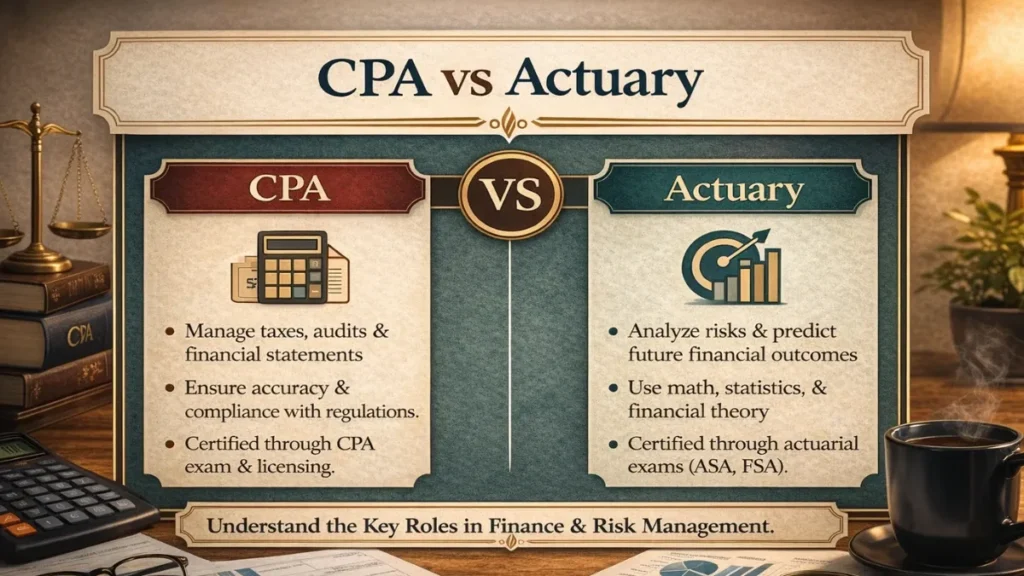
A comprehensive guide to both credentials; covering exams, salary, job duties, career growth, and how to decide which path is right for you.
Table of Contents
- What Is a CPA? Roles, Skills & Career Path
- What Is an Actuary? Roles, Skills & Career Path
- CPA vs Actuary: Key Differences Explained
- CPA vs Actuary Education Requirements
- CPA vs Actuary Exams: Difficulty, Structure & Pass Rates
- CPA vs Actuary Salary Comparison (2026)
- Job Outlook & Demand
- CPA vs Actuary Pros and Cons
- CPA vs Actuary: Which Career Is Right for You?
- Frequently Asked Questions
What Is a CPA? Roles, Skills & Career Path
A Certified Public Accountant (CPA) is a licensed accounting professional who has met the education, examination, and experience requirements set by their state’s Board of Accountancy. In the United States, the CPA credential is issued at the state level and is administered through the American Institute of CPAs (AICPA) in conjunction with NASBA (National Association of State Boards of Accountancy).
CPAs work across a remarkably wide range of fields. Public accounting at firms like Deloitte, PwC, EY, and KPMG (the Big 4) is the most well-known path but CPAs also work in government, healthcare, nonprofit, tech, real estate, and virtually every industry that requires financial oversight. Core responsibilities include:
- Preparing and auditing financial statements
- Advising on tax strategy and compliance
- Forensic accounting and fraud investigation
- Financial planning and analysis (FP&A)
- Mergers and acquisitions advisory
- Regulatory compliance and internal controls
Key distinction: Only a licensed CPA can legally sign and submit audit reports for publicly traded companies in the U.S. This legal authority is the core professional privilege of the credential.
What Is an Actuary? Roles, Skills & Career Path
An actuary is a business professional who uses advanced mathematics, statistics, and financial theory to assess risk; especially the financial implications of future, uncertain events. The two major credentialing bodies in the U.S. are the Society of Actuaries (SOA), which covers life, health, pension, and financial actuarial work, and the Casualty Actuarial Society (CAS), which focuses on property and casualty insurance.
Actuaries are most commonly employed in insurance companies, consulting firms, government agencies, and large corporations with significant employee benefit or pension obligations. Their primary job functions include:
- Pricing insurance products (life, health, auto, property)
- Calculating reserves and ensuring financial solvency
- Developing pension and retirement benefit plans
- Performing enterprise risk management (ERM)
- Modeling catastrophic events (natural disasters, pandemics)
- Advising regulators and policymakers on financial risk
Key distinction: Actuaries are among the most mathematically rigorous professionals in finance. The credential requires passing a series of highly demanding exams over many years, a process widely regarded as one of the most difficult professional certification paths in any field.
CPA vs Actuary: Key Differences Explained
| Factor | CPA (Certified Public Accountant) | Actuary (FSA / FCAS) |
|---|---|---|
| Governing Body | AICPA / NASBA (state boards) | SOA (life/health) or CAS (property & casualty) |
| Education Required | Bachelor’s + 150 credit hours (accounting focus) | Bachelor’s in math, stats, or actuarial science |
| Licensing Exams | 4 sections (AUD, FAR, REG, BAR/ISC/TCP) | P, FM, FAM + advanced exams (7–10 total) |
| Time to Credential | 1–2 years post-degree | 7–10 years post-degree (full FSA/FCAS) |
| Exam Pass Rate | ~45–55% per section | ~30–55% (early exams); lower for advanced |
| Median Salary (U.S.) | $78,000 – $130,000 | $120,000 – $160,000 |
| Primary Industries | Public accounting, corporate, government, nonprofit | Insurance, consulting, pensions, government |
| Core Skills | Accounting, tax law, auditing, financial reporting | Probability, statistics, financial modeling, risk theory |
| Work Environment | Office, client-facing, often fast-paced (tax season) | Office-based, analytical, project-driven |
| Career Versatility | Very high, nearly every industry | More specialized, mainly insurance/finance |
| Job Outlook (BLS) | +4% (2022–2032), ~126,500 openings/year | +23% (2022–2032), much faster than average |
| Continuing Education | 40 CPE hours/year (varies by state) | Ongoing professional development (CPD) required |
| Self-Employment | Common, many CPAs run their own firms | Less common, mostly employed by organizations |
CPA vs Actuary Education Requirements
Becoming a CPA
Most states require 150 semester credit hours of college education to sit for the CPA exam, typically a bachelor’s degree (120 hours) plus an additional 30 hours, often fulfilled via a master’s degree in accounting or a fifth-year program. The curriculum emphasizes financial accounting, auditing, taxation, and business law.
Work experience is also required: generally 1–2 years of supervised accounting experience under a licensed CPA, though requirements vary by state.
Becoming an Actuary
Aspiring actuaries typically earn a bachelor’s degree in actuarial science, mathematics, statistics, or a related quantitative field. Many begin taking actuarial exams in college. Unlike CPAs, there is no specific credit-hour mandate, the professional credential comes entirely from passing a rigorous exam series and fulfilling work-based requirements.
Employers typically hire candidates who have already passed at least 1–2 preliminary exams, making academic preparation extremely important.
CPA vs Actuary Exams: Difficulty, Structure & Pass Rates
CPA Exam Structure
The Uniform CPA Examination was significantly updated in January 2024 under the CPA Evolution initiative. It now consists of three core sections (required by all candidates) and three discipline sections (candidates choose one):
- Core sections (all required): Auditing and Attestation (AUD), Financial Accounting and Reporting (FAR), and Taxation and Regulation (REG)
- Discipline sections (choose one): Business Analysis and Reporting (BAR), Information Systems and Controls (ISC), or Tax Compliance and Planning (TCP)
- Each section is approximately 4 hours long
- Passing score: 75 (on a 0–99 scale); candidates have an 18-month window to pass all four sections
Actuarial Exam Structure
Actuarial exams are administered by the SOA or CAS and are split into preliminary exams (shared between both tracks) and advanced exams. The full credentialing process for an FSA (Fellow of the Society of Actuaries) or FCAS (Fellow of the Casualty Actuarial Society) involves:
- Exam P (Probability) 3 hours, multiple choice
- Exam FM (Financial Mathematics) 3 hours, multiple choice
- Exam FAM (Fundamentals of Actuarial Mathematics)
- Additional advanced modules, written answer exams, and professional development requirements
- Validation by Educational Experience (VEE) in economics, statistics, and accounting
- Associate level (ASA/ACAS) reached after several exams; Fellow (FSA/FCAS) requires further study
Difficulty comparison: The CPA exam is considered very challenging, but most candidates complete it within 1–2 years. The actuarial exam process is broadly considered more grueling due to its length, progressive difficulty, and the years of study required. Many candidates spend 300–400 hours studying per exam at the advanced levels.
CPA vs Actuary Salary Comparison (2026)
CPA Salaries
CPA salaries vary widely depending on specialization, employer type, geographic location, and years of experience. According to data from the AICPA and major compensation surveys, the typical CPA salary ranges are:
- Entry-level (0–3 years): $55,000 – $75,000
- Mid-career (4–9 years): $80,000 – $115,000
- Senior/Manager: $110,000 – $160,000
- Partner / CFO / Senior Director: $180,000 – $400,000+
- Big 4 CPA (Partner): $300,000 – $1,000,000+ (including distributions)
Actuary Salaries
Actuarial compensation is closely tied to exam progression. Each exam passed typically results in a meaningful salary increase. According to the Bureau of Labor Statistics and DW Simpson Actuarial Compensation surveys:
- Student actuary (0–2 exams): $60,000 – $80,000
- Associate actuary (ASA/ACAS): $90,000 – $130,000
- Fellow actuary (FSA/FCAS): $130,000 – $200,000
- Consulting actuary / Chief Actuary: $200,000 – $400,000+
Bottom line on salary: Fully credentialed actuaries (FSA/FCAS) tend to out-earn most CPAs on a purely median basis. However, CPA compensation potential is enormous at the partner and C-suite level; the pathways are different, but the ceiling for both is very high.
Job Outlook & Demand
CPA Job Outlook
The Bureau of Labor Statistics projects employment of accountants and auditors (including CPAs) to grow at approximately 4% from 2022 to 2032 in line with the average for all occupations. Despite the modest growth rate, about 126,500 openings are projected annually due to retirements and workforce transitions. The accounting profession faces some disruption from AI and automation in routine bookkeeping, but CPAs with advisory, tax strategy, and audit expertise remain in strong demand.
Actuary Job Outlook
The actuarial profession is growing significantly faster. The BLS projects actuarial employment to grow by approximately 23% from 2022 to 2032 much faster than average. This is driven by the increasing complexity of risk management, growing demand for data-driven insurance products, climate risk modeling, and healthcare actuarial needs. Actuaries with skills in predictive analytics and machine learning are especially sought after.
CPA vs Actuary Pros and Cons
CPA: Pros & Cons
Advantages of CPA
- Broad career flexibility, works in virtually any industry
- Faster path to credentialing (1–2 years)
- Strong demand and consistent job openings
- Ability to run your own accounting practice
- Highly recognized credential globally
- Wide range of specializations (tax, audit, forensic, FP&A)
- Strong partnership potential at Big 4 firms
Disadvantages of CPA
- Demanding busy season hours (60–80 hrs/week in public accounting)
- Some routine accounting work being disrupted by automation
- Lower median salary than fully credentialed actuaries
- Continuing education requirements (40+ CPE hours/year)
- Initial salaries can be modest compared to difficulty
Actuary: Pros & Cons
Advantages of Actuary
- High salary potential, even early in career
- Exceptional job growth outlook (+23%)
- Work is intellectually stimulating and analytical
- More regular hours than many finance careers
- Respected and specialized credential worldwide
- Each exam passed translates to a salary increase
- Growing need in emerging fields like climate risk and data science
Disadvantages of Actuary
- 7–10 years of rigorous exams, a very long commitment
- Career is narrower and less versatile than CPA
- Requires exceptional mathematical ability
- Exam failure can delay career progression significantly
- Fewer job openings in absolute numbers than accounting
- Work can be highly specialized and less dynamic
CPA vs Actuary: Which Career Is Right for You?
The right choice depends on your skills, personality, and professional goals. Here is a clear framework to help you decide:
Choose CPA if you…
- Enjoy working with businesses and clients directly
- Want broad career options across industries
- Prefer a faster path to full credentials (1–2 years)
- Are interested in tax strategy, auditing, or financial advisory
- Want the option to start your own practice someday
- Thrive in fast-paced, client-facing environments
- Have strong organizational and analytical skills (but not necessarily advanced math)
Choose Actuary if you…
- Genuinely love advanced mathematics and probability
- Are comfortable with a multi-year exam commitment
- Are interested in insurance, risk, or data-driven modeling
- Prefer structured, project-based work over client management
- Want higher earning potential in a specialized role
- Excel in statistical thinking and quantitative problem-solving
- Are drawn to emerging areas like climate risk or predictive analytics
Can you do both? Some professionals hold both credentials, though it’s rare due to the time investment. A more common overlap is CPAs working in insurance accounting or actuarial support roles, or actuaries with accounting knowledge moving into financial reporting for insurance companies. The two skill sets can complement each other in senior leadership and CFO roles within insurance.
Frequently Asked Questions
-
Both credentials are demanding, but in different ways. The CPA exam consists of 4 sections with a combined pass rate of around 45–55% and is typically completed in 1–2 years. The actuarial exam series involves 7–10 progressively harder exams spanning 7–10 years. Most professionals and industry observers consider the full actuarial credential (FSA or FCAS) to be the longer and more mathematically demanding path overall.
-
On a median basis, fully credentialed actuaries typically earn more than CPAs (with actuary medians ranging from $120,000 to $160,000 compared to $78,000 to $130,000 for CPAs). However, CPAs who become Big 4 partners, CFOs, or financial executives can earn significantly more. The salary ceiling for both professions is very high depending on the career trajectory.
-
Technically yes, but it requires passing the full actuarial exam series regardless of prior credentials, the CPA does not exempt anyone from actuarial exams. Some CPAs work in adjacent roles such as insurance accounting, financial reporting for insurance companies, or enterprise risk management. A full actuarial credential (FSA/FCAS) requires starting from the preliminary exams with strong mathematical ability.
-
Neither is objectively better, it depends on your strengths and interests. CPAs enjoy wider career flexibility, faster credentialing, and the ability to work across nearly every industry. Actuaries enjoy higher median pay, exceptional job growth, and highly specialized expertise. If you prefer versatility, choose CPA. If you excel in mathematics and want to specialize in risk and statistics, the actuarial path is likely the better fit.
-
Becoming a CPA typically takes 1–2 years after completing the 150 credit-hour education requirement, assuming you pass all exam sections within the 18-month testing window. Earning full actuarial credentials (FSA or FCAS) typically takes 7–10 years of exams, work experience, professional development modules, and VEE requirements after completing your undergraduate degree.
-
No, the actuarial profession is actually growing faster than most. The Bureau of Labor Statistics projects a 23% growth rate for actuaries from 2022 to 2032, far above the national average. Increasing complexity in insurance markets, climate risk modeling, healthcare cost analysis, and data-driven financial products is creating strong demand for actuarial expertise. Actuaries who also develop skills in machine learning and predictive analytics are particularly well-positioned.
-
Actuaries typically have more consistent hours throughout the year. CPAs in public accounting, especially at Big 4 firms experience demanding busy seasons (typically January–April for tax CPAs) with 60–80 hour work weeks. Corporate CPAs in industry roles have more predictable schedules. Both careers ultimately depend heavily on the employer, role, and individual workplace but actuarial work is generally considered more consistent in its demands.

(Qualified) Chartered Accountant – ICAP
Master of Commerce – HEC, Pakistan
Bachelor of Accounting (Honours) – AeU, Malaysia