Hedge accounting applies to all hedge relationships, with the exception of fair value hedges of the interest rate exposure of a portfolio of financial assets or financial liabilities.
Last Updated – September, 2026
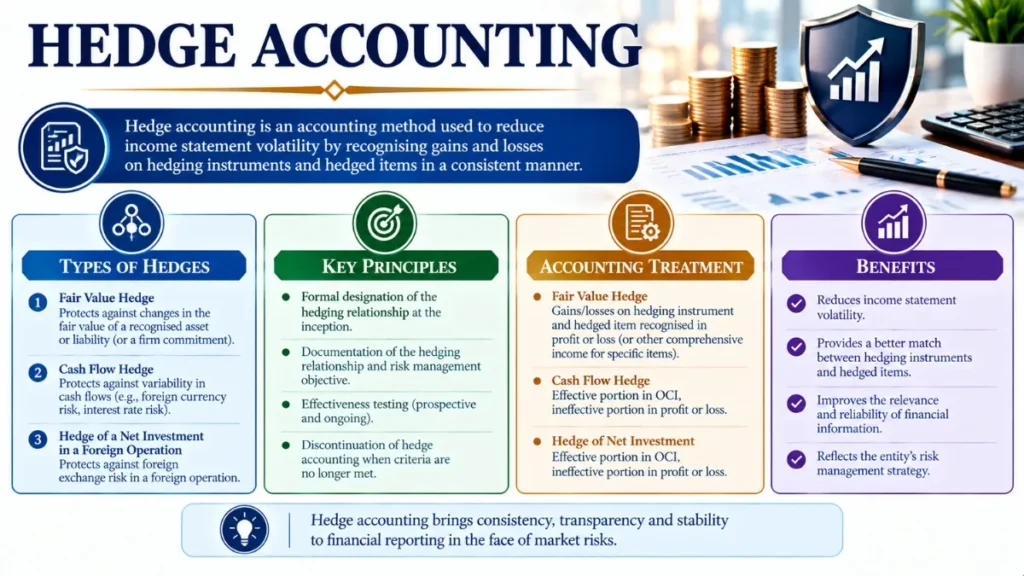
Financial Accounting · Risk Management
Hedge Accounting – The Definitive Guide to Managing Financial Risk
Hedge accounting allows companies to align the recognition of gains and losses on hedging instruments with the timing of the hedged item, smoothing earnings volatility and painting a truer picture of economic performance on financial statements.
01What Is Hedge Accounting?
Hedge accounting is a specialized accounting method that modifies the normal basis of accounting for gains and losses on financial instruments designated as hedges. Without it, a company using a derivative to manage risk would record the derivative at fair value each period, causing income statement volatility that doesn’t reflect the actual economic position of the business.
Under standard accounting, derivatives are marked to market every reporting period. This creates a mismatch, the derivative’s gain or loss hits earnings immediately, while the exposure it hedges may not be recognized until a later date or may reside off the income statement entirely (e.g., in OCI or as an unrecognized commitment). Hedge accounting corrects this mismatch.
At its core, hedge accounting pairs the hedging instrument (typically a derivative such as a swap, forward, option, or futures contract) with the hedged item (an asset, liability, firm commitment, forecast transaction, or net investment) so that offsetting gains and losses are recognized in the same accounting period.
Why it matters: A multinational corporation with €500M in euro-denominated revenues might use FX forward contracts to lock in USD rates. Without hedge accounting, each quarter-end revaluation of those forwards could swing earnings dramatically, misrepresenting the company’s true operating performance to investors.
02The Three Types of Hedge Accounting
Both IFRS 9 and ASC 815 recognize three formal categories of hedge relationships, each addressing a different type of risk exposure.
Fair Value Hedge
Hedges exposure to changes in the fair value of a recognized asset, liability, or unrecognized firm commitment attributable to a particular risk.
Cash Flow Hedge
Hedges exposure to variability in future cash flows attributable to a particular risk, including forecast transactions not yet on the balance sheet.
Net Investment Hedge
Hedges the foreign currency exposure of a parent’s net investment in a foreign operation (subsidiary, associate, branch, or JV).
How Each Type Affects Financial Statements
| Hedge Type | Hedging Instrument | Hedged Item Recognition | P&L Impact |
|---|---|---|---|
| Fair Value | Fair value through P&L | Carrying amount adjusted for hedged risk | Offsetting gains/losses in same period |
| Cash Flow | Effective portion → OCI; ineffective → P&L | Reclassified from OCI when item affects P&L | Deferred; released on transaction date |
| Net Investment | Effective portion → OCI (Translation Reserve) | Recognized on disposal of foreign operation | Reclassified on disposal or partial disposal |
03Qualification Criteria of Hedge Accounting
Hedge accounting is an elective accounting policy, it is not automatic. An entity must proactively designate and document the hedge relationship at inception and demonstrate it meets the following criteria throughout its life.
-
Formal designation and documentation – The hedge relationship, risk management objective, and strategy must be formally designated and documented at inception.
-
Eligible hedging instrument – Typically a derivative at fair value through P&L; under IFRS 9, certain non-derivative financial instruments may qualify for FX risk hedging.
-
Eligible hedged item – Must be a recognized asset/liability, unrecognized firm commitment, highly probable forecast transaction, or net investment in a foreign operation.
-
Economic relationship – The hedging instrument and hedged item must have values that generally move in opposite directions due to the hedged risk.
-
Credit risk does not dominate – The effect of credit risk must not outweigh the economic relationship between the hedging instrument and hedged item.
-
Hedge ratio – The designated quantity of the hedging instrument versus the hedged item must reflect the actual quantities used in the economic hedge.
Under ASC 815: Companies must also perform prospective and retrospective effectiveness testing. Under IFRS 9, the bright-line 80–125% quantitative threshold has been replaced with a principles-based assessment, though quantitative methods may still be used.
04IFRS 9 vs ASC 815
Hedge accounting is governed by two primary frameworks: IFRS 9 (Financial Instruments) for IFRS reporters, and ASC 815 (Derivatives and Hedging) for US GAAP reporters.
| Feature | IFRS 9 | ASC 815 (US GAAP) |
|---|---|---|
| Philosophy | Principles-based; aligned with risk management strategy | Rules-based; prescriptive requirements |
| Effectiveness Testing | Qualitative or quantitative; no bright-line threshold | Highly effective (80–125% ratio) required; quantitative |
| Eligible Hedged Items | Broader – risk components, groups of items, net positions | More restrictive – specific items and risk designations |
| Rebalancing | Permitted without discontinuing the hedge relationship | Generally requires de-designation and re-designation |
| Voluntary Discontinuation | Not permitted if hedge relationship still meets criteria | Permitted at any time |
| Options / Forwards | Time value and forward element may be deferred in OCI | Similar treatment available under 2017 ASU amendments |
| Basis Adjustments | Required for non-financial hedged items | Same |
| Standard Reference | IFRS 9 (replaced IAS 39) | ASC 815 (amended by ASU 2017-12) |
2017 Reforms: FASB’s ASU 2017-12 significantly expanded and simplified hedge accounting under US GAAP, narrowing the gap with IFRS 9. Key changes included permitting partial-term fair value hedges, eliminating separate measurement of hedge ineffectiveness, and simplifying documentation requirements.
05How Hedge Accounting Works
Implementing hedge accounting requires a structured approach. Below are the core steps from designation through ongoing assessment.
Define the specific risk (interest rate, FX, commodity price, credit risk) that creates variability in fair value or cash flows. Ensure the risk is identifiable and measurable separately from other risks.
Choose an appropriate derivative (or non-derivative for FX under IFRS 9) that offsets the identified risk. Determine whether to designate the entire instrument or only a portion.
At inception, formally document: the hedge relationship, risk management objective and strategy, identification of the hedging instrument and hedged item, nature of the hedged risk, and how effectiveness will be assessed.
Demonstrate (qualitatively or quantitatively) that an economic relationship exists and that the hedge will be highly effective in achieving offsetting changes in fair value or cash flows attributable to the hedged risk.
Record the hedging instrument at fair value each period. For fair value hedges, adjust the carrying amount of the hedged item. For cash flow hedges, defer the effective portion in OCI.
Continuously reassess whether the hedge relationship meets qualifying criteria. Under IFRS 9, rebalance the hedge ratio if it changes without discontinuing the relationship. Under ASC 815, perform periodic effectiveness testing.
06Hedge Accounting Journal Entries
Example 1: Fair Value Hedge (Interest Rate Swap)
Company A has $10M of 5% fixed-rate debt and enters into a pay-floating, receive-fixed interest rate swap. At period end, rising rates cause the swap’s fair value to increase by $150,000 and the fair value of the fixed-rate debt (the hedged item) to decline by $150,000.
| Account | Debit | Credit |
|---|---|---|
| Interest Rate Swap (Asset) | $150,000 | — |
| Fair Value Gain – P&L | — | $150,000 |
| ↑ Mark-to-market of swap | ||
| Fair Value Loss – P&L | $150,000 | — |
| Fixed-Rate Debt (Carrying Amount) | — | $150,000 |
| ↑ Basis adjustment to hedged item — losses offset gains above | ||
Example 2: Cash Flow Hedge (FX Forward)
Company B forecasts receiving €1M from a European customer in 6 months. It enters an FX forward to sell €1M at a locked rate. At period end, the forward has a fair value gain of $40,000 (effective portion).
| Account | Debit | Credit |
|---|---|---|
| FX Forward Contract (Asset) | $40,000 | — |
| Other Comprehensive Income (OCI) | — | $40,000 |
| ↑ Effective portion deferred in OCI, not P&L | ||
| ON SETTLEMENT (reclassification from OCI to P&L) | ||
| OCI | $40,000 | — |
| Revenue / FX Gain | — | $40,000 |
07Hedge Effectiveness Testing
A hedge is considered effective when the offsetting changes in fair value or cash flows attributable to the hedged risk are within an acceptable range. Effectiveness is a cornerstone requirement for applying and retaining hedge accounting.
Legacy 80–125% Effectiveness Test – ASC 815 / IAS 39 (Historical Context)
Important: This 80–125% bright-line test was used under legacy IAS 39 and remains a quantitative requirement under ASC 815 (US GAAP). Under IFRS 9, this specific numerical threshold no longer applies, it was replaced by a principles-based assessment requiring only that an economic relationship exists and that credit risk does not dominate. The visual above is provided for historical and comparative context.
Common Effectiveness Testing Methods
| Method | Description | Best Used For |
|---|---|---|
| Dollar-Offset Method | Compares the change in fair value of the hedging instrument to the change in fair value of the hedged item | Simple hedges with clearly offsetting values |
| Regression Analysis | Statistical analysis measuring correlation between hedging instrument and hedged item | Complex or long-dated hedges |
| Hypothetical Derivative Method | Compares actual derivative to a hypothetical perfect hedge; common under ASC 815 | Cash flow hedges under US GAAP |
| Critical Terms Match | Assumes perfect effectiveness when key terms align (notional, maturity, index, currency) | Qualitative assessment under IFRS 9 |
08Benefits and Limitations of Hedge Accounting
Benefits
Offsets derivative gains/losses with the hedged item in the same period, smoothing reported earnings.
Financial statements better reflect the entity’s actual economic risk management activities.
Reduced earnings noise makes performance metrics more meaningful and comparable period-to-period.
Avoids artificial earnings swings that could trigger debt covenants linked to profitability ratios.
Limitations and Challenges
Operational Complexity: Hedge accounting requires significant documentation, ongoing monitoring, effectiveness testing, and system capabilities. The administrative burden can be substantial, particularly for entities with large, diverse portfolios of hedging relationships.
Discontinuation Risk: Failure to maintain qualifying criteria results in prospective discontinuation of hedge accounting, which can suddenly introduce the very volatility the entity sought to avoid.
09Key Terms Glossary
- Hedging Instrument
- A designated derivative (or eligible non-derivative) whose fair value or cash flows offset the hedged item.
- Hedged Item
- An asset, liability, firm commitment, forecast transaction, or net investment exposed to fair value or cash flow risk.
- Basis Adjustment
- Adjustment made to the carrying amount of a non-financial hedged item when the hedged forecast transaction occurs.
- Ineffectiveness
- The portion of the hedging instrument’s gain/loss not offset by changes in the hedged item, always recognized in P&L immediately.
- OCI
- Other Comprehensive Income – the holding area for the effective portion of cash flow and net investment hedge gains/losses.
- Hedge Ratio
- The ratio of the quantity of hedging instrument to the quantity of hedged item, reflecting the actual proportions used in the economic hedge.
- Rebalancing
- Adjusting the designated hedge ratio (under IFRS 9) to maintain effectiveness without discontinuing the hedge relationship.
- Firm Commitment
- A binding agreement to exchange a specified quantity of resources at a specified price on specified future dates.
10Frequently Asked Questions
Hedge accounting aligns the timing of recognition of gains and losses on hedging instruments with those of the items they hedge. This eliminates artificial earnings volatility caused by fair-valuing derivatives without recognizing corresponding changes in the hedged exposure, thereby providing a more faithful representation of a company’s risk management activities in its financial statements.
No. Hedge accounting is entirely voluntary (elective). An entity may choose to use derivatives for economic hedging purposes without applying hedge accounting, accepting the resulting P&L volatility. Conversely, an entity that elects hedge accounting must maintain all qualifying criteria throughout the hedge’s life.
Ineffectiveness is the portion of the hedging instrument’s gain or loss that exceeds (or is insufficient to offset) the change in the hedged item’s fair value or cash flows. Under both IFRS 9 and ASC 815, all ineffectiveness must be recognized immediately in profit or loss, it cannot be deferred in OCI. This is why minimizing ineffectiveness through careful hedge design is critical.
Yes. Options can be designated as hedging instruments. Under both IFRS 9 and ASC 815, an entity may elect to exclude the time value of an option from the designated hedging relationship, recognizing changes in time value in OCI (as a cost of hedging) rather than immediately in P&L. Only the intrinsic value change is then included in the effectiveness assessment, which can significantly reduce earnings volatility from option premiums.
Upon discontinuation, the hedging instrument is no longer in a designated hedge relationship. For cash flow hedges, any cumulative gain or loss already recognized in OCI remains there until the forecast transaction occurs or is no longer expected to occur (in which case it is reclassified to P&L). For fair value hedges, any basis adjustment to the hedged item is amortized to P&L over the remaining life of the item.
Both IFRS 7 (Financial Instruments: Disclosures) and ASC 815 require extensive disclosures, including: a description of each hedging relationship and risk management strategy; the nature of the hedged risk; the nominal amount and term of the hedging instrument; hedge effectiveness information; amounts recognized in OCI and reclassified to P&L; and a reconciliation of OCI movements related to hedging instruments.

(Qualified) Chartered Accountant – ICAP
Master of Commerce – HEC, Pakistan
Bachelor of Accounting (Honours) – AeU, Malaysia