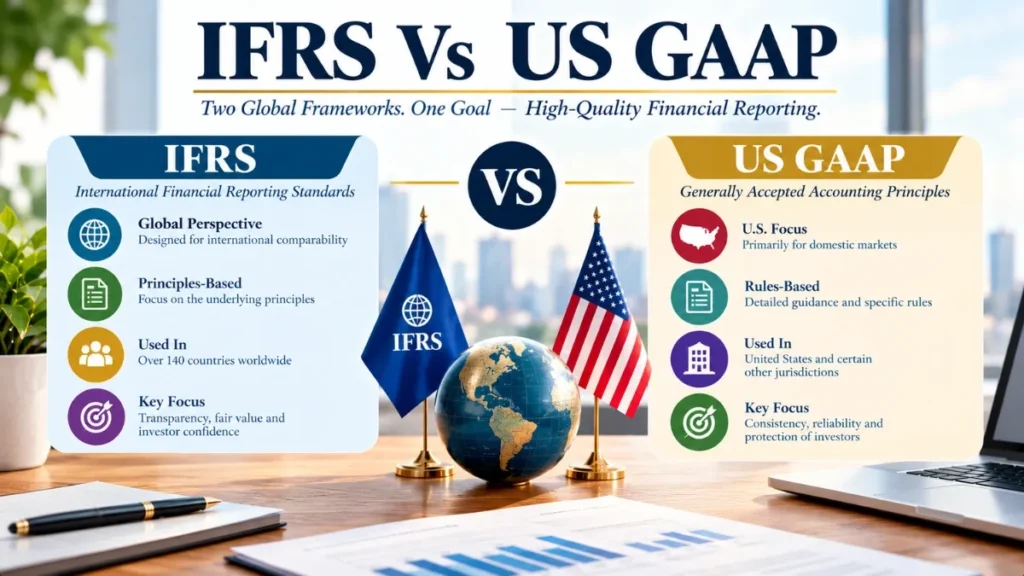
IFRS vs US GAAP a concept that compares two major accounting frameworks used worldwide. While IFRS is adopted in many jurisdictions, US GAAP governs financial reporting for applicable US entities.
Both IFRS and US GAAP aim to ensure reliable financial reporting but differ in areas such as revenue recognition, inventory, leases, and asset impairment. Understanding these differences helps accountants, auditors, investors, and businesses interpret financial statements accurately.
Last Updated – October, 2026
IFRS vs US GAAP – Key Differences, Examples & Which One Applies
A clear, practical comparison of the two accounting frameworks that shape financial reporting around the world, from inventory and leases to impairment, financial instruments and IFRS 18.
The Short Answer
IFRS (International Financial Reporting Standards) is a principles-based framework issued by the IASB and used in most countries outside the United States. US GAAP (Generally Accepted Accounting Principles) is a more detailed, rules-heavy framework issued by the FASB and required for US domestic public companies. Both aim at reliable financial statements, but they differ on inventory costing, asset revaluation, development costs, impairment reversals, lease expense, credit-loss modelling and cash-flow classification.
What Are IFRS and US GAAP?
Every company that reports to investors needs a common rulebook, so that a profit figure in one company means roughly the same thing as a profit figure in another. Two rulebooks dominate global finance.
IFRS
- Issued by the International Accounting Standards Board (IASB), overseen by the IFRS Foundation.
- Built on broad principles that call for professional judgment.
- Required or permitted in most jurisdictions worldwide, including the UK, the EU, Australia, Canada and many Asian and African markets.
- Standards carry the prefixes IFRS (for example, IFRS 15) and IAS (for example, IAS 2).
US GAAP
- Issued by the Financial Accounting Standards Board (FASB) and recognised by the US Securities and Exchange Commission (SEC).
- Organised in the FASB Accounting Standards Codification (ASC), with extensive industry-specific guidance.
- Required for US domestic SEC registrants and widely used by US private companies.
- Standards are cited as ASC topics (for example, ASC 606 or ASC 842).
Who Uses IFRS and Who Uses US GAAP?
The IFRS Foundation tracks how its standards are applied in each country and has published complete profiles for around 169 jurisdictions. Among those profiled, the large majority require IFRS for most or all publicly accountable companies, and a smaller group permits it. The United States is the most prominent exception. The profiles are updated over time, so check the IFRS Foundation page for the latest count.
US domestic companies listed with the SEC must report under US GAAP. Foreign private issuers listing in the US, however, may file financial statements prepared under IFRS as issued by the IASB without reconciling them to US GAAP, a rule the SEC introduced in 2007. This is why many European, Asian and Latin American companies list on US exchanges while keeping their IFRS books.
IFRS vs US GAAP – Principles vs Rules
The most quoted difference between the two systems is their style. IFRS sets out objectives and principles, then expects preparers and auditors to apply judgment to the facts. US GAAP tends to add detailed rules, bright-line thresholds and industry-specific exceptions.
What a principles-based approach means
Under IFRS, you ask whether the accounting reflects the economic substance of a transaction. The result can vary slightly between companies, yet the reasoning must be explained in the notes.
What a rules-based approach means
Under US GAAP, you often look for the specific paragraph or threshold that covers your situation. This produces more consistency and a clearer audit trail, but also a much larger body of guidance.
IFRS vs US GAAP Comparison Table
Use this table as a quick reference. Each major area is explained in more detail in the sections that follow.
| Area | IFRS | US GAAP |
|---|---|---|
| Framework | ||
| Standard setter | IASB (IFRS Foundation) | FASB (recognised by the SEC) |
| Style | Principles-based, more judgment | More detailed, rules and industry guidance |
| Assets | ||
| Inventory costing | LIFO prohibited; FIFO or weighted average | LIFO permitted, plus FIFO and average cost |
| Inventory write-down reversal | Required if value recovers, up to original cost | Prohibited once written down |
| Property, plant & equipment | Cost model or revaluation model | Cost model only |
| Development costs | Capitalised once defined criteria are met | Generally expensed as incurred (software has exceptions) |
| Impairment test (long-lived assets) | One step: carrying amount vs recoverable amount | Two steps for assets held and used: recoverability test, then fair value |
| Impairment reversal (long-lived assets) | Allowed, except for goodwill | Prohibited for assets held and used |
| Liabilities & Instruments | ||
| Lessee accounting | Single model: depreciation plus interest (IFRS 16) | Dual model: finance and operating leases (ASC 842) |
| Credit losses | Three-stage expected credit loss (IFRS 9) | Lifetime current expected credit loss, or CECL (ASC 326) |
| Contingent liabilities | “Probable” means more likely than not; midpoint of a range | “Probable” is a higher bar; low end of a range |
| Consolidation | Single control-based model (IFRS 10) | Voting-interest model plus variable interest entity model |
| Presentation | ||
| Cash flows: interest and dividends (current IAS 7) | Policy choices: interest paid in operating or financing; interest and dividends received in operating or investing; dividends paid in operating or financing | Interest paid, interest received and dividends received in operating; dividends paid in financing |
| Cash flows: from IFRS 18 (2027) | Most options removed; indirect method starts from operating profit. Most entities: interest and dividends paid in financing, received in investing | No equivalent change |
| Income statement structure | IFRS 18 defines operating, investing and financing categories from 2027 | No mandated subtotals; SEC rules shape the format |
| Interim reporting | Each interim period treated largely as a discrete period | Interim period viewed as part of the full year |
Inventory – LIFO and Write-Down Reversals
Inventory is one of the clearest places where the two frameworks part ways, and it directly changes reported profit.
LIFO is not allowed under IFRS
Last-in, first-out costing is permitted under US GAAP and is popular with US companies in periods of rising prices because it lowers taxable income. IAS 2 prohibits it, so IFRS reporters choose between first-in, first-out (FIFO) and weighted-average cost.
Reversing inventory write-downs
If inventory is written down to a lower value, IFRS requires the write-down to be reversed when the value later recovers, but never above the original cost. US GAAP treats the written-down amount as the new cost basis, so there is no reversal.
Worked Example
A retailer holds goods that cost $100,000. A downturn cuts their net realisable value to $70,000, so a $30,000 write-down is recorded. Next year, demand returns and the value rises to $95,000.
Under IFRS, the company reverses $25,000 of the write-down and reports inventory at $95,000. Under US GAAP, inventory stays at $70,000 and the recovery shows up as profit only when the goods are sold. Same economics, different reported earnings in different years.
Fixed Assets and Intangibles
Revaluation of property, plant and equipment
IAS 16 lets a company choose between carrying an asset class at cost less depreciation or at revalued fair value, with regular updates. Revaluation gains generally go to other comprehensive income. US GAAP does not allow upward revaluation of most fixed assets, which keeps balance sheets anchored to historical cost.
Research and development
IFRS separates research from development. Research is expensed, while development spending is capitalised once a company can show, for instance, technical feasibility, intent and ability to complete the asset, and probable future economic benefits. US GAAP expenses most research and development as incurred, with limited exceptions such as certain software costs. As a result, innovative IFRS reporters can show higher intangible assets and earlier profit than similar US GAAP reporters.
Component depreciation
IFRS requires each significant part of an asset with a different useful life, such as an aircraft engine versus the airframe, to be depreciated separately. US GAAP permits it but does not require it.
Impairment of Assets
Both frameworks require companies to write assets down when they are no longer worth their carrying amount. The method and the aftermath differ. The comparison below focuses on long-lived assets and goodwill; inventory, financial assets and other categories follow their own impairment models, and US GAAP requirements vary by asset type.
IFRS (IAS 36)
- Compare carrying amount with the recoverable amount, the higher of fair value less costs of disposal and value in use.
- Value in use relies on discounted cash flows.
- Goodwill is tested at the cash-generating-unit level.
- Impairment losses on assets other than goodwill can be reversed later.
US GAAP (ASC 360 & 350)
- Long-lived assets: first test recoverability using undiscounted cash flows, then measure any loss at fair value.
- Goodwill is tested at the reporting-unit level, with a single quantitative step.
- Impairment losses cannot be reversed for assets held and used.
The practical effect: US GAAP can delay recognising an impairment because undiscounted cash flows set a lower bar, but once recognised, the loss is permanent. IFRS may recognise impairments sooner and gives credit if conditions improve.
Leases – IFRS 16 vs ASC 842
Both frameworks now bring most leases onto the balance sheet as a right-of-use asset and a lease liability. The income statement is where they diverge.
IFRS 16 – one model for lessees
Almost every lease is treated like a financed purchase. The lessee records depreciation on the asset and interest on the liability, so total expense is higher early in the lease and lower later. EBITDA improves because rent no longer appears as an operating cost.
ASC 842 – finance and operating leases
US GAAP keeps two lessee classifications. Finance leases look like the IFRS 16 pattern. Operating leases record a single straight-line lease cost within operating expenses, so the profit and loss effect resembles traditional rent.
Financial Instruments and Credit Losses
Classification
IFRS 9 classifies debt instruments using the company’s business model and the contractual cash-flow characteristics of the instrument. US GAAP uses a more instrument-by-instrument approach, and equity investments with readily determinable fair values generally go through profit or loss.
Expected credit losses
Under IFRS 9, a loss allowance starts at 12-month expected losses and moves to lifetime expected losses when credit risk rises significantly (the three-stage model). Under US GAAP, the CECL model in ASC 326 requires lifetime expected losses to be recognised from day one on most financial assets carried at amortised cost. For long-dated loans, CECL tends to produce larger allowances at origination.
Presentation, Cash Flows and IFRS 18
Cash flow statement classification
Under IAS 7 today, IFRS gives policy choices: interest paid can sit in operating or financing activities, interest and dividends received in operating or investing, and dividends paid in operating or financing. US GAAP is more prescriptive: interest paid, interest received and dividends received are operating cash flows, and dividends paid are financing. IFRS 18 changes the IFRS side from 2027, as explained below.
IFRS 18 changes the income statement
IFRS 18, Presentation and Disclosure in Financial Statements, was published by the IASB in April 2024 and replaces IAS 1. It applies to annual reporting periods beginning on or after 1 January 2027, with earlier application permitted and restated comparatives required. It is the largest change to how IFRS companies present performance in more than two decades.
- Defined categories and subtotals. Income and expenses are grouped into operating, investing and financing categories, with a defined operating profit subtotal.
- Management-defined performance measures. Company-specific metrics such as adjusted profit or adjusted EBITDA must be disclosed in the notes and reconciled to the nearest IFRS subtotal, with an explanation of why they are useful.
- Better grouping. Tighter rules on aggregation, disaggregation and labelling aim to stop vague “other” lines from hiding important information.
- Cash flow statement amendments. IFRS 18 amends IAS 7 so the indirect method starts from operating profit rather than profit after tax, and removes most of the interest and dividend classification options. For most entities, interest and dividends paid become financing and interest and dividends received become investing. Entities with specified main business activities, such as banks, follow the income statement category of the related item. Check local endorsement and the effective date that applies to you.
IFRS 18 changes presentation and disclosure rather than how profit is measured. It does, however, widen the presentation gap with US GAAP, which has no equivalent defined subtotals.
- April 2024 IASB publishes IFRS 18 to replace IAS 1.
- Preparation period Companies assess impact, update systems and plan comparatives. Local endorsement proceeds in jurisdictions that require it.
- 1 January 2027 Mandatory effective date for annual periods beginning on or after this date, including related interim reporting.
IFRS and US GAAP Convergence
In 2002 the FASB and IASB agreed to work toward a single set of high-quality standards, and the boards later issued joint projects on revenue, business combinations and fair value measurement. That effort delivered real alignment, particularly in revenue recognition (IFRS 15 and ASC 606), but major projects on leases and financial instruments ended with different answers.
In the United States, the SEC has so far chosen to accept IFRS from foreign filers rather than require it for domestic companies. Today the boards work largely independently, and full convergence is no longer an active goal. The practical expectation is coexistence: two respected frameworks, a shrinking list of differences in some areas, and growing differences in others.
IFRS vs US GAAP – Which One Applies to Your Business?
Focus on IFRS if you…
- Work or study in the UK, EU, Middle East, South Asia, Africa, Australia or most of Asia.
- Prepare accounts for a company headquartered outside the US.
- Plan to sit ACCA, ICAEW or similar qualifications with an IFRS syllabus.
- Analyse global companies listed outside the US.
Focus on US GAAP if you…
- Work for a US public company, US subsidiary or US-based lender.
- Plan to become a US CPA.
- Analyse US-listed companies or prepare for a US IPO.
- Support a multinational that reports to a US parent.
For investors, the best habit is to read the accounting policy notes before comparing two companies. For finance teams, the best habit is to maintain a short bridge schedule that quantifies the big differences, typically inventory, leases, development costs and impairments.
Frequently Asked Questions
What is the main difference between IFRS and US GAAP?
IFRS is principles-based and issued by the IASB, while US GAAP is more rules-based and issued by the FASB. In practice they differ on topics such as LIFO inventory, revaluation of fixed assets, development costs, impairment reversals, lease expense patterns and credit-loss models.
Is IFRS or US GAAP better?
Neither is universally better. IFRS offers global comparability and more judgment. US GAAP offers more detailed guidance and, for some users, greater consistency. The right choice is usually dictated by the jurisdiction and the regulator rather than preference.
Which countries use IFRS?
The IFRS Foundation has published profiles for around 169 jurisdictions. In the large majority of them IFRS is required for most or all publicly accountable companies, and some others permit it. Examples include the European Union, the United Kingdom, Australia, Canada and many countries in Asia, the Middle East and Africa. The United States does not require IFRS for domestic companies.
Can a US company use IFRS?
US domestic SEC registrants must use US GAAP. Foreign private issuers listed in the US may use IFRS as issued by the IASB without reconciling to US GAAP. A US company may also prepare IFRS statements for non-SEC purposes, such as a foreign parent or foreign regulator.
Is LIFO allowed under IFRS?
No. IAS 2 prohibits LIFO. IFRS reporters must use FIFO or weighted-average cost. LIFO is permitted under US GAAP.
What is IFRS 18 and when does it take effect?
IFRS 18 replaces IAS 1 and sets new requirements for presenting the income statement and disclosing management-defined performance measures. It is effective for annual reporting periods beginning on or after 1 January 2027, with earlier application permitted.
Will IFRS and US GAAP ever fully converge?
Full convergence looks unlikely in the near term. The boards achieved alignment in areas such as revenue recognition but now work mainly on separate agendas. Most observers expect the two frameworks to coexist.
Do IFRS and US GAAP give the same net income?
Not necessarily. Differences in inventory, development costs, leases, impairments and contingencies can produce different net income and equity for the same company. Some foreign filers historically disclosed such reconciliations to show the size of the gap.
Conclusion
IFRS and US GAAP share the same goal, transparent and decision-useful financial statements, yet they reach it by different routes. IFRS leans on principles and judgment and is used almost everywhere outside the United States. US GAAP leans on detail and remains the standard for US domestic public companies. The differences that matter most are inventory costing, revaluation, development costs, impairment reversals, lease expense, credit losses and presentation, and IFRS 18 will make presentation differences more visible from 2027.
For authoritative text, consult the IFRS Foundation, the FASB and the SEC.
Sources and References
For the authoritative wording of any requirement, go to the standard setters and regulators. The main primary sources behind this guide are:
- IFRS Foundation: IFRS 18 Presentation and Disclosure in Financial Statements
- IFRS Foundation: Use of IFRS Accounting Standards by jurisdiction
- Financial Accounting Standards Board (FASB): US GAAP and the Accounting Standards Codification
- US SEC final rule (Federal Register): acceptance of IFRS financial statements from foreign private issuers without reconciliation to US GAAP
Disclaimer: This article is written by a Chartered Accountant for general educational purposes and is not accounting, tax or investment advice. Standards and local requirements change, so verify the current text and consult a qualified professional before making reporting decisions.

(Qualified) Chartered Accountant – ICAP
Master of Commerce – HEC, Pakistan
Bachelor of Accounting (Honours) – AeU, Malaysia