ISA 505 (Revised) deals with the auditor’s use of external confirmation procedures to obtain audit evidence in accordance with the requirements of ISA 330 (The Auditor’s Responses to Assessed Risks) and ISA 500 (Audit Evidence).
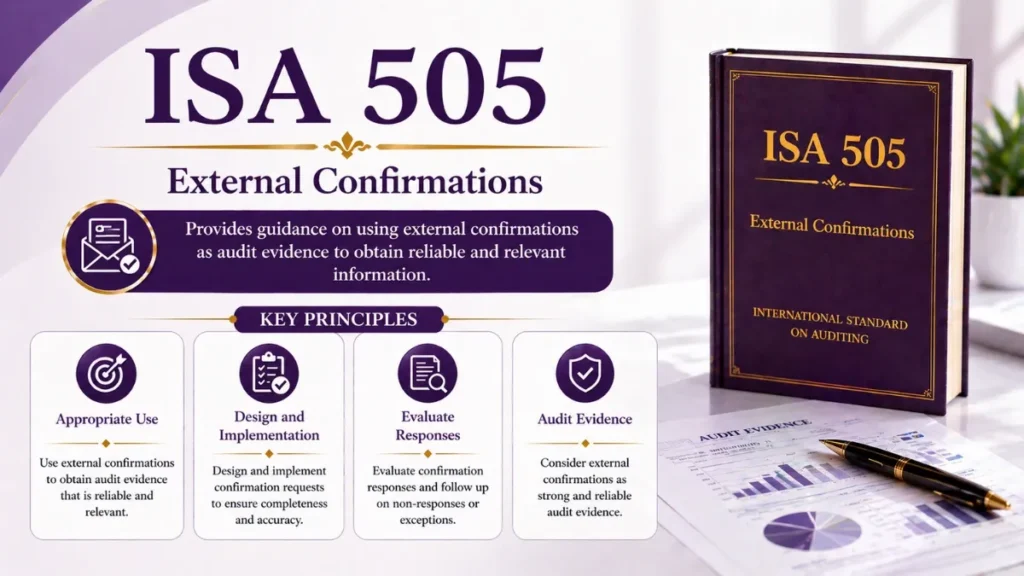
ISA 505 –
External Confirmations
A complete, authoritative guide for auditors on obtaining, evaluating, and documenting external confirmation evidence.
01What is ISA 505?
ISA 505 – External Confirmations is an International Standard on Auditing issued by the International Auditing and Assurance Standards Board (IAASB). It establishes the auditor’s responsibilities in obtaining and evaluating external confirmation evidence during a financial statement audit.
External confirmation is one of the most reliable forms of audit evidence. By obtaining written responses directly from third parties such as banks, debtors, lawyers, and other counterparties, auditors can corroborate the accuracy of information contained in the entity’s accounting records without relying solely on management-prepared documents.
External confirmation evidence is widely considered among the most persuasive audit evidence because it comes directly from a knowledgeable third party, independent of both the client and the auditor. ISA 505 ensures this process is conducted rigorously and systematically.
The standard applies whenever the auditor determines that external confirmations are a necessary procedure to gather sufficient appropriate audit evidence, particularly for financial assertions such as existence, rights and obligations, and accuracy.
02Objective of ISA 505
The objective of ISA 505 is to ensure that the auditor designs and performs external confirmation procedures that provide relevant and reliable audit evidence. Specifically, the standard aims to help auditors:
Determine When to Use Confirmations
Assess whether external confirmation procedures are appropriate given the assessed risks and the nature of account balances.
Design Effective Requests
Craft confirmation requests that are clear, unambiguous, and likely to generate reliable responses from confirming parties.
Evaluate Responses
Analyse responses for completeness, relevance, and reliability and identify exceptions or non-responses requiring further work.
Handle Non-Responses & Refusals
Apply alternative procedures when management refuses to allow confirmations or when confirming parties do not respond.
03Key Definitions Under ISA 505
| Term | Definition |
|---|---|
| External Confirmation | Audit evidence obtained as a direct written response to the auditor from a third party (the confirming party), either in paper form or by electronic or other medium. |
| Positive Confirmation Request | A request that asks the confirming party to respond directly to the auditor indicating whether they agree or disagree with the information stated in the request. |
| Negative Confirmation Request | A request that asks the confirming party to respond only if they disagree with the information provided in the request. |
| Non-Response | A failure of the confirming party to respond to, or a failure to completely respond to, a positive confirmation request. |
| Exception | A response that indicates a difference between information requested to be confirmed and information provided by the confirming party. |
| Confirming Party | The third party (e.g., a bank, debtor, creditor, or legal advisor) from whom the auditor requests confirmation. |
04Auditor Responsibilities Under ISA 505
ISA 505 places specific requirements on auditors. These are not optional best practices, they are mandatory obligations that must be fulfilled whenever external confirmations are used or considered as audit procedures.
Maintaining Control over Confirmation Requests
The auditor must maintain control over the entire confirmation process. This means the auditor, not management sends the requests, receives the responses, and follows up on non-responses. Allowing management to handle any part of this process significantly impairs the reliability of the evidence obtained.
If the auditor cannot maintain adequate control over confirmation requests and responses (e.g., management intercepts responses), the evidence obtained should be treated with extreme scepticism and may not be reliable.
Assessing the Reliability of Responses
Not all responses are equally reliable. The auditor should consider whether the response came from the correct person (i.e., someone knowledgeable and authorised), whether it was sent directly to the auditor, and whether there are any indicators that the response may have been altered or intercepted.
Considering Information Technology Risks
When confirmations are received electronically, the auditor must consider whether electronic confirmation processes introduce risks of interception, alteration, or fraud. The auditor may need to verify the authenticity of email responses through a follow-up phone call or alternative means.
ISA 505 acknowledges that electronic confirmations (e.g., email or web-based responses) can be acceptable, provided the auditor satisfies themselves that the source is legitimate and the transmission is secure.
05External Confirmation Process (Step by Step)
Identify Items Requiring Confirmation
Based on the risk assessment and understanding of the entity, determine which balances, transactions, or other items require third-party corroboration. Common items include accounts receivable, bank balances, loans, and legal contingencies.
Select the Confirming Party
Identify the appropriate third party with direct knowledge of the item. For bank balances, this is the financial institution. For receivables, it is the customer. Ensure that the confirming party is genuinely independent.
Design the Confirmation Request
Draft a clear, unambiguous request that specifies the exact information the auditor needs confirmed. Obtain management’s authorisation for the request, as the entity’s relationship with the third party may require formal consent.
Send the Request and Maintain Control
The auditor (not management) sends the request directly to the confirming party. All responses must be returned directly to the auditor via a return address or email controlled exclusively by the auditor.
Follow Up on Non-Responses
Where no response has been received within a reasonable timeframe, the auditor should send follow-up requests. Document each follow-up attempt as part of the audit file.
Evaluate Responses and Investigate Exceptions
Analyse each response for completeness and accuracy. Investigate any exceptions, differences between the entity’s records and the confirming party’s response to determine whether they indicate misstatements or timing differences.
Perform Alternative Procedures for Non-Responses
When a positive confirmation receives no response, the auditor must perform alternative audit procedures to address the risk of material misstatement. Document the procedures performed and the conclusions reached.
06Types of External Confirmation Requests (Positive vs Negative)
ISA 505 distinguishes between two primary types of confirmation requests, each with its own use cases, advantages, and limitations.
Positive Confirmation Request
Asks the confirming party to respond regardless of whether they agree or disagree. This approach is more reliable because silence is not interpreted as agreement. Best used for higher-risk balances, large amounts, or when individual responses are essential.
Negative Confirmation Request
Asks the confirming party to respond only if they disagree with the information. Provides less reliable evidence because non-response could mean the party agrees or simply did not respond. Suitable only for large populations of small, low-risk balances.
Blank Confirmation Request
A form of positive confirmation where the confirming party is asked to fill in the balance or information themselves, rather than confirming a stated amount. More reliable than confirmations that state an amount, as it eliminates acquiescence bias.
Blank confirmation requests, where the confirming party must supply the balance themselves are generally considered more reliable than requests that state a balance, as they reduce the risk of a confirming party simply agreeing to an incorrect amount without checking.
07Management Refusal to Allow Confirmations and Fraud Risk
One of the most significant provisions in ISA 505 concerns situations where management requests the auditor not to seek external confirmations. This scenario carries significant audit implications and must be handled carefully.
When Can Management Refuse?
Management may cite legitimate business reasons, such as ongoing disputes with a customer or sensitive negotiations for requesting that confirmations not be sent. ISA 505 acknowledges that such reasons may be valid. However, the auditor cannot simply accept the refusal without scrutiny.
Auditor’s Obligations When Faced with a Refusal
Per ISA 505, if management refuses to allow the auditor to perform external confirmation procedures, the auditor must:
Inquire into the Reasons for the Refusal
Understand management’s stated rationale. Document the reasons provided and evaluate their reasonableness.
Evaluate the Implications for Risk
Assess whether the refusal suggests a risk of material misstatement. A refusal without adequate justification may indicate that management is concealing something, a significant fraud risk indicator.
Perform Alternative Procedures
Design and perform alternative audit procedures that address the same assertions as the planned confirmation procedures. Document these alternatives thoroughly.
Consider the Effect on the Audit Report
If alternative procedures do not provide sufficient appropriate evidence, consider the implications for the audit opinion, including whether a modified opinion may be necessary.
Under ISA 240 (The Auditor’s Responsibilities Relating to Fraud), an unexplained management refusal to allow external confirmations, particularly for accounts receivable should be treated as a significant fraud risk indicator. The auditor must escalate their scepticism and scrutiny accordingly.
08Handling Non-Responses and Exceptions
Exceptions in confirmation responses, where a confirming party’s information differs from the entity’s records must never be dismissed as administrative errors without adequate investigation. ISA 505 requires auditors to evaluate all exceptions carefully.
Common Causes of Exceptions
Exceptions can arise from legitimate timing differences (e.g., payments in transit), legitimate disputes (e.g., a customer disputing an invoice), or potentially from errors or fraud. The auditor must determine which category applies.
| Type of Exception | Likely Cause | Auditor Response |
|---|---|---|
| Timing Difference | Payment or shipment in transit at the confirmation date | Verify subsequent receipt or delivery; no misstatement likely |
| Disputed Balance | Customer disputes the amount owed | Evaluate whether a provision or write-off is required |
| Recording Error | The entity has misrecorded the transaction | Identify if misstatement exists; consider broader impact |
| Fraud Indicator | Confirming party not aware of a transaction | Treat as a significant fraud risk; escalate immediately |
09Practical Examples of External Confirmations
To understand how ISA 505 operates in practice, consider the following common scenarios encountered in real-world audits:
1. Bank Confirmation (Bank Balance & Loans)
One of the most universal applications of ISA 505 is the bank confirmation. At period end, the auditor sends a standardised bank confirmation request to each bank where the entity holds accounts. The request typically asks the bank to confirm account balances, overdraft facilities, outstanding loans, charges, and contingent liabilities. This provides reliable evidence on the existence, completeness, and accuracy of the entity’s banking relationships.
2. Debtors / Accounts Receivable Confirmation
For entities with significant trade receivables, confirmations are sent to a sample of customers asking them to confirm the balance they owe. This addresses the existence and accuracy assertions for the receivables balance, a common area of misstatement. The auditor typically selects a statistical or risk-based sample, with larger balances and higher-risk customers receiving priority.
3. Lawyer / Solicitor Confirmation
To address the completeness and valuation of provisions for legal claims and contingent liabilities, auditors send confirmation letters to the entity’s external legal advisors. Lawyers are asked to confirm all pending or threatened litigation and to provide their assessment of likely outcomes. This is crucial for compliance with IAS 37 (Provisions, Contingent Liabilities and Contingent Assets) and accurate financial statement presentation.
4. Inventory Held by Third Parties
Where inventory is held at third-party warehouses or with consignees, the auditor must confirm the existence and condition of such inventory directly with the third party. This is especially relevant for commodities businesses, logistics companies, or entities with complex supply chains.
10Documentation Requirements Under ISA 505
ISA 505 requires auditors to maintain robust documentation of the entire external confirmation process. This documentation must be sufficient to allow an experienced auditor, with no prior connection to the engagement, to understand the procedures performed and the conclusions reached.
Audit files should include: the list of items selected for confirmation; copies of all confirmation requests sent; evidence that requests were controlled by the auditor; all responses received; follow-up actions for non-responses; investigation of all exceptions; and the auditor’s overall conclusions.
Where management refuses to permit confirmations or where the auditor has concerns about the reliability of responses, the documentation must also record the reasons for the refusal, the risk assessment implications, and the alternative procedures performed.
11Frequently Asked Questions
Is an auditor required to perform external confirmation procedures in every audit?
Not necessarily. ISA 505 does not make external confirmation procedures compulsory for every audit engagement. That said, ISA 330 obliges auditors to evaluate whether confirmations are warranted given the assessed risks of material misstatement. In practice, for audits involving material receivables or significant banking relationships, confirmations will form a near-standard part of the audit programme.
What should an auditor do when no response is received?
Where a positive confirmation request remains unanswered, the auditor is required to carry out alternative audit procedures to obtain sufficient appropriate evidence over the balance in question. Typical alternatives include reviewing subsequent cash receipts, inspecting original invoices and shipping documentation, and cross-referencing with other corroborating records. All follow-up steps and substitute procedures must be fully documented in the audit working papers.
Can the auditor rely solely on external confirmations as audit evidence?
No, external confirmations represent one category of audit evidence and should be combined with other procedures rather than relied upon in isolation. Even where confirmation evidence is highly persuasive, this does not remove the auditor’s obligation to exercise professional judgement and weigh all available information before drawing conclusions.
Are negative confirmation requests ever sufficient on their own?
Standalone negative confirmation requests will rarely meet the threshold for adequate audit evidence. Their use is appropriate only when the relevant population comprises a high volume of individually small, homogeneous, low-risk items and the entity operates within a robust control environment. Even then, negative confirmations should ordinarily be supplemented with additional corroborating procedures.
How does ISA 505 interact with ISA 240 (Fraud)?
Under ISA 240, a management refusal to permit external confirmation procedures is treated as a red flag for potential fraud. When an auditor encounters such a refusal, they are required to heighten their professional scepticism and apply more rigorous alternative procedures. Both the refusal and the explanations offered by management must be thoroughly assessed and documented as part of the fraud risk evaluation.
What happens if the auditor suspects a confirmation response has been falsified?
Where there are grounds to doubt the authenticity of a response (for instance), if it shows signs of having been intercepted or tampered with, the auditor should seek to verify it by contacting the confirming party directly. Such circumstances are serious and may point to fraudulent activity, which would bring the auditor’s responsibilities under ISA 240 into full effect.

(Qualified) Chartered Accountant – ICAP
Master of Commerce – HEC, Pakistan
Bachelor of Accounting (Honours) – AeU, Malaysia