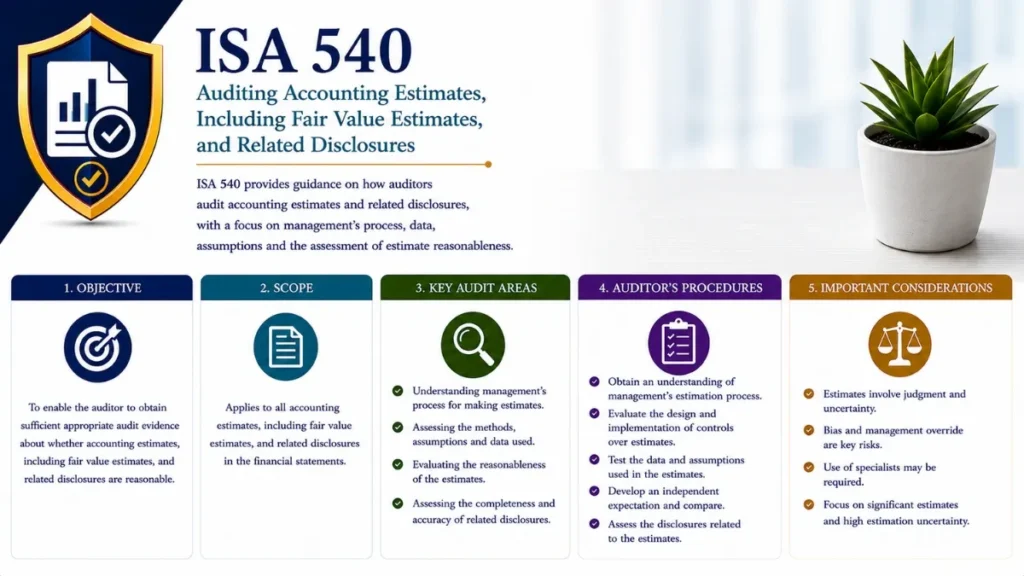
ISA 540 (Revised) – Auditing Accounting Estimates and Related Disclosures deals with the auditor’s responsibilities relating to accounting estimates and related disclosures in an ‘audit‘ of financial statements.
Last Updated – August, 2026
International Standard on Auditing · IAASB
ISA 540 – The Complete Guide to Auditing Accounting Estimates & Related Disclosures
A practical, plain-language walkthrough of ISA 540 (Revised); what it requires, why it was rewritten, and how auditors put its risk-based approach into practice.
At a Glance
- Full title
- Auditing Accounting Estimates and Related Disclosures
- Supersedes
- Extant ISA 540 (2008)
- Applies to
- Every accounting estimate and disclosure in a financial statement audit
- Core idea
- Scale audit effort to complexity, judgment & estimation uncertainty
- Works alongside
- ISA 315 (Revised), ISA 200, ISA 330
- Status in 2026
- Under IAASB post-implementation review (survey closed June 2026)
01What Is ISA 540?
Almost no financial statement is built entirely on hard numbers. Depreciation periods, loan loss allowances, warranty provisions, litigation reserves, and fair value measurements are all estimates, figures management arrives at using judgment, assumptions, and sometimes complex models, because the exact amount simply cannot be known with certainty at the reporting date. ISA 540 (Revised), Auditing Accounting Estimates and Related Disclosures, issued by the International Auditing and Assurance Standards Board (IAASB) is the international standard that governs how an auditor examines those figures.
ISA 540 applies to every accounting estimate that appears in a set of financial statements, regardless of size, industry, or the financial reporting framework used.
02Why Was ISA 540 Revised?
The original 2008 version of ISA 540 was written for a financial reporting world that looked different from today’s. Accounting estimates have since grown considerably more complex, driven by fair value accounting, sophisticated valuation models, and perhaps most decisively, the shift to expected credit loss (ECL) impairment models under standards such as IFRS 9. Regulators and audit oversight bodies also raised recurring concerns that auditors were not always challenging management’s estimates with sufficient rigor, particularly where estimation uncertainty was high.
The IAASB responded with a holistic rewrite. ISA 540 (Revised) was approved in 2018 and became effective for audits of financial statements for periods beginning on or after 15 December 2019. Its central design goal was to push auditors toward a more robust, evidence-based, and appropriately skeptical approach, one that scales naturally from the simplest provision to the most model-intensive fair value estimate, instead of applying a one-size-fits-all checklist.
“The revision was built to keep pace with a changing market and to foster a more independent, challenging, and skeptical mindset in auditors.” — Rationale underpinning the IAASB’s 2018 revision of ISA 540
03Objective and Scope of ISA 540
ISA 540 frames the auditor’s objective in two parts. First, the auditor must obtain sufficient appropriate audit evidence about whether accounting estimates and related disclosures are reasonable in the context of the applicable financial reporting framework or, where relevant, are misstated. Second, the auditor must evaluate whether the disclosures around those estimates give the users of the financial statements enough insight into the judgment involved and the uncertainty that surrounds it.
Notice what this objective does not say: it does not ask the auditor to independently recompute a single “correct” figure. Estimates rarely have one correct answer, they have a reasonable range. The auditor’s job is to test whether management’s process, data, assumptions, and resulting figure fall within that reasonable range, and whether the uncertainty involved has been properly disclosed.
04Key Definitions
ISA 540 introduces several terms that recur throughout the standard. Understanding them is essential before the risk-based requirements make sense.
- Accounting estimate
- A monetary amount for which the measurement, under the requirements of the applicable financial reporting framework, is subject to estimation uncertainty.
- Estimation uncertainty
- The susceptibility of an accounting estimate to an inherent lack of precision in its measurement. In other words, the inherent inability to measure it with complete accuracy.
- Management bias
- A lack of neutrality by management in the preparation of information, whether intentional or unintentional.
- Auditor’s point estimate / range
- An amount, or range of amounts, developed by the auditor to evaluate management’s point estimate, based on available evidence.
- Outcome of an accounting estimate
- The actual monetary amount that results from resolving the underlying transaction(s), event(s), or condition(s) addressed by the accounting estimate, but never proof on its own that an estimate was unreasonable when made.
05The Three Inherent Risk Factors
The conceptual heart of ISA 540 (Revised) is a simple idea, the risk of material misstatement in an accounting estimate rises and falls with three interacting inherent risk factors. The auditor is required to consider each one specifically when assessing risk.
Figure 1 – ISA 540’s three inherent risk factors combine to shape audit effort on any given estimate.
Complexity
Complexity refers to how complicate the process for making the estimate is, the number of data inputs, the sophistication of any model used, the extent of specialized skill required, and how many people or departments are involved in producing it.
Judgment
Judgment is the degree of subjectivity involved in selecting an appropriate method, making assumptions, or choosing data sources. The more room there is for reasonable people to disagree, the higher this factor runs.
Estimation Uncertainty
Estimation uncertainty is the inherent lack of precision in measurement itself, some estimates (a straight-line depreciation charge) carry very little; others (a long-duration insurance liability, or a Level 3 fair value measurement) carry a great deal, simply because of what is being measured.
These three factors do not act alone, the standard also asks the auditor to consider how they interact with each other, and with the susceptibility of the estimate to misstatement due to management bias or fraud. A moderately complex estimate with high estimation uncertainty and a strong incentive for management to bias the outcome (say, to hit an earnings target) warrants a different audit response than the same estimate in a low-pressure environment.
06Risk Assessment Procedures Under ISA 540
Before responding to any risk, ISA 540 requires the auditor to build a detailed understanding of how management actually produces its estimates. The auditor is expected to obtain an understanding of:
- The requirements of the applicable financial reporting framework relevant to the estimate, including any related disclosure requirements.
- How management identifies transactions, events, and conditions that give rise to the need for an estimate.
- The method, including any model, used to make the estimate, and whether it is applied consistently and appropriately.
- The relevant controls over the estimation process, including controls over data, assumptions, and any models used.
- How management selects and applies assumptions, and whether it considers alternative outcomes.
- How management understands, and where relevant addresses, estimation uncertainty, including whether it has considered a range of reasonably possible outcomes.
Critically, this understanding must extend to evaluating the design and implementation of relevant controls, not necessarily testing their operating effectiveness at this stage, but understanding whether the control environment around estimates is sound. Where an entity uses complex models, this understanding often needs to reach into model governance; validation, change control, and who has authority to override outputs.
07Audit Procedures and Responses to Assessed Risks
ISA 540 describes a “spectrum” of inherent risk, and expects the auditor’s response to move along that spectrum rather than defaulting to a single fixed procedure. For lower-risk estimates, testing how management made the estimate; reviewing its method, data, and assumptions is often sufficient. For higher-risk estimates, the standard expects one or more of the following, often in combination:
- Testing how management made the estimate – evaluating the method, data, and assumptions used, including whether the method is applied consistently and whether assumptions are reasonable and internally consistent.
- Developing an auditor’s point estimate or range – using independently developed assumptions or data (or a combination) to form an expectation the auditor can compare management’s estimate against.
- Testing the operating effectiveness of controls – combined with substantive procedures, particularly where the auditor intends to rely on automated or IT-dependent controls in the estimation process.
- Obtaining evidence from events occurring up to the date of the auditor’s report – using information that has since crystallized to corroborate, or challenge, an estimate made at an earlier date.
Where the estimate involves specialized expertise the audit team does not possess; actuarial modeling, complex financial instrument valuation, geological reserve estimation, ISA 540 works alongside ISA 620 to bring an auditor’s expert into the engagement, without diminishing the engagement team’s own responsibility for the conclusion reached.
08Management Bias & Professional Skepticism
Because estimates inherently involve judgment, they are also a natural pressure point for management bias. ISA 540 places explicit emphasis on this risk, requiring the auditor to remain alert to indicators of possible management bias throughout the audit, not only when testing the estimate itself.
Typical indicators auditors are trained to watch for include changes to an estimation method or assumptions that lack a clear business rationale, selective use of favorable data, assumptions that consistently sit at the optimistic end of a reasonable range, and a pattern of estimates that move in the direction that best supports reported results period after period. Individually, any one of these might be safe. Viewed cumulatively, across the financial statements as a whole, they can be a red flag the standard specifically asks the auditor to stand back and evaluate.
This ties directly back to ISA 200’s requirement for professional skepticism, the auditor is expected to critically assess audit evidence rather than simply corroborate management’s explanations, particularly where estimation uncertainty is significant.
09Disclosures & Documentation Requirements
ISA 540’s title itself signals a shift from earlier practice, it covers accounting estimates and related disclosures as a single unit of audit attention. The auditor evaluates whether disclosures adequately explain the methods, assumptions, and data used, and critically whether they communicate the degree of estimation uncertainty involved in a way that is useful to users of the financial statements, particularly for estimates that carry high estimation uncertainty.
Documentation requirements are correspondingly detailed. The auditor’s working papers need to capture the basis for the auditor’s conclusions on each significant estimate, indicators of possible management bias identified (and how they were addressed), and, where the auditor developed its own point estimate or range, the rationale behind it. This level of documentation is what allows engagement quality reviewers and inspectors to trace the auditor’s reasoning after the fact.
10ISA 540 (Revised) Vs Previous ISA 540
| Aspect | Extant ISA 540 (2008) | ISA 540 (Revised, 2018) |
|---|---|---|
| Risk framing | General risk of material misstatement | Explicit inherent risk factors: complexity, judgment, estimation uncertainty |
| Scalability | Implicit | Explicit “spectrum of inherent risk” approach built into the standard |
| Management bias | Addressed briefly | Standalone focus, with specific indicators auditors must consider |
| Disclosures | Secondary consideration | Integrated throughout; estimation uncertainty disclosures explicitly evaluated |
| Controls understanding | General requirement | Detailed expectations, including model governance and IT-dependent controls |
| Structure | Linear procedures | Risk-based, aligned closely with ISA 315 (Revised) |
11Common Challenges When Applying ISA 540
Firms implementing ISA 540 (Revised) consistently report a similar set of friction points, which is useful context for anyone studying or applying the standard:
- Scoping effort proportionately. Applying the full weight of the standard’s most detailed procedures to a genuinely low-risk estimate wastes time; under-scoping a deceptively complex one is a quality risk. Getting the initial risk assessment right is where most engagement efficiency is won or lost.
- Auditing models the team didn’t build. Expected credit loss models, actuarial reserves, and complex valuation models often sit outside the core engagement team’s expertise, making the coordination with auditor’s experts a recurring practical challenge.
- Distinguishing hindsight from evidence. Using subsequent events and actual outcomes to corroborate an estimate is a legitimate and required procedure, but the standard is careful to prevent auditors from judging a past estimate’s reasonableness purely by how it turned out.
- Documenting judgment, not just conclusions. Inspectors consistently flag files where the final conclusion is well supported but the reasoning path, particularly around management bias indicators is thin.
122026 Post-Implementation Review
ISA 540 (Revised) has now been in force for several audit cycles, and the IAASB has moved into a formal post-implementation review of the standard. In February 2026 the Board opened a public consultation survey, open through mid-June 2026, seeking feedback from preparers, auditors, regulators, and other stakeholders on how the standard has performed in practice including its perceived benefits, any implementation challenges observed, and views on the non-authoritative guidance issued to support it.
Separately, the IAASB’s broader standard-setting agenda continues to evolve the surrounding suite of standards ISA 540 depends on, including ongoing work refining how principles-based audit requirements apply as firms increasingly use technology-enabled tools to gather and evaluate audit evidence. Firms tracking ISA 540 compliance should treat this as a live area. While the core requirements of the standard remain unchanged for now, the review process may inform future amendments or additional application guidance.
13Frequently Asked Questions
What is ISA 540 in simple terms?
It is the international auditing standard that sets out how auditors should examine accounting estimates; figures such as provisions, reserves, and fair value measurements that cannot be known with certainty along with the disclosures that explain them.
When did ISA 540 (Revised) become effective?
It applies to audits of financial statements for periods beginning on or after 15 December 2019, replacing the 2008 version of the standard.
What is the difference between ISA 540 and ISA 315?
ISA 315 (Revised) sets out how auditors identify and assess risks of material misstatement across the financial statements as a whole. ISA 540 takes that same risk-based approach and applies it specifically to accounting estimates, adding requirements around complexity, judgment, estimation uncertainty, and the disclosures that accompany an estimate, detail that ISA 315 does not go into.
Does ISA 540 apply to every accounting estimate in an audit?
Yes, it applies on a scalable basis to all accounting estimates and related disclosures, whether a simple provision or a highly complex, model-driven valuation.
Why was ISA 540 revised in 2018?
To respond to growing complexity in accounting estimates, the rise of expected credit loss models under standards like IFRS 9, and a push toward a more robust and skeptical audit mindset around estimation uncertainty.
14Key Takeaways
- ISA 540 (Revised) governs the audit of every accounting estimate and its related disclosures, scaled to risk rather than applied uniformly.
- Three inherent risk factors; complexity, judgment, and estimation uncertainty sit at the center of the risk assessment.
- Auditor responses range from testing management’s process to independently developing a point estimate or range, depending on where an estimate sits on the risk spectrum.
- Professional skepticism toward possible management bias is a thread that runs through the entire standard, not an isolated step.
- The standard is currently under IAASB post-implementation review, with stakeholder feedback gathered through June 2026.

(Qualified) Chartered Accountant – ICAP
Master of Commerce – HEC, Pakistan
Bachelor of Accounting (Honours) – AeU, Malaysia