ISA 570 (Revised 2024) – Going Concern deals with the auditor’s responsibilities in the ‘audit‘ of financial statements relating to going concern and the implications for the auditor’s report.
Last Updated – April, 2026
IAASB International Standard on Auditing
ISA 570 – Going Concern
1. What is ISA 570?
International Standard on Auditing (ISA) 570, titled Going Concern, is issued by the International Auditing and Assurance Standards Board (IAASB), the global body responsible for setting auditing standards in the public interest. It defines the auditor’s responsibilities when it comes to evaluating whether a business will continue to operate for the foreseeable future.
The standard applies to all audits of financial statements, regardless of entity size, industry, or jurisdiction, although certain additional requirements apply specifically to listed (publicly traded) entities.
Purpose
Establishes the auditor’s responsibilities for evaluating management’s use of the going concern basis of accounting.
Issuing Body
Issued by the International Auditing and Assurance Standards Board (IAASB), part of the International Foundation for Ethics and Audit.
Global Scope
Adopted by over 130 countries worldwide, forming the basis of national auditing standards in most jurisdictions.
Public Interest
Designed to protect investors, creditors, and other stakeholders by ensuring transparent reporting of financial viability risks.
2. Going Concern Basis of Accounting
The going concern basis of accounting is a fundamental assumption in financial reporting. Under this assumption, an entity is presumed to be able to realise its assets, discharge its liabilities, and continue its normal operations for the foreseeable future, generally interpreted as at least twelve months from the reporting date.
When financial statements are prepared on the going concern basis, assets are measured at their expected operational value rather than forced-liquidation or break-up values. Departing from this basis for example, shifting to a liquidation basis can dramatically alter the carrying value of assets and liabilities, and significantly affects how users interpret financial statements.
“The going concern assumption is not merely an accounting convention, it represents a fundamental assertion about an entity’s capacity to survive and deliver value to its stakeholders over the medium term.” – International Auditing and Assurance Standards Board (IAASB)
When is the Going Concern Basis Not Appropriate?
Management must not use the going concern basis if they intend to liquidate the entity, cease operations, or have no realistic alternative to doing so. In such cases, a different basis of accounting must be applied, commonly the liquidation basis and appropriate disclosures are required.
3. Auditor Responsibilities Under ISA 570
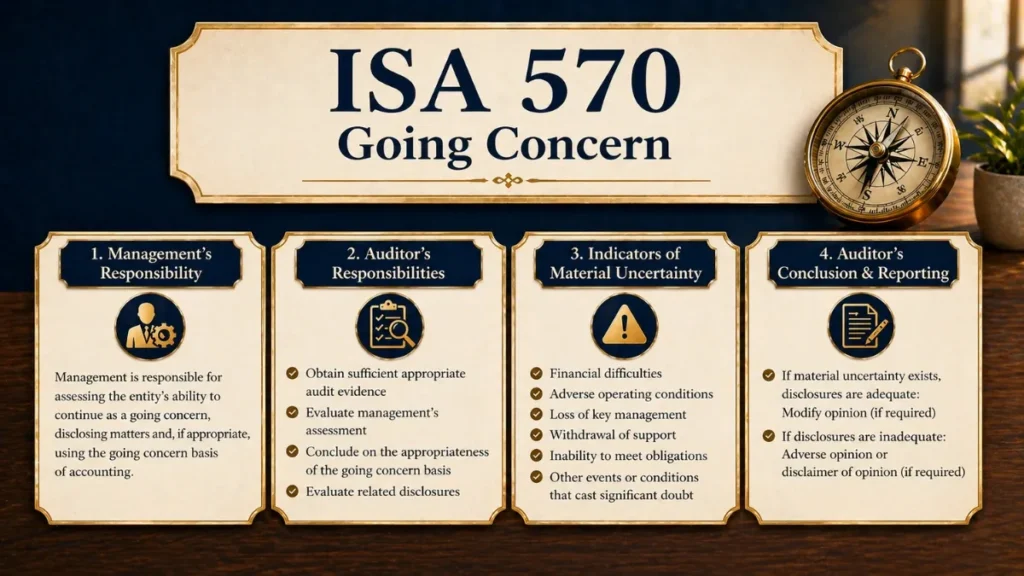
ISA 570 assigns primary responsibility for the going concern assessment to management, it is management’s duty to evaluate the entity’s ability to continue as a going concern and to prepare financial statements on the appropriate basis. However, the auditor has a distinct and parallel set of obligations.
The auditor’s key objective under ISA 570 is to obtain sufficient appropriate audit evidence to conclude whether a material uncertainty exists related to events or conditions that may cast significant doubt on the entity’s ability to continue as a going concern, and to determine the implications for the auditor’s report.
Specifically, the auditor must:
Evaluate Management’s Assessment
Critically assess management’s going concern evaluation, including the assumptions underpinning any forecasts and projections, with professional scepticism throughout.
Perform Independent Risk Assessment
Conduct going concern-specific risk assessment procedures, independently of management to identify any events or conditions that could cast significant doubt.
Challenge Management’s Plans
Scrutinise management’s plans to deal with adverse events, assess their feasibility and whether mitigating actions are realistic and sufficiently certain.
Draw an Explicit Conclusion
Conclude explicitly on whether management’s use of the going concern basis is appropriate and whether a material uncertainty exists, these are now two distinct required conclusions under the 2024 revision.
Report Transparently
Communicate going concern findings clearly in the auditor’s report, with entity-specific language tailored to the circumstances of the engagement.
4. Going Concern Risk Indicators
ISA 570 guidance identifies a broad range of events and conditions that may cast significant doubt on an entity’s ability to continue as a going concern. These are typically grouped into four categories:
Financial Indicators
Operating Indicators
Other Indicators
The presence of one or more of these indicators does not automatically mean a material uncertainty exists. The auditor must consider the full context, the aggregate effect of multiple factors, and management’s ability to mitigate these risks effectively.
5. Audit Procedures Under ISA 570
When events or conditions are identified that may cast significant doubt, ISA 570 requires the auditor to perform additional audit procedures to obtain sufficient appropriate evidence. These typically include:
Analyse and Discuss Cash Flow Forecasts
Obtain management’s cash flow projections for at least 12 months from the date of approval of the financial statements. Assess the assumptions, compare actuals to prior forecasts, and stress-test key variables.
Review Subsequent Events
Analyse events and transactions after the period end that may be relevant to going concern; such as refinancing agreements, loss of a major contract, or regulatory action.
Inquire of Management and TCWG
Hold detailed discussions with management and those charged with governance (TCWG) about plans, mitigating actions, and their assessment of the entity’s financial position and prospects.
Review Financing Arrangements
Inspect loan agreements, covenant terms, correspondence with lenders, and evidence of committed credit facilities. Confirm the availability and accessibility of financial support.
Consider Legal and Regulatory Matters
Review pending litigation, regulatory correspondence, and tax disputes that could impair the entity’s ability to continue operating or access its assets.
6. Material Uncertainty Related to Going Concern (MURGC)
Under ISA 570 (Revised 2024), a Material Uncertainty Related to Going Concern (MURGC) is formally defined as an uncertainty arising from events or conditions that, individually or collectively, may cast significant doubt on an entity’s ability to continue as a going concern, where the magnitude and likelihood of the potential impact are such that appropriate disclosure in the financial statements is required.
The 2024 revision significantly clarified this definition, addressing previous inconsistencies in international interpretation and practice.
When Does a Material Uncertainty Exist?
A material uncertainty is deemed to exist when the potential impact and likelihood of the identified events or conditions are such that, unless management’s plans successfully mitigate their effects, the entity may be unable to realise its assets, discharge its liabilities in the normal course of business, and continue its operations during the period assessed.
“Close Call” Situations
A key innovation of the 2024 revision is explicit guidance on “close call” situations, cases where significant judgement by management was required to conclude that no material uncertainty exists. Previously, such nuanced situations were not explicitly addressed and could be handled inconsistently between engagements. The revised standard now requires auditors to report on these situations prominently in the Going Concern section of the auditor’s report (not in the Key Audit Matters section).
ISA 570 (Revised 2024) requires the auditor to form two explicit conclusions: (1) whether management’s use of the going concern basis is appropriate; and (2) whether a material uncertainty exists. These are separate, distinct conclusions required in all audits.
7. ISA 570 Reporting Requirements
One of the most significant dimensions of ISA 570 (Revised 2024) is its impact on what auditors must communicate, both in the auditor’s report and in written communications with those charged with governance.
In the Auditor’s Report
All Entities
A Going Concern section must appear in every auditor’s report, explicitly stating the auditor’s conclusions on management’s use of the going concern basis and whether a MURGC exists.
Listed Entities
Additional incremental content is required, reflecting heightened public interest. Auditors must provide entity-specific information about the going concern assessment and the work performed.
Material Uncertainty Exists
A separate, prominent “Material Uncertainty Related to Going Concern” section must be included, with reference to the related disclosures in the financial statements.
Close Call Situations
When significant management judgement is involved even though no MURGC exists, this must be reported in the Going Concern section (not buried in KAM).
Communications with Those Charged with Governance (TCWG)
ISA 570 requires the auditor to communicate promptly with those charged with governance (TCWG) typically the board or audit committee about any events or conditions identified that may cast doubt on going concern, the adequacy of management’s disclosure, and the auditor’s conclusions. The 2024 revision strengthens and expands these communication requirements significantly.
8. ISA 570 Revised 2024: Key Changes
Released in November 2024 by the IAASB, ISA 570 (Revised 2024) represents the most substantial overhaul of the standard since the 2016 revision. It was driven by major corporate collapses globally, the COVID-19 pandemic, and growing calls from investors and regulators for more robust and transparent going concern audits.
Refined Definitions
A formally revised and clarified definition of “Material Uncertainty Related to Going Concern” (MURGC) to improve consistency across jurisdictions and reduce divergent interpretation.
Robust Risk Assessment
Auditors must now conduct more timely and thorough risk assessments specifically focused on going concern, earlier in the audit cycle and with greater rigour.
Extended Assessment Period
The assessment period is now anchored to at least 12 months from the date of approval of the financial statements not just the reporting date, providing more decision-useful information.
Two Explicit Conclusions
Two distinct, required conclusions for all audits: on management’s appropriateness of the going concern basis; and on whether a material uncertainty exists.
Enhanced Transparency
Significantly expanded auditor reporting requirements, particularly for listed entities, with entity-specific language about the auditor’s work and responsibilities.
Close Call Guidance
Explicit requirements for reporting “close call” situations where no MURGC exists but significant management judgement was exercised, previously a gap in the standard.
9. Difference between ISA 570 (2016 vs 2024)
The table below summarises the most significant differences between the extant 2016 standard and the 2024 revision:
| Dimension | ISA 570 (Revised 2016) | ISA 570 (Revised 2024) |
|---|---|---|
| Assessment Period | At least 12 months from the date of the financial statements | At least 12 months from the date of approval of the financial statements |
| Definition of MURGC | Not explicitly defined; referenced indirectly | Formally defined with clear threshold language for consistency |
| Auditor’s Conclusions | Implicit conclusion on going concern overall | Two explicit, distinct conclusions required for all audits |
| Reporting Approach | Exception-based, detailed commentary only when problems arise | Going Concern section required in all auditor’s reports |
| Listed Entity Requirements | Limited additional requirements | Significant incremental auditor’s report content for listed entities |
| “Close Call” Guidance | Not addressed | Explicit requirements for reporting significant management judgements |
| Risk Assessment Timing | Standard audit risk assessment integration | More timely, dedicated going concern risk assessment required |
| TCWG Communications | Standard communication requirements | Strengthened and expanded communication requirements |
| Effective Date | Periods ending on or after December 15, 2016 | Periods beginning on or after December 15, 2026 |
10. Practical Application of ISA 570 in Audits
For Auditors
The 2024 revision significantly increases the work effort associated with going concern assessments. Audit firms should expect to:
For CFOs and Finance Teams
Management should equally prepare for heightened auditor scrutiny. Key considerations include:
The Expectation Gap: A central motivation for the 2024 revision was narrowing the expectation gap, the difference between what the public believes auditors should do with respect to going concern and what auditors are actually required to do. The revised standard directly responds to this by expanding requirements and enhancing transparency, resulting in more decision-useful information for investors and other stakeholders.
12. Historical Timeline
Original ISA 570
Earlier versions of the standard provided basic going concern guidance; reporting was largely exception-based with limited transparency requirements.
ISA 570 (Revised) Issued
The IAASB issued the first major revision, clarifying auditor responsibilities and introducing the separate “Material Uncertainty Related to Going Concern” paragraph in auditor reports.
ISA 570 (Revised) Effective
The 2016 revision became effective for financial statement audits for periods ending on or after this date, establishing a new global baseline for going concern auditing.
COVID-19 & Corporate Failures
The global pandemic and a series of high-profile corporate collapses intensified stakeholder calls for a more robust and transparent going concern standard. The IAASB approved a project to revise ISA 570 in March 2022.
ISA 570 (Revised 2024) Issued
The IAASB released the landmark revised standard, significantly enhancing auditor responsibilities, introducing two explicit conclusions, strengthening reporting, and adding guidance on “close call” situations.
ISA 570 (Revised 2024) Effective
The 2024 revision becomes effective for audits of financial statements for periods beginning on or after this date, ushering in a new era for going concern auditing globally.
13. Frequently Asked Questions (FAQ)
What is the difference between ISA 570 and ISA 570 Revised 2024?
When is ISA 570 (Revised 2024) effective?
What is a “Material Uncertainty Related to Going Concern” (MURGC)?
What are “close call” situations under ISA 570?
Does ISA 570 apply to small and medium entities (SMEs)?
What does the auditor report say when there is no material uncertainty?
How does ISA 570 interact with other ISAs?
What is the IAASB and who does ISA 570 apply to?

(Qualified) Chartered Accountant – ICAP
Master of Commerce – HEC, Pakistan
Bachelor of Accounting (Honours) – AeU, Malaysia