ISA 620 – Using the Work of an Auditor’s Expert deals with the auditor’s responsibilities relating to the work of an individual or organization in a field of expertise other than accounting or auditing, when that work is used to assist the ‘auditor’ in obtaining sufficient appropriate audit evidence.
Last Updated – August, 2026
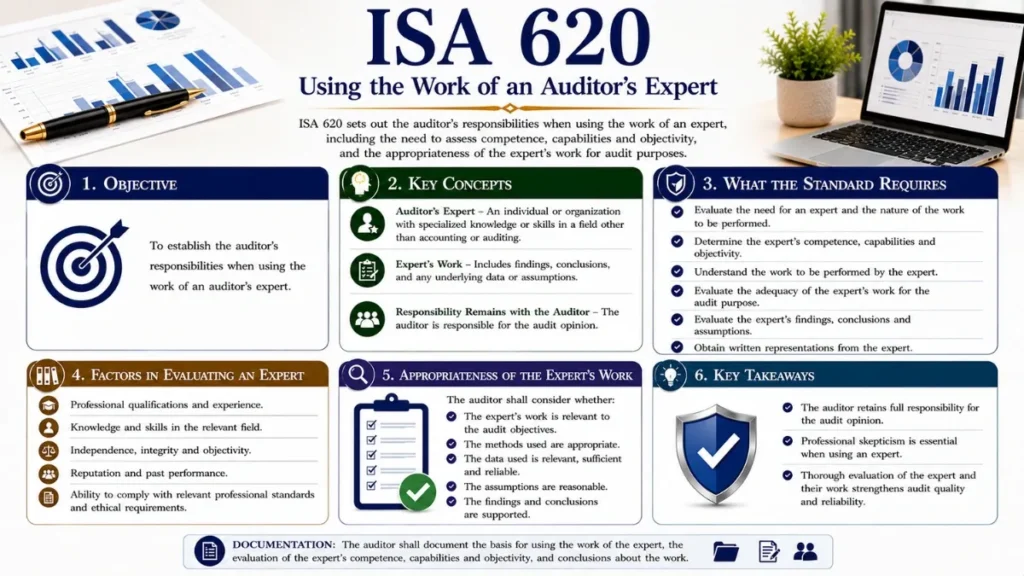
ISA 620
Using the Work of an Auditor’s Expert
A practical, working guide to when auditors must call in outside expertise, how competence and objectivity are evaluated, and how the expert’s findings are folded into audit evidence without the auditor ever handing off responsibility for the opinion.
I.Objective & Scope of ISA 620
ISA 620 titled Using the Work of an Auditor’s Expert issued by IAASB sets out what an auditor must do whenever the audit relies, in part, on the findings of someone who knows something the auditor doesn’t.
Auditors are trained to test financial statement assertions, not to value a pension obligation, appraise a mineral reserve, or interpret a construction contract dispute. When a matter falls outside accounting or auditing knowledge but is still material to the financial statements, the standard requires the auditor to bring in a specialist and then treat that specialist’s output the same way any other piece of audit evidence is treated: with professional scepticism, corroboration, and a documented evaluation of reliability.
Importantly, ISA 620 does not transfer any part of the audit opinion to the expert. The auditor remains solely accountable for the conclusions reached, regardless of how technical the underlying matter was.
II.ISA 620 and Use of an Auditor’s Expert
Certain balances and disclosures simply cannot be audited with accounting skill alone. Typical situations where an auditor’s expert is engaged include:
- Valuations – complex financial instruments, unquoted investments, or specialised property and equipment.
- Actuarial calculations – defined benefit pension obligations and long-term employee benefit liabilities.
- Physical condition or quantity – mineral reserves, stockpiles, or the remaining useful life of specialised plant.
- Legal interpretation – the effect of contracts, regulations, or ongoing litigation on the financial statements.
- Technical estimates – engineering assessments, environmental liabilities, or IT-driven fraud analysis in complex systems.
The common thread is materiality combined with technical complexity: the more judgement-heavy and the more material the balance, the stronger the case for involving an expert.
III.Key Definitions
Auditor’s Expert
An individual or organisation with expertise in a field other than accounting or auditing, whose work is used by the auditor to help obtain sufficient appropriate audit evidence.
Internal vs. External Experts
An auditor’s expert can be internal, a partner or staff member of the audit firm or a network firm with the relevant specialised knowledge or external, engaged from outside the firm entirely. The distinction matters because it changes how much evidence the auditor needs to gather about independence: internal experts are already subject to the firm’s quality control and ethical requirements, while external experts require a fresh inquiry into any relationships or interests that could threaten objectivity.
IV.Auditor’s Expert vs Management’s Expert
One of the most commonly confused distinctions in practice is between an expert engaged by the auditor and an expert already engaged by the entity being audited. They are governed by different standards and trigger different audit responses.
Comparing the two categories of expert
| Aspect | Auditor’s Expert (ISA 620) | Management’s Expert (ISA 500) |
|---|---|---|
| Who engages them | The audit firm, to support the audit itself | The entity, to help prepare the financial statements |
| Auditor’s task | Evaluate competence, capability, objectivity, and adequacy of the work performed | Evaluate the expert’s work only as one source of audit evidence, per ISA 500 |
| Terms of engagement | Typically agreed directly between auditor and expert | Set by management; auditor has no direct engagement relationship |
| Independence focus | Central requirement, objectivity is formally assessed | Assessed indirectly, as part of evaluating reliability of evidence |
V.The Auditor’s Responsibilities
ISA 620 builds around a sequential chain of judgements. Skipping a link in this chain is one of the most frequent inspection findings in engagements that use experts.
Determine the need for an auditor’s expert
Assess, during risk assessment and response planning, whether the audit team has the knowledge to evaluate a matter and if not, whether that gap is significant enough to require outside expertise.
Evaluate competence, capability, and objectivity
Confirm the expert is technically qualified, practically able to perform the work required, and free from undue bias or conflicting interests.
Obtain a sufficient understanding of the expert’s field
Gain enough working knowledge of the discipline to evaluate the expert’s assumptions, methods, and conclusions not to replicate the expert’s work, but to sense-check it.
Agree the terms of the engagement
Document the nature, scope, and objectives of the expert’s work, respective roles, communication protocols, and confidentiality requirements.
Evaluate the adequacy of the expert’s work
Test the relevance and reasonableness of findings, assumptions, and source data before relying on them as audit evidence.
VI.Evaluating Competence, Capability & Objectivity of an Expert
These three qualities are assessed together, and the depth of the assessment scales with how significant the expert’s work is to the audit conclusion.
- Competence – the nature and level of expertise, professional certification, and reputation within the field.
- Capability – the practical ability to apply that expertise to this engagement: available time, resources, and access to relevant data.
- Objectivity – freedom from interests or relationships that could compromise professional judgement, including financial interests in the client, family relationships, or prior involvement in preparing the balance under review.
Relevant inputs for this evaluation include the expert’s professional certifications, published work, experience with similar engagements, and and for external experts, direct enquiry about relationships with the entity being audited.
Practical Tip
The more material and judgemental the matter, the more corroboration is expected. A routine property valuation from a well-known chartered surveyor needs far less scrutiny than a one-off, entity-specific valuation model built by an expert with no prior track record.
VII.Agreeing the Terms of Engagement with an Auditor’s Expert
For anything beyond the most straightforward reliance, ISA 620 expects the terms of the arrangement to be documented, usually in writing. A well-drafted agreement typically addresses:
- The nature, scope, and objectives of the expert’s work.
- The respective roles and responsibilities of the auditor and the expert.
- The nature, timing, and extent of communication between the two, including the form of any report to be provided.
- Confidentiality requirements, given the expert may access sensitive client information.
- Where relevant, any restriction on the expert’s association with the auditor’s report.
VIII.Evaluating the Adequacy of an Auditor’s Expert’s Work
Once findings are in hand, the auditor cannot simply file them as evidence. ISA 620 requires an active evaluation covering three areas:
- Relevance and reasonableness of the findings in light of the auditor’s own understanding of the entity, and consistency with other audit evidence.
- Significant assumptions and methods used, including whether they are appropriate and consistently applied.
- Relevance, completeness, and accuracy of source data the expert relied upon, where that data is significant to the expert’s work.
Procedures used to test adequacy can include reviewing the expert’s working papers, discussing the findings directly with the expert, comparing conclusions against independent data points, or where concerns remain unresolved, engaging a second expert for corroboration.
Where It Goes Wrong
The most common inspection deficiency is treating the expert’s report as a black box: filing it without testing the assumptions feeding into it, or without reconciling the source data back to the entity’s own records.
IX.Referring to the Expert in the Auditor’s Report
As a general rule, an unmodified auditor’s report does not refer to the use of an auditor’s expert, doing so could be misread as diluting the auditor’s sole responsibility for the opinion. A reference is only appropriate where law or regulation requires it, or where it is relevant to explaining a modified opinion, in which case the auditor must first obtain the expert’s consent before naming them, since the reference does not reduce the auditor’s own responsibility for the conclusions drawn.
Key Takeaways
- ISA 620 governs experts engaged by the auditor, not experts engaged by management, that distinction sits with ISA 500.
- Competence, capability, and objectivity must all be evaluated, with more scrutiny applied as the matter grows more material and judgemental.
- Agreed terms of engagement should cover scope, roles, communication, and confidentiality.
- The expert’s findings are evidence to be tested, not a conclusion to be adopted on trust.
- The audit opinion remains entirely the auditor’s responsibility, regardless of how much technical work the expert performed.
X.Frequently Asked Questions
Is an actuary who values a client’s pension scheme automatically an “auditor’s expert”?
Can an audit firm’s in-house valuation specialist count as an auditor’s expert?
Does using an auditor’s expert reduce the auditor’s liability for the opinion?
What happens if the auditor disagrees with the expert’s conclusions?
Do the terms of engagement with an auditor’s expert always need to be in writing?

(Qualified) Chartered Accountant – ICAP
Master of Commerce – HEC, Pakistan
Bachelor of Accounting (Honours) – AeU, Malaysia