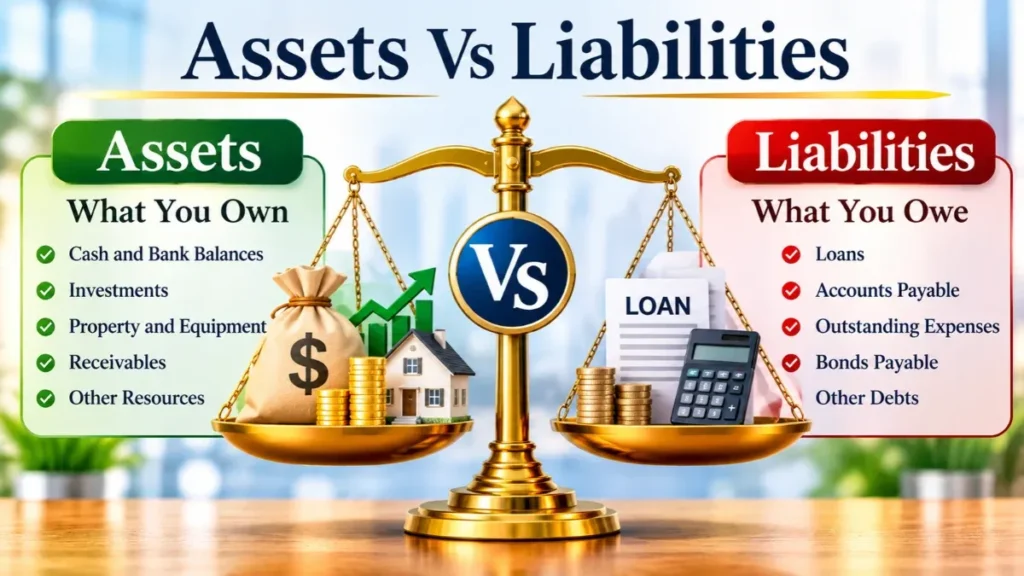
Assets vs liabilities are two fundamental components of accounting that help individuals and businesses understand their financial position. Assets are resources owned or controlled that provide future economic benefits, such as cash, property, inventory, and equipment, whereas liabilities are financial obligations owed to others, including loans, accounts payable, and outstanding expenses.
Understanding the difference between assets and liabilities is essential for interpreting a balance sheet, calculating equity and net worth, assessing financial health, and making informed financial decisions. This guide explores their definitions, key differences, practical examples, types, and financial ratios to help you understand how they work together in the accounting equation.
Last Updated – November, 2026
Editorial standard: Written by a Qualified Chartered Accountant. Definitions follow the IFRS Conceptual Framework and US GAAP, every worked example is recalculated so the totals tie out, and sources are listed at the end. See the author page for full credentials and areas of expertise.
Assets vs Liabilities: The Quick Answer
In plain English, assets are things a person or business owns or controls that can provide future economic benefit, and liabilities are obligations to pay or deliver value to others. Formally, IFRS defines an asset as a present economic resource controlled by the entity as a result of past events, and a liability as a present obligation to transfer an economic resource as a result of past events. What remains after subtracting liabilities from assets is equity (net worth), and every balance sheet follows one equation: Assets = Liabilities + Equity.
Key Takeaways
- Own vs owe: assets are what you own or control; liabilities are what you owe.
- The equation never breaks: Assets = Liabilities + Equity, and Equity = Assets − Liabilities.
- Time matters: both are split into current (within 12 months) and non-current (longer than 12 months).
- Debt is not automatically bad: a liability that funds an asset earning more than the debt costs can build value.
- Ratios tell the story: the current ratio, debt-to-asset ratio and debt-to-equity ratio turn raw balances into a health check.
- Modern rules changed leases: under ASC 842 and IFRS 16, most leases now create both a right-of-use asset and a lease liability.
Every financial decision, from taking a bank loan to buying a house, comes back to two questions: what do I own and what do I owe? Answer them accurately and you can see whether you can cover next month’s bills, absorb a bad quarter, or safely take on new debt. This guide explains assets and liabilities in plain English, shows worked numbers you can verify, and covers the situations that confuse most people, from leases to car loans to the family home.
What Is an Asset?
Formal definition (IFRS): the IFRS Conceptual Framework defines an asset as a present economic resource controlled by the entity as a result of past events. An economic resource, in turn, is a right that has the potential to produce economic benefits. The benefit does not have to be certain or even likely; the potential is what counts. US GAAP’s conceptual framework words this differently, but the core idea is the same.
In plain English: an asset is something you own or control that can bring in cash, save you cash, or be sold, such as money in the bank, stock you plan to sell, a machine, or a patent.
Three tests help you decide quickly:
- Control: you own it, or you have the legal right to use and benefit from it.
- Past event: it arose from something that already happened, such as a purchase, a sale on credit, or a contract.
- Future benefit: it has the potential to bring in cash or save cash, directly or indirectly.
Assets do not need to be physical. A trademark, a software platform and a customer invoice that has not yet been paid are all assets, because each is expected to produce future cash.
What Is a Liability?
Formal definition (IFRS): a liability is a present obligation of the entity to transfer an economic resource as a result of past events. The resource transferred can be cash, goods or services.
In plain English: a liability is a debt or commitment you are expected to settle. Liabilities include bank loans, supplier invoices you have not paid, wages you owe employees, taxes due, and customer deposits for work you have not yet delivered.
A liability does not have to involve borrowed money. If a customer prepays you $2,000 for a service you will perform next month, you owe that service. Until you deliver it, the $2,000 sits on your balance sheet as a liability called unearned (or deferred) revenue.
Assets vs Liabilities – Key Differences
Assets: what you own
- Provide future economic benefit
- Increase net worth
- Listed by liquidity (cash first)
- Examples: cash, receivables, inventory, equipment, patents
Liabilities: what you owe
- Require future payment or delivery
- Decrease net worth
- Listed by due date (soonest first)
- Examples: loans, payables, accrued wages, taxes, unearned revenue
| Feature | Assets | Liabilities |
|---|---|---|
| Definition | Resources owned or controlled that are expected to provide future benefit | Present obligations to pay or deliver value to others |
| Effect on equity | Increase it | Decrease it |
| Balance sheet side | Left side (or top) | Right side (or below assets) |
| Ordering | By liquidity, most liquid first | By maturity, soonest due first |
| Cash-flow direction | Typically produce or protect cash inflows | Typically require cash outflows |
| Time split | Current vs. non-current | Current vs. non-current |
| Normal balance (double entry) | Debit | Credit |
| Typical measurement | Cost less depreciation or amortization, or fair value | Amount owed, plus accrued interest |
| Risk signal | Too few current assets signals liquidity trouble | Too many liabilities relative to assets signals leverage risk |
What Are the Different Types of Assets?
Accountants sort assets in two ways: by how fast they turn into cash (current vs. non-current) and by whether you can touch them (tangible vs. intangible).
Current assets
Expected to become cash within 12 months or one operating cycle.
- Cash and cash equivalents
- Accounts receivable
- Inventory
- Short-term investments
- Prepaid expenses
Non-current (fixed) assets
Held and used for longer than 12 months.
- Land and buildings
- Machinery and equipment
- Vehicles
- Long-term investments
- Right-of-use (leased) assets
Tangible assets
Physical items with a form you can see and touch.
- Equipment
- Real estate
- Inventory
- Furniture and vehicles
Intangible assets
Non-physical rights that still create value.
- Patents and copyrights
- Trademarks and brands
- Software and licenses
- Purchased goodwill
Depreciation does not turn an asset into a liability
A common myth is that a car or a laptop becomes a liability because it loses value. In accounting it stays an asset; it is simply carried at a lower book value. For example, a $30,000 vehicle depreciated straight-line over 5 years with no salvage value loses $6,000 per year. After two years its book value is $30,000 − $12,000 = $18,000, and it is still an asset.
What Are the Different Types of Liabilities?
Current liabilities
Due within 12 months.
- Accounts payable
- Accrued wages and expenses
- Taxes payable
- Short-term loans and the current portion of long-term debt
- Unearned revenue
Non-current liabilities
Due after 12 months.
- Bank loans and notes payable
- Mortgages
- Bonds payable
- Lease liabilities (long-term portion)
- Deferred tax liabilities
- Pension obligations
Contingent liabilities
Possible obligations that depend on an uncertain future event.
- Pending lawsuits
- Product warranties
- Loan guarantees
- Environmental clean-up claims
When is a contingent liability recorded?
Under US GAAP (ASC 450), a loss contingency is recorded when a loss is probable and the amount can be reasonably estimated; if it is only reasonably possible, it is disclosed in the notes. Under IFRS (IAS 37), an obligation is recognized as a provision when an outflow is probable (more likely than not) and a reliable estimate exists; a merely possible obligation is disclosed as a contingent liability. Lenders and buyers read those footnotes closely, so an unrecorded exposure can distort every risk judgment about the business.
How Assets and Liabilities Appear on a Balance Sheet
The balance sheet is a snapshot of financial position on a single date. Assets are listed first, in order of liquidity. Liabilities follow, in order of when they fall due, and equity closes the statement. The two totals must match.
Here is a worked example for Brightleaf Studio, a fictional small design business. Every figure below is used again in the ratio section, so you can check the math.
| Line item | Amount |
|---|---|
| ASSETS | |
| Cash | $40,000 |
| Accounts receivable | $25,000 |
| Inventory | $15,000 |
| Prepaid expenses | $5,000 |
| Total current assets | $85,000 |
| Equipment (net of depreciation) | $45,000 |
| Software and trademarks | $20,000 |
| Total non-current assets | $65,000 |
| TOTAL ASSETS | $150,000 |
| LIABILITIES | |
| Accounts payable | $18,000 |
| Accrued wages | $7,000 |
| Unearned revenue | $10,000 |
| Current portion of bank loan | $5,000 |
| Total current liabilities | $40,000 |
| Long-term bank loan | $35,000 |
| TOTAL LIABILITIES | $75,000 |
| EQUITY | |
| Owner’s capital | $50,000 |
| Retained earnings | $25,000 |
| TOTAL EQUITY | $75,000 |
| TOTAL LIABILITIES + EQUITY | $150,000 |
Assets, Liabilities and Equity (Understanding the Accounting Equation)
Equity is the residual claim on the assets after all liabilities are settled. For a corporation it is called shareholders’ equity; for a sole proprietorship or partnership, owner’s equity. It grows with owner investment and profit and shrinks with losses and withdrawals or dividends.
The accounting equation can be rearranged to solve for whichever number is missing:
- Positive equity: $800,000 in assets and $500,000 in liabilities leave $300,000 in equity.
- Negative equity: $400,000 in assets and $450,000 in liabilities leave −$50,000. Liabilities exceed assets, which is a sign of financial distress and can lead to insolvency if cash runs out.
Negative equity gives you two levers: reduce what you owe (pay down or refinance the costliest debt, sell idle assets) or add capital (new owner investment or equity financing).
How Business Transactions Affect Assets and Liabilities
Because of double-entry bookkeeping, every transaction changes at least two accounts and leaves the equation in balance. This table shows nine common events. A plus sign means increase, a minus sign means decrease, and “no change” means the total is unaffected.
| Transaction | Assets | Liabilities | Equity |
|---|---|---|---|
| Owner invests $10,000 cash | + $10,000 | no change | + $10,000 |
| Borrow $20,000 from a bank | + $20,000 | + $20,000 | no change |
| Buy $5,000 equipment with cash | + $5,000 and − $5,000 (no net change) | no change | no change |
| Buy $3,000 inventory on credit | + $3,000 | + $3,000 | no change |
| Pay the $3,000 supplier bill | − $3,000 | − $3,000 | no change |
| Customer prepays $2,000 | + $2,000 | + $2,000 | no change |
| Deliver the prepaid service | no change | − $2,000 | + $2,000 (revenue) |
| Pay $1,000 rent in cash | − $1,000 | no change | − $1,000 (expense) |
| Accrue $4,000 wages not yet paid | no change | + $4,000 | − $4,000 (expense) |
Notice the pattern: expenses and revenue move equity, while borrowing and repaying move assets and liabilities together. That is why an expense is not the same thing as a liability. An expense reduces profit when it occurs; it becomes a liability only if it remains unpaid.
Examples of Assets and Liabilities – Loans, Leases, Cars and Homes
Leases: now on the balance sheet
Older guidance said a leased vehicle was simply an expense, not an asset. That changed. Under ASC 842 (US GAAP) and IFRS 16, a lessee generally records a right-of-use asset and a matching lease liability for leases longer than 12 months. Short-term leases of 12 months or less can usually be kept off the balance sheet by election, and small businesses that keep simple cash-basis books for tax purposes may not apply these standards. If your financial statements are prepared under GAAP or IFRS, assume a long-term lease creates both an asset and a liability.
A financed car: one purchase, two entries
If you buy a $28,000 vehicle with a $28,000 loan, you record a vehicle asset of $28,000 and a loan liability of $28,000. Equity does not change on day one. As you make payments, the loan shrinks and the vehicle depreciates independently, so the two lines move on different schedules.
Property you own versus property you rent
Owned property is an asset and its mortgage is a liability. A rented office, on the other hand, is not an asset you own, although a long-term lease will still appear as a right-of-use asset and lease liability as explained above.
Goodwill and other intangibles
Goodwill appears as an asset only when one company buys another for more than the fair value of its identifiable net assets. Home-grown brand value, however strong, generally is not recorded on the balance sheet, which is why some of the most valuable companies carry modest intangible assets on paper.
Prepaid expenses and unearned revenue: mirror images
If you pay for next year’s insurance in advance, you hold a prepaid expense (an asset). If a customer pays you in advance, you hold unearned revenue (a liability). The same cash movement creates opposite entries depending on which side of the deal you are on.
Is It an Asset, Liability or Expense? A Decision Flow
When you are unsure how to classify something, run it through these three questions in order.
Do you control it, and will it bring benefit beyond the current period?
Yes → Asset Record it and depreciate or amortize it if it has a limited life. If no, go to question 2.
Do you currently owe cash, goods or services to someone because of something that already happened?
Yes → Liability Record the amount owed, and split it into current and non-current portions. If no, go to question 3.
Was the benefit used up in this period (rent, utilities, wages already paid, supplies consumed)?
Yes → Expense Record it against profit, which reduces equity. If you have not paid yet, it also creates a liability.
Financial Ratios Used to Compare Assets and Liabilities
Raw balances are hard to judge in isolation. Ratios put assets and liabilities in proportion. The figures below come directly from the Brightleaf Studio balance sheet above.
| Ratio | Formula | Brightleaf result | How to read it |
|---|---|---|---|
| Working capital | Current assets − Current liabilities | $85,000 − $40,000 = $45,000 | Cash cushion left after short-term bills are paid. |
| Current ratio | Current assets ÷ Current liabilities | 2.13 | Above 1.0 means current assets cover current liabilities. Healthy ranges vary widely by industry. |
| Quick ratio | (Current assets − Inventory) ÷ Current liabilities | 1.75 | A stricter liquidity test that ignores inventory, which can be slow to sell. |
| Debt-to-asset ratio | Total liabilities ÷ Total assets | 0.50 | Half of all assets are funded by creditors. Lower generally means less financial risk. |
| Debt-to-equity ratio | Total liabilities ÷ Total equity | 1.00 | $1 of debt for every $1 of owner funding. Higher means more leverage. |
Watch the direction of the fraction. The debt-to-asset ratio is liabilities divided by assets. Inverting it (assets divided by liabilities) gives a different measure that moves the opposite way, so always check which version a source is using before comparing numbers.
No single ratio is a verdict. Compare your results with companies in the same industry and with your own history. A ratio that is trending the wrong way for three quarters in a row deserves attention even if today’s number looks acceptable.
How to Calculate Total Assets, Total Liabilities and Equity (Assets and Liabilities Calculator)
Calculate equity and key ratios
Enter four totals from your own balance sheet. The sample values are Brightleaf Studio’s.
This calculator is for education only and runs in your browser; nothing you type is stored or sent anywhere. A negative equity result means liabilities exceed assets.
Assets vs Liabilities in Personal Finance
The same logic applies to households. Your net worth is simply total assets minus total liabilities. Here is a sample household:
| Assets | Value | Liabilities | Balance |
|---|---|---|---|
| Home (market value) | $250,000 | Mortgage | $180,000 |
| Savings account | $20,000 | Car loan | $8,000 |
| Car (market value) | $12,000 | Credit card | $3,000 |
| Total assets | $282,000 | Total liabilities | $191,000 |
| Net worth ($282,000 − $191,000) | $91,000 | ||
Balance sheet vs cash flow
In formal accounting, a home you own is an asset because it holds value you could sell. A popular personal-finance rule of thumb defines assets as things that put money in your pocket and liabilities as things that take money out, which would label an owner-occupied home a cash drain because of mortgage payments, taxes and maintenance. Both views are useful. Use the balance-sheet lens to measure net worth and the cash-flow lens to judge how much of your monthly income each item consumes or generates.
Good Debt vs Bad Debt – How Liabilities Affect Financial Health
A liability becomes “good” when the asset it funds earns more than the debt costs to carry.
- Productive borrowing: a business borrows $40,000 at 8% to buy equipment expected to add about $18,000 a year in operating profit. First-year interest is roughly $3,200, so the equipment earns more than the loan costs and the loan is working in the owner’s favor.
- Unproductive borrowing: carrying everyday overhead on a high-interest credit card adds interest while creating no lasting asset, so the debt outlives whatever it bought.
Before taking on a liability, ask: What asset or benefit does this fund? What is the all-in cost? Can current cash flow cover the payments with room to spare?
Common Misconceptions About Assets and Liabilities
| Myth | Reality |
|---|---|
| “Depreciating items are liabilities.” | They stay assets and are carried at a lower book value. |
| “All liabilities are bad.” | Debt that funds productive assets can raise returns. What matters is cost versus benefit. |
| “Only cash counts as an asset.” | Receivables, inventory, equipment, patents and brands are all assets. |
| “Expenses and liabilities are the same.” | An expense reduces profit when incurred; a liability is an unpaid obligation. An unpaid expense is both. |
| “Equity is cash in the bank.” | Equity is a residual claim (assets minus liabilities), not a pile of cash. |
| “A leased car is not on the books.” | Under ASC 842 and IFRS 16, most leases longer than 12 months create a right-of-use asset and a lease liability. |
| “A high asset total means the business is healthy.” | Healthy depends on liquidity and leverage. A company with large but illiquid assets can still run out of cash. |
How to Review Assets and Liabilities (An Accountant’s Checklist)
When accountants review a balance sheet, they test it against a few standard assertions: that balances are complete, exist, are properly valued and are correctly classified. You can apply the same discipline to your own books.
- Completeness of liabilities. Look for bills that arrived after year-end but relate to the period. Supplier statements and payments made in the following weeks often reveal unrecorded payables and accruals.
- Existence and recoverability of receivables. Confirm that old invoices are genuinely collectible and make an allowance for doubtful debts. An uncollectible receivable overstates both assets and equity.
- Inventory valuation. Inventory is normally carried at the lower of cost and net realizable value, so slow-moving or damaged stock may need to be written down.
- Impairment of long-lived assets. If equipment, goodwill or other assets are no longer expected to recover their carrying amount, an impairment loss is required.
- Current vs. non-current classification. Check repayment dates carefully. A long-term loan can become current if a covenant is breached and the lender has the right to demand repayment, unless a waiver is in place.
- Cut-off. Make sure sales, purchases and payments are recorded in the period they belong to, not the period the cash moved.
- Related-party balances. Loans to or from owners and directors should be identified separately and disclosed where required.
- Reconciliation. Agree subledgers (receivables, payables, fixed asset register) and bank and loan statements to the general ledger.
- Contingencies and commitments. Assess lawsuits, warranties and guarantees, then record or disclose them under the applicable standard.
How to Manage Assets and Liabilities Effectively
- Reconcile monthly. Match bank, card and loan statements to your books so balances reflect reality.
- Watch receivables closely. An aging report shows which customers are late; slow collections turn a current asset into a cash problem.
- Calendar your liabilities. List due dates for loans, taxes and supplier invoices, and pay on schedule to protect credit and avoid penalties.
- Keep a liquidity buffer. Aim for a current ratio comfortably above 1.0 for your industry and enough cash to cover several weeks of fixed costs.
- Match financing to purpose. Fund long-lived assets with long-term financing and short-term needs with short-term financing.
- Review ratios every quarter. Track trends in the current, debt-to-asset and debt-to-equity ratios, and check any loan covenants your lender requires.
- Disclose contingencies. Record or disclose lawsuits, warranties and guarantees so nothing surprises lenders, investors or auditors.
Frequently Asked Questions
What is the main difference between assets and liabilities?
Assets are what a person or business owns or controls that is expected to provide future benefit, while liabilities are what they owe to others. Assets increase net worth; liabilities reduce it. The difference between the two is equity.
Is a loan an asset or a liability?
A loan you borrow is a liability, because you must repay it. The cash you receive from it is an asset. A loan you make to someone else is an asset for you, recorded as a receivable.
Is a car an asset or a liability?
A car you own is an asset, even though it depreciates. If you financed it, the unpaid loan balance is a separate liability. A leased car under ASC 842 or IFRS 16 usually creates both a right-of-use asset and a lease liability.
Is a house an asset or a liability?
In accounting and net-worth calculations, a house you own is an asset valued at its market value, and the mortgage is a liability. In a cash-flow view, some people call it a liability because it consumes money each month.
Is cash an asset?
Yes. Cash and cash equivalents are current assets and the most liquid assets a business holds, because they can be spent immediately.
Are accounts payable assets or liabilities?
Accounts payable are current liabilities. They represent money you owe suppliers for goods or services received but not yet paid for.
Is equity an asset or a liability?
Neither. Equity is the owners’ residual claim, equal to assets minus liabilities. It appears on the balance sheet alongside liabilities as a source of funding for the assets.
Are expenses liabilities?
No. An expense reduces profit when it is incurred. It becomes a liability only if you have not paid it yet, for example accrued wages or an unpaid utility bill.
What is a good ratio of assets to liabilities?
There is no single number. Total assets above total liabilities means positive equity. A debt-to-asset ratio below 0.5 is often considered conservative, and a current ratio above 1.0 shows short-term bills are covered, but acceptable levels vary by industry and business model.
Why must a balance sheet always balance?
Every asset is financed either by borrowing (liabilities) or by owner funding and retained profit (equity). Double-entry bookkeeping records both sides of each transaction, so total assets always equal total liabilities plus equity.
Sources and References
- IFRS Foundation, Conceptual Framework for Financial Reporting (definitions of asset and liability): ifrs.org
- IFRS Foundation, IAS 37 Provisions, Contingent Liabilities and Contingent Assets: ifrs.org
- IFRS Foundation, IFRS 16 Leases: ifrs.org
- Financial Accounting Standards Board, ASC 842 Leases and ASC 450 Contingencies: fasb.org
Disclaimer: This article from Entrepreneurial Hub is for general educational purposes and is not accounting, tax, legal or investment advice. Rules differ by country, accounting framework and business structure, so consult a qualified accountant about your specific situation before making financial decisions. The Brightleaf Studio figures are fictional examples.

(Qualified) Chartered Accountant – ICAP
Master of Commerce – HEC, Pakistan
Bachelor of Accounting (Honours) – AeU, Malaysia