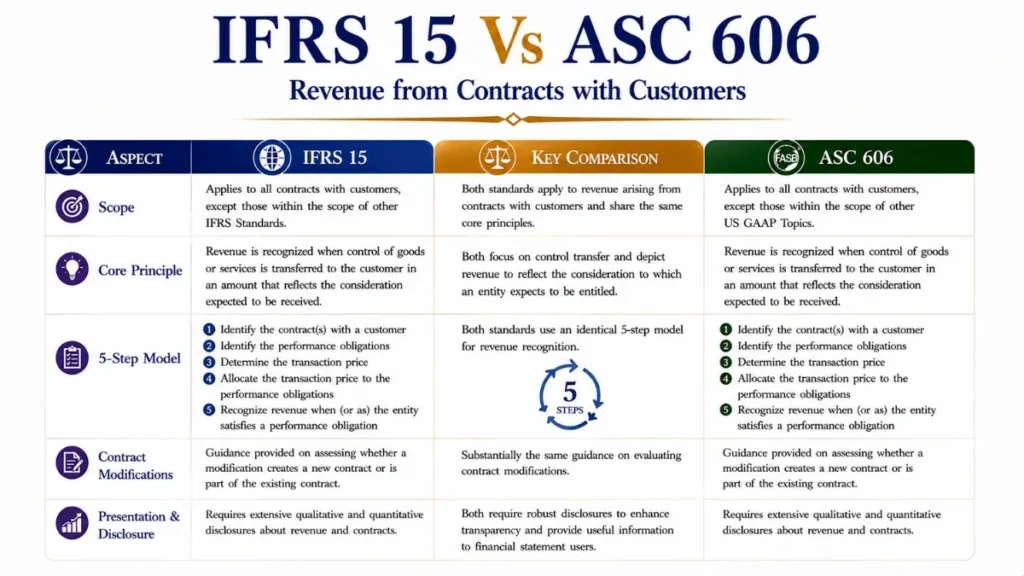
IFRS 15 Vs ASC 606 are the primary revenue recognition standards used globally. While both frameworks follow a similar five-step model for recognizing revenue, subtle differences in application, disclosure, and guidance can affect financial reporting.
Understanding the key distinctions of the concept IFRS 15 Vs ASC 606 helps businesses ensure accurate revenue recognition and ‘compliance‘ across International and U.S. accounting frameworks.
Last Updated – March, 2026
Accounting Standards | Revenue Recognition
IFRS 15 Vs ASC 606
A definitive guide to the two converged revenue recognition frameworks; what they share, where they diverge, and why it matters.
IFRS 15 Vs ASC 606 – Overview & Origins
Before 2018, revenue recognition included dozens of industry-specific rules under US GAAP and a single, principles-based standard under IFRS. Recognizing the need for consistency, the Financial Accounting Standards Board (FASB) and the International Accounting Standards Board (IASB) embarked on a joint project to create a unified framework.
The result was two highly converged but not identical standards: IFRS 15 issued by the IASB and ASC 606 issued by the FASB. Both replaced many legacy pronouncements and centered on a single, coherent five-step model for recognizing revenue.
IASB · International
IFRS 15
Revenue from Contracts with Customers applicable to entities reporting under International Financial Reporting Standards. Effective for annual periods beginning on or after 1 January 2018.
FASB · United States
ASC 606
Revenue from Contracts with Customers applicable to US GAAP reporters. Effective for public entities in annual periods beginning after 15 December 2017; one year later for private companies.
IFRS 15 and ASC 606 Five-Step Revenue Recognition Model
The cornerstone of both IFRS 15 and ASC 606 is an identical five-step framework. Entities must work through each step sequentially for every contract with a customer.
Identify the Contract with a Customer
A contract must be identified that creates enforceable rights and obligations. Both standards require the contract to have commercial substance, approved terms, and collectability to be probable.
Identify the Performance Obligations
Distinct goods or services promised in a contract are identified as separate performance obligations. The concept of “distinct” separately identifiable and capable of being distinct, is defined equivalently in both standards.
Determine the Transaction Price
The amount of consideration the entity expects to receive is estimated, including variable consideration, significant financing components, non-cash consideration, and amounts payable to the customer.
Allocate the Transaction Price
The transaction price is allocated to each performance obligation based on relative standalone selling prices. Both standards use the same hierarchy: observable prices first, then estimation methods.
Recognize Revenue When (or As) a Performance Obligation Is Satisfied
Revenue is recognized either over time or at a point in time, based on whether control transfers progressively or at a specific moment. The criteria for over-time recognition are the same under both standards.
Key Differences Between IFRS 15 and ASC 606
While the two standards are highly related, there are meaningful differences, mostly in specific application guidance and disclosure requirements. Understanding these is critical for multinational entities reporting under both frameworks.
IFRS 15 vs ASC 606 (Side-by-Side Comparison)
The table below summarizes the major areas of both similarities and differences across the two standards at a glance.
| Topic | IFRS 15 | ASC 606 |
|---|---|---|
| Issuing Body | IASB | FASB |
| Framework | Principles-based | Rules-based (more detailed) |
| Five-Step Model | ✓ Identical | ✓ Identical |
| Effective Date (Public) | 1 Jan 2018 | After 15 Dec 2017 |
| Effective Date (Private) | 1 Jan 2018 | After 15 Dec 2018 |
| Variable Consideration | Expected value / Most likely amount | Expected value / Most likely amount |
| Significant Financing Component | Required if material | Required if material |
| License of IP | Access vs Use model | Functional vs Symbolic IP |
| Sales with Right of Return | General principles only | Explicit detailed guidance |
| Warranties | Less prescriptive | More detailed guidance |
| Principal vs. Agent | Control-based (general) | Control-based + detailed examples |
| Contract Costs | Capitalized if incremental & recoverable | Capitalized if incremental & recoverable |
| Collaborative Arrangements | No specific guidance | ASU 2018-18 guidance |
| Disclosures | Principles-based | More prescriptive & detailed |
| Transition Methods | Full retrospective / Modified retrospective | Full retrospective / Modified retrospective |
Green cells indicate convergence; red cells indicate divergence between the two standards.
Practical Differences Between IFRS 15 and ASC 606
For most companies, the transition to either standard or both represented the most significant accounting change in a generation. The practical implications go far beyond the finance department.
Revenue Timing & Earnings Volatility
The shift from transaction-based to contract-based recognition can cause revenue to be recognized earlier or later than under previous standards. For example, entities that previously deferred all license revenue may now recognize a significant portion at the point of delivery, while bundled arrangements may require more allocation work.
Systems & Data Requirements
Both standards require granular contract-level data; standalone selling prices, performance obligation tracking, contract modification logs, and variable consideration estimates. Legacy billing systems rarely captured this information, driving significant IT investment at adoption.
Impact on Key Metrics
Revenue recognition timing changes can affect debt covenants (often tied to revenue or EBITDA), management compensation plans, and investor communications. Entities must proactively communicate these changes.
Areas Requiring Most Judgment
- Variable consideration: Estimating rebates, royalties, and other contingent payments under the constraint
- Significant financing components: Determining whether a payment timing arrangement contains a financing element
- Principal vs. agent: Especially in digital platforms, marketplaces, and logistics arrangements
- License classification: Determining whether IP is “functional” or “symbolic” / “right to access” or “right to use”
- Contract modifications: Deciding whether a change is a separate contract, prospective adjustment, or cumulative catch-up
Industry-Specific IFRS 15 vs ASC 606 Considerations
Software & Technology
Perhaps the most affected industry. Pre-606/15, US software companies followed highly prescriptive rules under SOP 97-2. The new standards introduced significant changes in how SaaS subscriptions, perpetual licenses, post-contract support, and professional services are bundled and recognized. The license IP guidance (functional vs symbolic / access vs use) remains one of the most consequential divergences for tech companies operating in both IFRS and US GAAP jurisdictions.
Construction & Real Estate
Long-term construction contracts have always raised complex revenue questions. Both standards generally continue over-time recognition for construction contracts where the customer controls the asset being built, but the specific criteria for determining over-time recognition are now more precisely articulated and uniformly applied.
Telecommunications
Bundled contracts (e.g., handset + service plan) required significant changes. Carriers must now allocate transaction prices based on relative standalone selling prices, often resulting in more revenue being allocated to the handset (recognized at delivery) and less to the service component (recognized over time).
Pharmaceuticals & Life Sciences
Milestone payments, royalty arrangements, and collaborative R&D agreements are prevalent. The variable consideration constraint and the sales-based/usage-based royalty exception (particularly under ASC 606) require careful analysis. The scope of IFRS 15 for collaborative arrangements also needs to be evaluated separately.
Retail & Consumer Goods
Rights of return, loyalty programs, and gift cards are common issues. Both standards treat unexpired loyalty points as a separate performance obligation, deferring a portion of revenue until redemption. Gift cards with breakage estimates require judgment about “unconstrained” revenue recognition.
Frequently Asked Questions
- Are IFRS 15 and ASC 606 the same standard?
- They are not identical, but they are the result of a joint convergence project and share the same five-step framework and core principles. The most significant differences arise in specific application guidance, particularly around licenses of IP, warranties, and the level of prescriptiveness in disclosures. For most common transactions, the accounting outcome will be the same under both standards.
- Which standard is more principles-based?
- IFRS 15 is generally regarded as more principles-based, consistent with the IASB’s broader approach to standard-setting. ASC 606, while significantly less prescriptive than earlier US GAAP revenue guidance, is still more rules-based and includes more detailed implementation guidance, industry-specific examples, and additional ASUs (Accounting Standards Updates) addressing specific fact patterns.
- Does the standard affect industries differently?
- Yes. Industries with complex arrangements; technology, telecom, construction, and pharmaceuticals experienced the most significant changes. Simpler businesses with straightforward point-in-time sales saw fewer impacts. The change was most dramatic for US tech companies that had previously followed SOP 97-2, an industry-specific standard that has now been entirely superseded by ASC 606.
- Can a company report under both IFRS 15 and ASC 606?
- Yes, and many multinationals do, for example, a US-listed company with a foreign parent reporting under IFRS. In most cases, the financial statements will be identical. However, entities in affected industries (particularly tech and pharma) may need to track and disclose differences where the standards diverge, especially around license classification.
- What happened to industry-specific revenue standards under US GAAP?
- ASC 606 superseded over 200 pieces of legacy guidance, including SOP 97-2 (software), SOP 81-1 (construction), and numerous EITF consensuses. The result was a dramatic simplification of the US GAAP revenue literature, replaced by a single, coherent standard supplemented by a small number of targeted ASUs.
Conclusion
IFRS 15 and ASC 606 represent a landmark achievement in international accounting harmonization. For the first time, entities around the world follow a single conceptual model for revenue recognition, one grounded in the principle that revenue should reflect the transfer of control of promised goods or services.
Their differences are real but narrow. IFRS 15 relies more on judgment and principle; ASC 606 provides more prescriptive guardrails. For entities operating across both frameworks, careful analysis of specific transactions, particularly licenses of IP, rights of return, and collaborative arrangements remains essential.
As standard-setters continue to monitor implementation and issue additional guidance, staying current with both the IASB’s and FASB’s educational materials and post-implementation reviews is strongly recommended for finance professionals worldwide.

(Qualified) Chartered Accountant – ICAP
Master of Commerce – HEC, Pakistan
Bachelor of Accounting (Honours) – AeU, Malaysia