ISA 701 – Communicating Key Audit Matters in the Independent Auditor’s Report deals with the auditor’s responsibility to communicate ‘key audit matters’ in the auditor’s report.
Last Updated – March, 2026
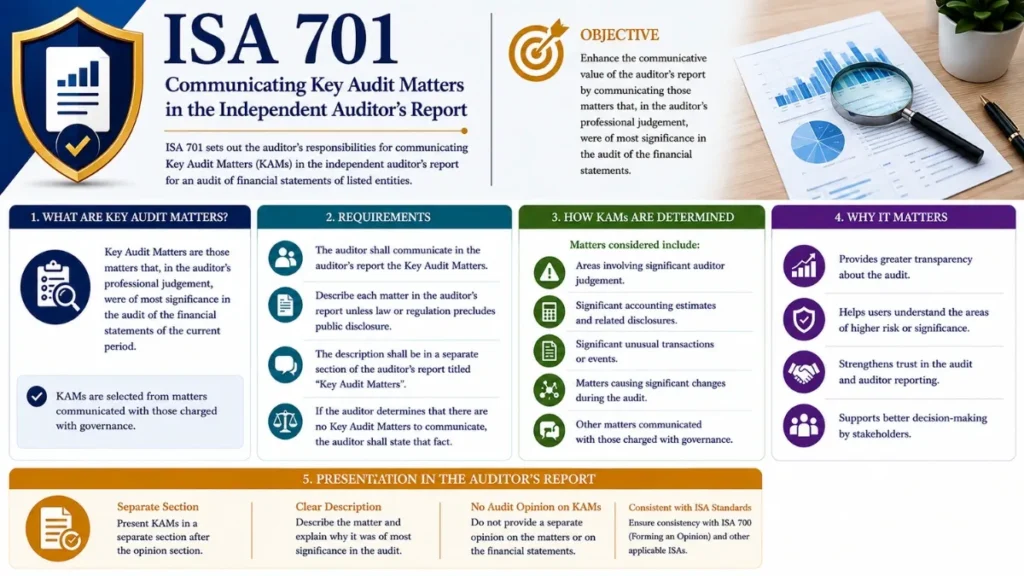
ISA 701 – Key Audit Matters Explained
ISA 701 establishes the auditor’s responsibility to communicate Key Audit Matters (KAM) in the independent auditor’s report; enhancing transparency, relevance, and the communicative value of audit reporting for listed entities and beyond.
What Is ISA 701?
International Standard on Auditing (ISA) 701, titled Communicating Key Audit Matters in the Independent Auditor’s Report, was issued by the International Auditing and Assurance Standards Board (IAASB) in January 2015. It is effective for audits of financial statements for periods ending on or after 15 December 2016.
ISA 701 represents one of the most transformative changes to the auditing profession in recent decades. Its overall objective is to enhance the communicative value of the auditor’s report by providing greater transparency about the audit performed; making audit reports more informative, entity-specific, and useful for investors, regulators, and other stakeholders.
Before ISA 701, auditor reports were widely criticised as generic “pass/fail” communications that offered little insight into the actual audit process. ISA 701 directly addresses this by requiring auditors to identify and describe the matters that required their most significant professional attention during the audit.
ISA 701 Scope and Applicability
ISA 701 applies in the following circumstances:
- Listed entities – Mandatory for audits of complete sets of general-purpose financial statements of listed entities (companies whose shares or debt are publicly traded).
- Legal or regulatory requirement – When law or regulation requires the auditor to communicate KAM for other types of entities.
- Auditor’s choice – When the auditor voluntarily decides to communicate Key Audit Matters, even for non-listed entities.
- Publicly accountable entities – In some jurisdictions (e.g., Uganda via ICPAU PS1/16), ISA 701 is mandatory for all publicly accountable entities.
- SMPs and voluntary adoption – Small and medium-sized practices may voluntarily adopt ISA 701, broadening its reach across entity sizes.
ISA 701 does not apply when the auditor has concluded there is a material uncertainty related to going concern, in those cases, ISA 570 (Revised) governs reporting. Nor does it apply when the auditor disclaims an opinion.
What Are Key Audit Matters (KAMs)?
Key Audit Matters are those matters that, in the auditor’s professional judgment, were of most significance in the audit of the financial statements of the current period. Key Audit Matters are selected from matters communicated with those charged with governance.
KAMs are not just important audit findings, they are the most significant matters, chosen from a pool of matters already discussed with those charged with governance (the audit committee, board of directors, etc.) under ISA 260 (Revised).
The Distinction That Matters
It is critical to understand that identifying a matter as a KAM does not change the auditor’s opinion. A KAM description in the auditor’s report is neither a separate opinion on that specific matter nor a qualification. It is a communication of where the auditor focused significant professional attention, providing context that helps users better understand the financial statements.
How Are Key Audit Matters Selected?
ISA 701 establishes a structured, judgment-based decision-making framework. The selection is a two-stage process grounded in professional judgment:
Identify Areas of Significant Auditor Attention
From all matters communicated with those charged with governance, identify those requiring significant auditor attention: significant risks (ISA 315), significant events or transactions, and areas involving significant management judgment including high-uncertainty accounting estimates.
Determine Matters of “Most Significance”
From the areas identified in Step 1, determine which matters were of most significance in the current period’s audit. This considers: depth of interaction with governance on the matter, materiality (quantitative and qualitative), complexity and subjectivity of management’s accounting policies, and the nature of uncorrected misstatements.
Apply the KAM Criteria
Matters that are already separately addressed (going concern, basis for qualified/adverse opinion) are excluded from the KAM section unless they are also of most significance for a separate reason, a judgment call governed by ISA 706 (Revised).
Develop Preliminary View at Planning Stage
Auditors may form a preliminary view of likely KAMs at the planning stage and discuss this with those charged with governance in accordance with ISA 260. Final KAM determination is based on results of the completed audit, not the preliminary view.
Key Factors in the Determination
Significant Risks
Areas of significant risk identified under ISA 315 (Revised), the risk assessment standard are primary candidates for KAM consideration.
Management Judgment
Significant management judgments, especially accounting estimates with high estimation uncertainty, are frequently identified as KAMs.
Significant Events & Transactions
The effect on the audit of significant events or unusual transactions during the period; acquisitions, restructurings, or one-off events.
Governance Interaction
The depth, frequency, and complexity of interactions with those charged with governance about a matter often signals its significance.
There is no prescribed minimum or maximum number of KAMs. The number depends on the nature, size, and complexity of the entity, and the circumstances of the audit. However, auditors should avoid a “box-ticking” or boilerplate approach that reduces KAMs to formulaic language.
How Are KAMs Communicated in the Auditor’s Report?
Once identified, each Key Audit Matter must be described clearly in a dedicated section of the auditor’s report, titled “Key Audit Matters.” ISA 701 prescribes the content and structure of each description.
| Disclosure Element | Description | ISA 701 Reference |
|---|---|---|
| Why the Matter is a KAM | A succinct explanation of why the matter was considered one of most significance, connecting it to risks, complexity, or significance to users. | Para. 13(a) |
| How the Matter Was Addressed | A description of how the auditor responded to or addressed the matter in the audit, including the procedures performed and key observations. | Para. 13(b) |
| Introductory Language | A clear statement that KAMs are not a separate opinion and do not modify the auditor’s overall opinion on the financial statements. | Para. 11 |
| Cross-reference to Financial Statements | Where relevant, a cross-reference to related disclosures in the financial statements to assist users in further understanding the matter. | Para. 13(c) |
| No Other KAMs Statement | If there are no KAMs beyond those arising from a qualified/adverse opinion or going concern, the section may state this explicitly. | Para. A58 |
“Revenue recognition – The Group’s revenue recognition policies are complex, involving multiple performance obligations and variable consideration. We identified this as a Key Audit Matter due to the significant management judgment involved in determining the timing and amount of revenue to be recognised. Our audit procedures included evaluating the appropriateness of the revenue recognition policy against IFRS 15, testing a sample of customer contracts, and assessing the completeness of disclosures in Note 3.”
Placement and Format
The Key Audit Matters section appears in the auditor’s report immediately after the Basis for Opinion section and before the Going Concern section, if applicable. Each KAM may include a descriptive heading. The language must be entity-specific and avoid generic descriptions that offer no real insight to users, a concern repeatedly raised by regulators.
Key Audit Matters Examples
While KAMs must be entity-specific, certain areas recur frequently across industries because they inherently involve high judgment, complexity, and materiality. Research and regulatory reviews have consistently found the following matter types appearing most often as KAMs:
Impairment of Assets
Goodwill impairment, loan impairment (common in banks), and impairment of financial assets under ECL models are among the most frequently disclosed KAMs globally.
Revenue Recognition
Especially for entities with complex contracts, multiple deliverables, or variable consideration compounded since IFRS 15 / ASC 606 adoption.
Provisions & Contingent Liabilities
Insurance technical provisions, litigation provisions, and tax contingencies requiring substantial management judgment and estimation.
Pension & Post-Employment Benefits
The valuation of defined benefit obligations involves actuarial assumptions that can materially affect the financial statements.
Business Combinations & Fair Value
Acquisition accounting, including purchase price allocation and fair value measurement of assets and liabilities acquired.
IT Systems & Cybersecurity
Increasing frequency of KAMs related to IT general controls, system implementations, and digital transformation risks.
Frequently Asked Questions
Does a KAM modify the auditor’s opinion?
No. Identifying and describing a Key Audit Matter does not modify the auditor’s overall opinion on the financial statements. The introductory language in the KAM section must explicitly state this. A KAM is a communication of significant areas of audit focus, not a separate or qualified opinion on those areas.
How many Key Audit Matters should be disclosed?
ISA 701 does not prescribe a minimum or maximum number of KAMs. The number depends on the nature, size, and complexity of the entity. Auditors must use professional judgment, but should avoid boilerplate language or treating KAMs as a compliance exercise rather than a genuine communication tool.
Can an auditor decide not to include a matter as a KAM?
Yes. Even if a matter required significant attention, the auditor may conclude it is not of “most significance” and therefore not a KAM using professional judgment. Additionally, there is a rare exception where, if disclosing a KAM would be “severely prejudicial” to the entity, the auditor may omit it, but this exception is extremely narrow and must be carefully justified.
Does ISA 701 apply to small companies?
ISA 701 is mandatory only for listed entities and where required by law or regulation. However, auditors of non-listed and smaller entities may voluntarily apply ISA 701. Some jurisdictions have expanded mandatory application to all publicly accountable entities, including certain non-listed public interest entities.
What is the difference between a KAM and an Emphasis of Matter paragraph?
These serve different purposes. An Emphasis of Matter (ISA 706) draws attention to a matter already presented in the financial statements that is fundamental to users’ understanding, it is responsive to a specific disclosure. KAMs under ISA 701 are broader: they describe the most significant areas of audit focus, including the audit procedures performed and how the matter was addressed, going beyond just pointing to disclosures.
What happens if there are no KAMs to report?
This is theoretically possible but extremely rare for listed entities. If the auditor determines there are no KAMs beyond those arising from a modified opinion or going concern, the KAM section must clearly state that there are no other KAMs to communicate, transparency is required either way.

(Qualified) Chartered Accountant – ICAP
Master of Commerce – HEC, Pakistan
Bachelor of Accounting (Honours) – AeU, Malaysia