Levels of planning refer to the different layers of organizational planning used to achieve short-term and long-term business goals effectively. These levels typically include strategic, tactical, and operational planning, each serving a unique role in decision-making and execution.
Last Updated – May, 2026
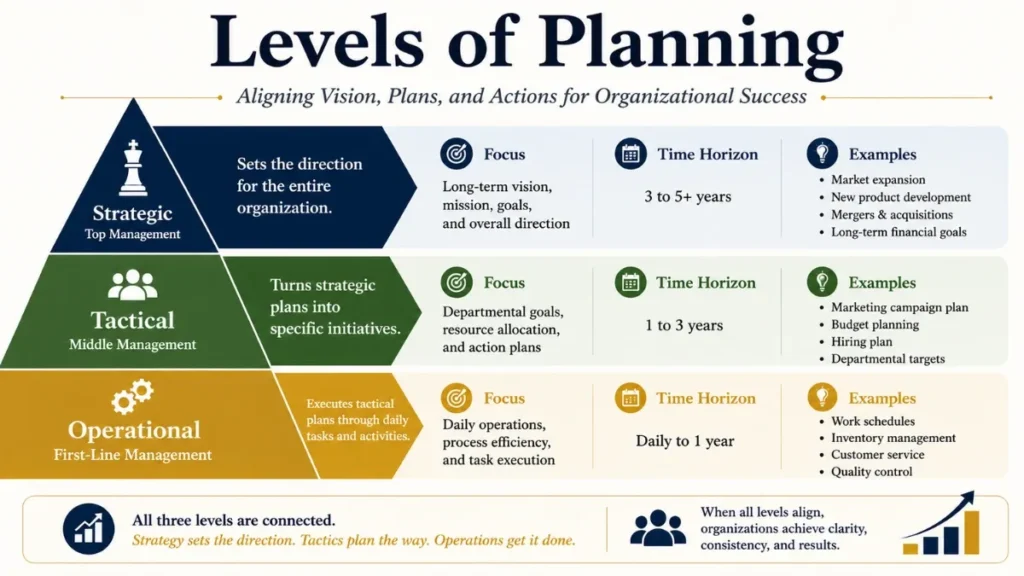
Levels of Planning in Management
A comprehensive guide to Anthony’s hierarchical framework, from boardroom strategy to shop-floor execution
Introduction to Planning in Management
Planning is the foundational function of management; the intellectual process of determining in advance what is to be done, how it is to be done, when it is to be done, and who is to do it. Every organization, regardless of size or sector, depends on systematic planning to navigate uncertainty, deploy resources wisely, and move toward purposeful goals.
However, not all planning is the same. The plans drawn up by a Chief Executive Officer (CEO) charting ten-year growth differ profoundly in nature, scope, and time horizon from the plans made by a factory supervisor scheduling next week’s production shifts. This reality gave rise to one of the most enduring conceptual frameworks in management thought, the hierarchical levels of planning.
“Organizations are purposive social systems. To align purpose with action across every tier of the hierarchy, planning must itself be hierarchical.”
— Adapted from R.N. Anthony’s Planning and Control Systems (1965)R.N. Anthony’s Three Levels of Planning
Robert N. Anthony, a professor at Harvard Business School, introduced the seminal three-tier hierarchy of planning and control in his landmark 1965 work, Planning and Control Systems: A Framework for Analysis. Anthony’s genius was to recognize that the managerial activities of an organization could be meaningfully categorized based on their time horizon, scope, degree of certainty, and level of authority involved.
According to Anthony, organizational planning can be classified into three distinct hierarchical levels:
- Strategic Planning – Determining organizational objectives and the policies that govern the acquisition and use of resources to achieve those objectives.
- Management Control (Tactical Planning) – The process by which managers assure that resources are obtained and used effectively and efficiently in the accomplishment of the organization’s objectives.
- Operational Control (Operational Planning) – The process of assuring that specific tasks are carried out effectively and efficiently in accordance with established plans and procedures.
Each level is distinct yet interdependent. Strategic plans cascade downward to inform tactical decisions; tactical plans, in turn, give shape and direction to operational activities. The framework is not a rigid silo structure but a flowing hierarchy where alignment across levels is the ultimate measure of planning effectiveness.
The Three Levels of Planning – In Depth
Each level has its own characteristics, actors, time frames, and outputs. Let us examine them in detail.
Strategic Planning
Strategic planning is the highest level of organizational planning. It is the process of deciding on the goals and objectives of the entire organization, determining the fundamental policies that shall govern the acquisition and use of resources, and establishing the broad framework within which the organization will operate over the long term.
Key Characteristics
Strategic planning is broad and directional rather than detailed and prescriptive. It deals with fundamental questions: What business are we in? Where do we want to be in a decade? What competitive advantages should we pursue? The decisions made at this level are typically irreversible or very difficult to reverse, making them high-stakes and judgment-intensive.
Strategic planning involves extensive environmental scanning; analyzing external factors (market trends, competitive landscape, regulatory environment, technological shifts) as well as internal capabilities (strengths and weaknesses). Tools such as SWOT analysis, PESTLE analysis, and Porter’s Five Forces are commonly employed at this stage.
Real-World Examples
Tactical Planning
Tactical planning, referred to by Anthony as management control, is the intermediate layer of the planning hierarchy. It bridges the abstract ambitions of strategic plans with the concrete routines of operational activity. Middle managers translate organizational strategy into specific departmental or functional programs, allocating resources, setting budgets, and establishing performance benchmarks.
Key Characteristics
Tactical planning is more specific and measurable than strategic planning, but less detailed than operational planning. It focuses on how strategic goals will be pursued within a defined time frame and with available resources. The plans produced here; departmental budgets, marketing campaigns, hiring plans, capital expenditure schedules are concrete enough to be assigned, monitored, and evaluated.
A critical function of tactical planning is resource allocation. Middle managers must decide how to distribute limited financial, human, and material resources across competing priorities in ways that best advance the organization’s strategic goals. This requires both analytical rigor and political negotiation within the organization.
Real-World Examples
Operational Planning
Operational planning, or operational control in Anthony’s terminology, is the ground-level tier of the planning hierarchy. It involves the detailed scheduling, coordination, and direction of day-to-day activities that collectively constitute the actual work of the organization. First-line supervisors and department heads are the primary actors at this level.
Key Characteristics
Operational plans are highly specific, task-oriented, and time-bound. They answer precise questions: Who does what, with which resources, by when? Because these plans govern routine activities with known parameters, they rely heavily on standard operating procedures (SOPs), established rules, and quantitative performance standards.
Unlike strategic plans that embrace uncertainty, operational plans operate in relatively predictable, structured environments. Deviations from plan can be detected quickly and corrected in near real-time. This makes operational planning and control closely linked, execution and monitoring happen simultaneously.
Real-World Examples
Difference Between Strategic, Tactical and Operational Planning
The following table provides a side-by-side comparison of all three levels across key dimensions, enabling a clear and comprehensive understanding of their distinctions.
| Dimension | Strategic Planning | Tactical Planning | Operational Planning |
|---|---|---|---|
| Time Horizon | Long-term (3-10+ yrs) | Medium-term (1-3 yrs) | Short-term (daily-1 yr) |
| Conducted By | Top management, Board | Middle management | First-line supervisors |
| Scope | Entire organization | Department / function | Unit / task level |
| Nature of Decisions | Unstructured, novel | Semi-structured | Structured, routine |
| Degree of Certainty | Low / high ambiguity | Moderate | High / predictable |
| Detail Level | Broad & directional | Moderately specific | Highly specific |
| Flexibility | Relatively flexible | Moderate flexibility | Limited flexibility |
| Primary Focus | Where to go & why | How to get there | What to do now |
| Key Tools Used | SWOT, PESTLE, scenarios | Budgets, KPIs, programs | SOPs, schedules, rules |
| Information Source | Mostly external | Mixed (internal & external) | Mostly internal |
| Reversibility | Difficult to reverse | Moderately reversible | Easily adjusted |
| Risk Level | High | Moderate | Low |
Relationship Between Different Levels of Planning
While the three levels are analytically distinct, they are operationally interdependent. Anthony’s framework is not a description of three isolated silos but a model of a cascading hierarchy where each level derives its purpose from the one above it and gives concrete form to it through the one below.
Top-Down Flow: Strategy Shapes Tactics and Operations
The strategic plan sets the overarching destination. Tactical plans then chart the route, breaking the long-term goal into medium-term programs and budgets. Operational plans, in turn, direct the day-to-day activities that execute those programs. A misalignment at any of these transitions where tactical plans do not faithfully serve strategic goals, or where operational activities deviate from tactical plans constitutes a planning failure with potentially serious consequences.
Bottom-Up Flow: Operations Inform Strategy
The flow is not exclusively downward. Operational data; actual performance metrics, resource utilization rates, quality reports flow upward to inform tactical adjustments. Accumulated tactical experience, in turn, shapes the realism and refinement of future strategic choices. Anthony recognized this feedback loop as essential to adaptive management.
The Role of Management Control as the Integrating Bridge
Anthony’s particular contribution was to highlight the management control (tactical) level as the critical integrating mechanism. Top management alone cannot translate strategy into daily operations, that requires a layer of informed, empowered middle managers who understand both the strategic intent and the operational realities. This insight has had lasting influence on how organizations design their managerial hierarchies, reporting systems, and performance management frameworks.
Importance of Planning Levels in Organizations
The practical implications of Anthony’s framework extend across organizational design, information systems, performance measurement, and managerial development.
Role Clarity
Defines what each tier of management is responsible for planning, avoiding overlap and confusion.
Vertical Alignment
Ensures day-to-day activities are purposefully connected to the organization’s long-term vision.
Better Information Systems
Guides the design of MIS/ERP systems tailored to the distinct information needs of each level.
Sharper Decision-Making
Enables managers to apply the appropriate decision-making tools for their planning level.
Performance Measurement
Allows organizations to set level-appropriate KPIs and hold each tier accountable.
Risk Management
Acknowledges that risk profiles differ by level, enabling more calibrated risk strategies.
Adaptive Feedback
Supports upward flow of operational data to continuously refine tactical and strategic plans.
Organizational Design
Informs how managerial layers should be structured and empowered for effective governance.
Frequently Asked Questions
Below are answers to commonly asked questions about levels of planning in management.
What are the three levels of planning according to R.N. Anthony?
According to R.N. Anthony, the three levels of planning are: (1) Strategic Planning long-term planning conducted by top management to set organizational goals and direction; (2) Tactical (Management Control) Planning medium-term planning by middle management to allocate resources and implement strategy; and (3) Operational Planning short-term, day-to-day planning by lower management to execute specific tasks and achieve immediate objectives.
Who introduced the concept of levels of planning in management?
Robert N. Anthony of Harvard Business School introduced this hierarchical framework in his landmark 1965 publication, Planning and Control Systems: A Framework for Analysis. His model categorized organizational managerial activity into strategic planning, management control, and operational control, a classification that has remained foundational in management theory for over half a century.
What is the difference between strategic planning and tactical planning?
Strategic planning is long-term (3-10 years), broad in scope, highly uncertain, and conducted by top management to determine the organization’s overarching direction, mission, and objectives. It answers the question: Where are we going and why?
Tactical planning, by contrast, is medium-term (1-3 years), departmental in focus, moderately structured, and carried out by middle management to determine how strategic goals will be pursued. It answers: How do we get there, and with what resources?
What is operational planning and how does it differ from the other levels?
Operational planning is the most granular and short-term level (daily to one year). It is carried out by first-line supervisors and unit managers to schedule specific tasks, assign responsibilities, and direct routine activities using standard procedures. Unlike strategic and tactical planning, operational planning operates in a highly structured, predictable environment where deviations can be corrected quickly. It answers: What exactly needs to be done today, and by whom?
Why is the hierarchy of planning important in an organization?
The hierarchy of planning is important because it ensures vertical alignment, that every activity at every level serves the organization’s overarching mission. Without a clear hierarchy, organizations risk having brilliant strategies that are never executed, or busy operations that are disconnected from any strategic purpose. The framework also clarifies managerial roles, guides information system design, enables level-appropriate performance metrics, and supports both top-down resource deployment and bottom-up feedback.
How does management control (tactical planning) act as a bridge between strategy and operations?
Management control, what Anthony called the “middle tier” performs the critical translation function in organizational planning. Top management sets strategic direction, but strategic goals are typically expressed in abstract terms (market leadership, profitability targets, innovation objectives). Middle managers must convert these broad imperatives into concrete budgets, programs, performance targets, and resource allocations that operational managers can actually implement. Without this bridging role, strategic intent would remain aspirational rather than actionable.
Is R.N. Anthony’s planning framework still relevant today?
Yes, Anthony’s framework remains highly relevant, even in the modern era of agile organizations and digital transformation. While the tools, technologies, and time horizons of planning have evolved considerably, (the fundamental logic) that organizations require different types of planning at different levels of their hierarchy, serving different purposes with different information is as valid today as it was in 1965. Contemporary frameworks like the Balanced Scorecard, OKRs, and Hoshin Kanri are all, in essence, practical operationalizations of Anthony’s hierarchical planning concept.

(Qualified) Chartered Accountant – ICAP
Master of Commerce – HEC, Pakistan
Bachelor of Accounting (Honours) – AeU, Malaysia