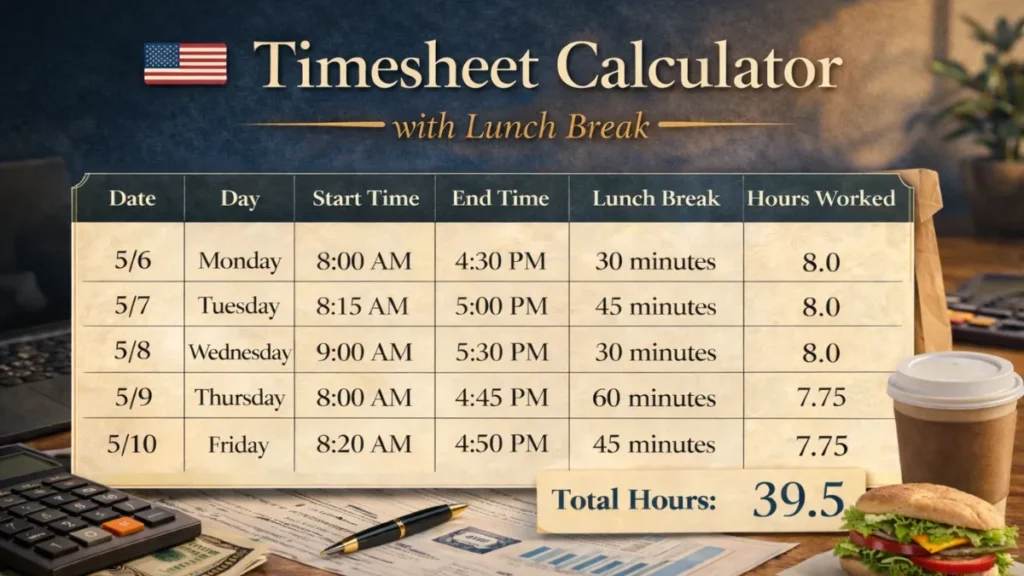
A timesheet calculator with lunch break helps USA employees and employers accurately track daily work hours while automatically deducting unpaid break time. By entering clock-in, clock-out, and lunch duration, you can ‘quickly calculate total payable hours’.
This tool is essential for payroll accuracy, overtime tracking, and compliance with labor policies. Learn how a timesheet calculator with lunch break simplifies time tracking and ensures precise wage calculations.
Last Updated – April, 2026
Timesheet Calculator
with Lunch Break
Calculate your exact work hours after deducting unpaid lunch breaks; daily totals, weekly hours, overtime, and gross pay, all in one place.
Weekly Timesheet Calculator with Lunch Break
Enter clock-in / clock-out times and lunch break for each day
| Day | Start Time | End Time | Lunch (min) | Net Hours | Skip Day |
|---|
| Day | Start | End | Break | Net Hours | Daily Pay |
|---|
How to Use This Timesheet Calculator with Lunch Break
Tracking your actual work hours, net of unpaid break time, is essential for accurate payroll, overtime compliance, and fair compensation. Follow these five simple steps:
Enter Clock-In Time
Select the time you started work for each day of the week using the time picker field.
Enter Clock-Out Time
Select the time you stopped working that day, the total elapsed time is computed automatically.
Set Lunch Break Duration
Enter your unpaid lunch or meal break in minutes. Use the Default dropdown to apply one value to all days at once.
Add Your Hourly Rate
Optional, enter your hourly wage to have the calculator estimate your daily and weekly gross pay automatically.
Click Calculate
Hit the Calculate button to see your net work hours, overtime, and estimated earnings in a clear summary.
The Timesheet Formula: How Net Hours Are Calculated
The calculation is straightforward and follows a standard formula used by payroll professionals across the United States:
Worked Example
Suppose you work Monday through Friday, clocking in at 8:30 AM and out at 5:00 PM each day, with a 30-minute unpaid lunch break:
- Gross time per day: 5:00 PM − 8:30 AM = 8.5 hours
- Lunch deduction: 30 minutes = 0.5 hours
- Net hours per day: 8.5 − 0.5 = 8.0 hours
- Weekly total (5 days): 8.0 × 5 = 40.0 hours
- Overtime hours: 0 (exactly at threshold)
- At $20/hr: $800 gross pay
If you worked an extra half day Saturday, 8:00 AM to 12:00 PM with no lunch, your weekly total becomes 44.0 hours. The 4 overtime hours would be paid at a minimum of $30/hr (1.5×), adding $120 on top of your regular $800.
Overtime Calculator with Lunch Break (FLSA Rules)
The Fair Labor Standards Act (FLSA) is the federal law governing wages, overtime, and break requirements in the United States. Here is what every American employee and employer should know about lunch break deductions:
Key FLSA Provisions on Meal Periods
Unpaid meal breaks According to FLSA meal and break rules, such breaks are permissible under federal law if and only if the employee is completely relieved of all duties for the full break duration. If the employee must remain available, monitor equipment, or perform any duties during lunch, that time is compensable and must be paid.
Short rest breaks of 20 minutes or fewer are considered work time under the FLSA and must always be paid, regardless of what the employer calls them.
Overtime Calculation and the 40-Hour Rule
The FLSA requires overtime pay for all hours worked beyond 40 in a single workweek at a rate of at least 1.5 times the regular rate of pay. Overtime is calculated on actual hours worked, unpaid lunch breaks are excluded from this count.
California mandates daily overtime (time-and-a-half) for hours worked beyond 8 in a single day, and double time beyond 12 hours. Always verify your state’s specific regulations.
State-by-State Meal Break Requirements (USA)
While federal law does not mandate meal breaks, many U.S. states have their own requirements. The table below summarizes rules in key states:
| State | Meal Break Required? | Minimum Duration | Trigger (hours worked) | Notes |
|---|---|---|---|---|
| California | Required | 30 minutes | After 5 hours | Second break after 10 hrs; waivable by mutual consent for shifts ≤6 hrs |
| New York | Required | 30 minutes | After 6 hours | Factory workers get 60-min break; additional rules for certain industries |
| Illinois | Required | 20 minutes | After 7.5 hours | Must occur at least 5 hours into the shift |
| Florida | Not Required* | — | — | Required for minors (under 18): 30 min after 4 hrs |
| Texas | Not Required | — | — | Follows federal FLSA standards only |
| Washington | Required | 30 minutes | After 5 hours | Additional 30-min break for every 4 hours worked beyond the first |
| Pennsylvania | Not Required* | — | — | Minors must receive 30-min break for shifts over 5 hours |
| Massachusetts | Required | 30 minutes | After 6 hours | May be waived if employee agrees and is not required to remain on duty |
* = No state-mandated break for adult employees; FLSA applies. Always verify with your state’s Department of Labor as regulations change.
Frequently Asked Questions
Everything you need to know about calculating work hours with lunch break deductions in the USA.
Why Accurate Time Tracking with Lunch Breaks Matters
Many employees and employers underestimate the financial and legal significance of correctly accounting for lunch breaks on timesheets.
For Employees
Incorrect timesheet entries, especially failing to deduct lunch breaks correctly can result in under- or over-reporting of hours. The U.S. Department of Labor recovered over $274 million in back wages for workers in a recent fiscal year, with wage theft from improper time recording being a major contributor.
For Employers
Failure to accurately account for compensable time can expose businesses to FLSA violations, back wage liability, and civil penalties. Employers are legally required to maintain accurate records of hours worked and wages paid for all non-exempt employees. Using a structured timesheet system with built-in lunch deduction logic is a fundamental step toward compliance.
The Paycheck Impact
An employee incorrectly recorded for 15 extra minutes per day accumulates roughly 65 extra hours per year. At $20/hr, that is a $1,300 annual discrepancy. For employers managing large workforces, the aggregate impact of systematic errors can be substantial in either direction.
Timesheet Calculator with Lunch Break – Free Online Tool for U.S. Employees & Employers
This calculator is for informational and estimation purposes only and does not constitute legal or financial advice.
Content authored and reviewed by Jhanzayb (ACA), Qualified Chartered Accountant.
Always consult your employer’s HR department or a qualified labor attorney for specific compliance questions.
Verify state-specific break requirements with the U.S. Department of Labor (WHD).
All calculations follow federal FLSA standards

(Qualified) Chartered Accountant – ICAP
Master of Commerce – HEC, Pakistan
Bachelor of Accounting (Honours) – AeU, Malaysia