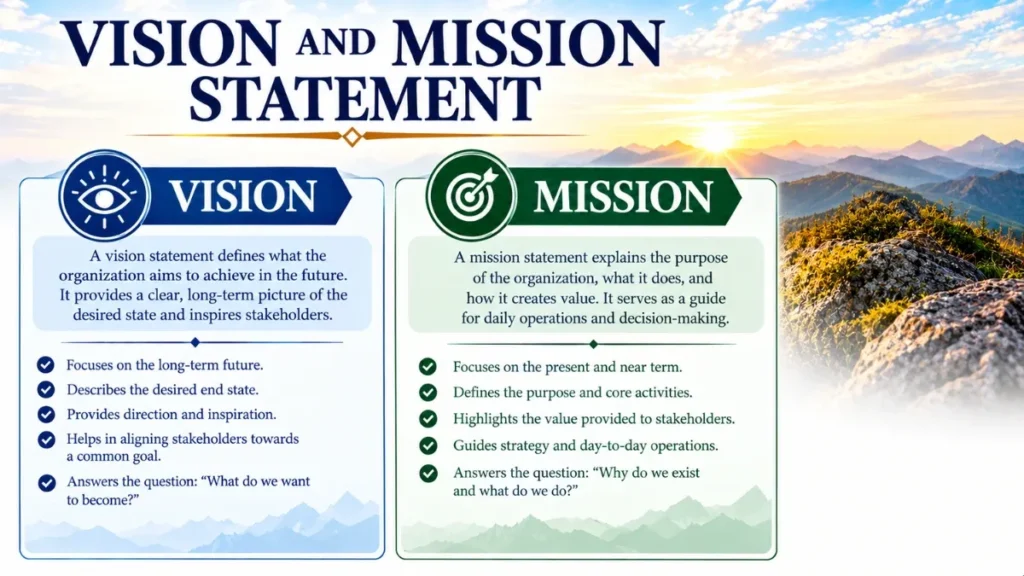
Vision and mission statement a concept that states ‘Vision’ represents a desired optimal future state of what the organization wants to achieve over time, and ‘Mission’ is the purpose of an organization and the reason for its existence.
Last Updated – March, 2026
Vision & Mission Statements
The complete guide to crafting purposeful declarations that inspire organizations, align teams, and earn lasting trust.
In this guide
What Are Vision and Mission Statements?
Every lasting organization from a neighborhood bakery to a Fortune 500 company is anchored by two foundational declarations: its vision statement and its mission statement. Together they answer the most fundamental questions of organizational existence: Where are we going? and Why do we exist?
What Is a Vision Statement?
A vision statement is a forward-looking declaration that describes the future state an organization aspires to create, the world as it could and should be. It is ambitious, inspiring, and long-term in nature.
What Is a Mission Statement?
A mission statement defines why an organization exists today; what it does, who it serves, and how. It operates in the present tense, guiding daily decisions and establishing the scope of current activity.
The Destination
A vivid, aspirational declaration of the future state an organization seeks to create, inspiring action toward a long-term goal.
The Path
A concise statement of why an organization exists today; what it does, who it serves, and how it guides daily decisions.
Strategy without purpose is a plan without a soul. The vision and mission give every decision a moral gravity.
— Organizational strategy principle
Vision vs Mission Statement – Key Differences
Though often used interchangeably, vision and mission statements serve distinct strategic purposes. Understanding their differences ensures each fulfills its proper role.
| Dimension | Vision Statement | Mission Statement |
|---|---|---|
| Time orientation | Future-focused (long-term) | Present-focused (now) |
| Core question | Where do we want to be? | Why do we exist today? |
| Tone | Aspirational, inspirational | Purposeful, practical |
| Audience | Primarily internal; inspires teams | Internal & external; informs stakeholders |
| Frequency of change | Rarely changes | Evolves with strategy |
| Typical length | One to two sentences | One to three sentences |
| Success metric | Does it inspire pursuit? | Does it guide decisions? |
Why Vision and Mission Statements Matter
Far from mere corporate formalities, well-crafted vision and mission statements deliver measurable organizational value across every level of an enterprise.
Strategic Alignment
When every department, team, and individual understands the organizational purpose, decisions become faster and more consistent. Leaders at every level can evaluate opportunities and trade-offs through a shared lens, reducing friction and miscommunication.
Employee Engagement
People are not motivated by revenue targets alone. According to research published in the Harvard Business Review, employees who feel connected to a meaningful organizational purpose are significantly more engaged, productive, and loyal. A compelling vision turns a job into a calling.
Customer Trust
Customers increasingly choose organizations whose values align with their own. A clear mission statement signals integrity and direction, it tells customers not just what you sell, but why you exist and who you are.
Stakeholder Confidence
Investors, partners, and board members use vision and mission statements to assess organizational maturity. A crisp, credible statement communicates that leadership has thought deeply about purpose and long-term direction.
Decision-Making Compass
Perhaps most practically, mission and vision statements serve as decision filters. When facing a strategic crossroads; whether to launch a new product, enter a new market, or restructure a team. Leaders can ask: “Does this serve our mission? Does it advance our vision?” The answer guides the choice.
How to Write a Vision Statement
A great vision statement is ambitious yet believable, short yet resonant. It should make people feel something, a pull toward a better future that the organization is uniquely positioned to create.
Vision Statement Formula
We envision a world where [desired future state] achieved through [your organization’s distinctive contribution].
-
1
Think decades, not quarters
A vision should describe a destination 10–30 years away. If it feels achievable this year, it is not a vision, it is a goal.
-
2
Describe impact, not activity
Focus on the change you create in the world, not the services you provide. “A world without hunger” beats “feeding communities one meal at a time.”
-
3
Keep it short and memorable
If it cannot be remembered without reading it, it will not be lived. Aim for one powerful sentence that fits on a single line.
-
4
Make it bold enough to inspire
Visions should stretch belief. If everyone immediately agrees it is achievable, raise the ambition. Visionary organizations make audacious commitments.
-
5
Ground it in authenticity
A vision only inspires if it is believed. It must reflect genuine organizational values, not marketing language disconnected from reality.
How to Write a Mission Statement
A mission statement must answer three questions simultaneously and do so with precision: What do you do? Who do you do it for? Why does it matter?
Mission Statement Formula
We [what you do] for [who you serve] so that [the meaningful outcome you deliver].
-
1
Define your core activity precisely
Use active, specific verbs. “We connect,” “We build,” “We protect,” “We educate”, clarity here prevents mission drift.
-
2
Name your audience explicitly
Who you serve shapes everything. Naming your audience, even broadly signals focus and accountability.
-
3
State the meaningful outcome
Go beyond features or services. Describe the transformation your work creates. This is the “why it matters” that turns a description into a purpose.
-
4
Avoid jargon and buzzwords
Words like “world-class,” “synergy,” and “leverage” dilute credibility. Write in plain, powerful language that a teenager could understand.
-
5
Test it against real decisions
Ask: if we used this mission to evaluate the last three major decisions we made, would it have guided us correctly? If not, revise.
Vision and Mission Statement Real-World Examples
Examining how leading organizations craft their statements reveals common patterns; clarity, brevity, and an orientation toward human impact.
Google — Mission
Mission“To organize the world’s information and make it universally accessible and useful.”
Source: about.googleAmazon — Mission
Mission“To be Earth’s most customer-centric company, where people can find and discover anything they might want to buy.”
Source: ir.aboutamazon.comHabitat for Humanity — Vision
Vision“A world where everyone has a decent place to live.”
Source: habitat.orgLinkedIn — Mission
Mission“To connect the world’s professionals to make them more productive and successful.”
Source: about.linkedin.comStarbucks — Mission
Mission“To inspire and nurture the human spirit — one person, one cup, and one neighborhood at a time.”
Source: starbucks.comTesla — Vision
Vision“To accelerate the world’s transition to sustainable energy.”
Source: tesla.comThe strongest examples share a key quality: they are specific enough to be meaningful yet broad enough to inspire. They make a claim about the world, not just the company.
Vision and Mission Statement Best Practices
Crafting the statements is only half the work. How you develop, communicate, and maintain them determines whether they drive real organizational change.
Co-Create, Don’t Dictate
Statements written collaboratively earn deeper buy-in. Involve diverse voices from across the organization in the drafting process.
Review and Update Regularly
Markets and strategies evolve. Review your mission every 3–5 years to ensure it still reflects your current reality and direction.
Communicate Them Internally
Post it. Reference it in meetings. Use it in hiring. A statement kept in a drawer is a statement without power.
Align Them With Core Values
Your core values should flow naturally from your mission and vision, they are the behavioral commitments that make both possible.
Frequently Asked Questions
Absolutely. Small businesses benefit enormously from clarity of purpose. A clear mission helps owners make better hiring decisions, prioritize customers, and communicate consistently. The size of the organization does not determine the value of purpose.
Most effective statements are between one and three sentences. Brevity is a feature, not a limitation. If it requires more than three sentences, the thinking is not yet clear enough, keep refining until the essence can be expressed simply.
Vision statements are meant to be enduring, but they are not immutable. If an organization achieves its original vision, or if the world changes dramatically, it should be revisited. However, frequent changes undermine the credibility and inspiring power of the statement.
Conceptually, the vision comes first. You define where you are going before you define how you get there. In practice, many organizations find it easier to articulate their current mission first, then work backward to define the aspirational future state their mission is building toward.
A mission statement expresses organizational purpose, it is internal and values-driven. A value proposition is a marketing statement explaining why a customer should choose you over alternatives, it is external and benefit-driven. The two should be aligned, but they serve different audiences and functions.
The most effective organizations embed their vision and mission into onboarding, performance reviews, leadership communications, and physical spaces. The statements should be referenced during strategy reviews and used explicitly to evaluate major decisions. Communication alone does not create culture, consistent behavior does.
Jhanzayb is a Qualified Chartered Accountant (ACA) with deep expertise in business strategy, financial planning, and entrepreneurship. Through Entrepreneurial Hub, he publishes authoritative, experience-backed content to help founders and business leaders make informed strategic decisions. His professional qualifications and hands-on experience ensure every insight meets the highest standards of accuracy and integrity.

(Qualified) Chartered Accountant – ICAP
Master of Commerce – HEC, Pakistan
Bachelor of Accounting (Honours) – AeU, Malaysia