SIC-32 Intangible Assets – Website Costs explains how expenditure incurred on developing and maintaining a website should be accounted for under IFRS. It provides guidance on when website development costs can be recognised as an intangible asset and when they must be expensed as incurred.
The interpretation applies the recognition and measurement principles of IAS 38 Intangible Assets, to different stages of website development. Understanding SIC-32 is essential for determining the appropriate capitalization, amortization and impairment treatment of website-related expenditure.
Last Updated – November, 2026
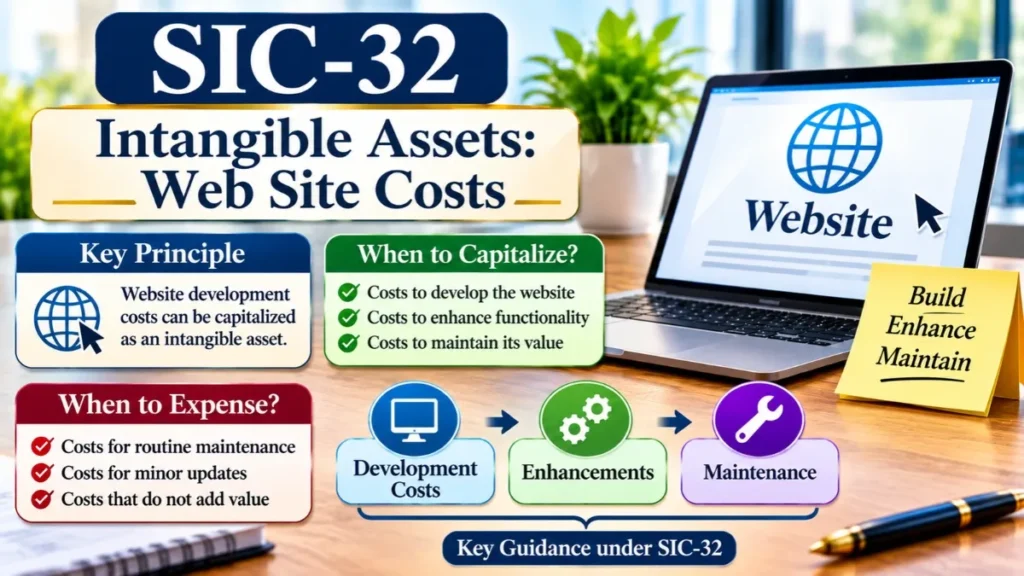
SIC-32 Intangible Assets – Web Site Costs is an IFRS Interpretation that explains how to account for the cost of building and running a company website. It confirms that a website you develop in-house is an internally generated intangible asset under IAS 38. Costs are capitalized only during the application and infrastructure development, graphical design and content development stages, and only if the entity can show the website will generate probable future economic benefits. Planning costs, ongoing operating costs, and any cost of a website built mainly to advertise your own products and services are expensed as incurred.
What Is SIC-32?
SIC-32 is an interpretation originally developed by the Standing Interpretations Committee of the former International Accounting Standards Committee. The International Accounting Standards Board issued it in March 2002. It does not create a new standard. It tells preparers how the existing rules in IAS 38 apply to one specific and very common situation: a business spending money to build, improve and run its own website.
The interpretation matters because websites are no longer brochures. For many entities, the website is a sales channel, a customer portal or the core of the business. Without clear guidance, two companies could spend the same amount on the same project and report very different results, one expensing everything and the other capitalizing everything.
SIC-32 has remained in the IFRS Accounting Standards ever since. According to the IFRS Foundation, later standards have made only minor consequential amendments to it, including IFRS 15 Revenue from Contracts with Customers, IFRS 16 Leases, the 2018 amendments to references to the Conceptual Framework, and IFRS 18 Presentation and Disclosure in Financial Statements (issued April 2024). None of these changed the underlying principle.
Why the interpretation exists: IAS 38 already prohibits capitalizing research and brand-type spending, but allows capitalizing development costs that meet strict criteria. SIC-32 translates that research-versus-development line into website language, so you can sort real project costs into the right bucket.
Scope of SIC-32 – When Does the Interpretation Apply?
SIC-32 applies to expenditure on purchasing, developing and operating a website, whether the site is for internal access (an intranet) or external access (customers and the public). It does not stand alone. It sits on top of IAS 38 and several neighboring standards.
Within SIC-32
- Websites developed using the entity’s own internal expenditure
- Websites with external access (e-commerce, customer portals, marketing sites)
- Websites with internal access (intranets, staff portals)
- Costs of the planning, development and operating stages
Dealt with elsewhere
- Web servers, networking and other hardware: IAS 16 Property, Plant and Equipment
- Fees paid to an internet service provider for hosting: expensed as the service is received
- Websites developed to be sold to customers: inventory or revenue standards
- Leased assets: IFRS 16
SIC-32 Accounting Treatment for Website Development Costs
The whole interpretation can be reduced to four rules. If you remember these, you can reason through almost any website cost.
- An internally developed website is an intangible asset. It is identifiable, controlled by the entity and, if it meets the criteria, expected to generate future benefits. IAS 38 therefore governs it.
- Capitalization requires more than the general IAS 38 test. The entity must also be able to demonstrate how the website will generate probable future economic benefits, for example by taking orders for goods and services.
- A promotional website cannot be capitalized. All expenditure to develop a website solely or primarily to promote and advertise the entity’s own products and services is recognized as an expense when incurred, because future benefits cannot be reliably separated from the advertising effect.
- Stage matters. Planning is treated like research and expensed. Development stages can be capitalized. Operating costs are generally expensed, unless a specific enhancement meets the recognition criteria.
Five Stages of Website Development Costs
SIC-32 breaks a website project into five stages and gives each its own default treatment. Think of it as a timeline running from the first idea to day-to-day upkeep.
- 1PlanningResearch-type work. Expense.
- 2Application and infrastructure developmentCapitalize if criteria are met.
- 3Graphical designCapitalize if criteria are met.
- 4Content developmentCapitalize, except for advertising content.
- 5OperatingExpense, except qualifying enhancements.
Stage 1: Planning
The planning stage has the same character as the research phase in IAS 38. Typical activities include undertaking feasibility studies, defining objectives and specifications, evaluating alternative products and suppliers, and selecting preferences. These costs are always expensed because the entity cannot yet demonstrate that an asset exists.
Stage 2: Application and infrastructure development
This is where the website becomes real. Activities include obtaining a domain name, purchasing or developing operating software, developing code for the application, installing developed applications on the web server and stress testing. Once the IAS 38 development criteria are satisfied, directly attributable costs are capitalized as part of the website intangible asset. Hardware purchased in this stage goes to IAS 16, not to the intangible.
Stage 3: Graphical design
Designing the appearance of web pages, including layout and color, belongs to the development phase. If the criteria are met, directly attributable design costs are capitalized.
Stage 4: Content development
Content is where many entities go wrong. Creating, purchasing, preparing and uploading text or graphics before completion of the website is capitalized to the extent it is not developed to advertise and promote the entity’s own products and services. For example, product data that drives an online ordering system can qualify, while promotional banners and brand messaging cannot.
Stage 5: Operating
The operating stage begins once the website is complete and available for use. From that point, updating graphics, revising content, backing up data, reviewing security, registering with search engines and analyzing usage are expensed as incurred. The exception is expenditure that enhances the website, such as adding a new function that is probable to generate additional future economic benefits and that meets the IAS 38 recognition criteria. Such enhancement costs are capitalized.
Website Development Costs – Capitalization vs Expense (Decision Flow)
Use this sequence for any individual website cost.
- Is the cost for hardware, hosting or leased assets? Hardware: IAS 16 Hosting service fee: Expense as service received Lease: IFRS 16
- Is it a planning or feasibility cost, or incurred before the development stage begins? Yes: Expense No: continue.
- Is the website (or this content) mainly for advertising and promoting your own products and services? Yes: Expense No: continue.
- Can you demonstrate how the website will generate probable future economic benefits? (For example, it takes orders, processes bookings or delivers a paid service.) No: Expense Yes: continue.
- Are all six IAS 38 development criteria met? No: Expense Yes: continue.
- Is the cost directly attributable to creating, producing or preparing the website for its intended use? Yes: Capitalize No (general overheads, training, inefficiencies): Expense.
- Is the website already live, and is this routine upkeep rather than a new capability? Routine upkeep: Expense Qualifying enhancement: Capitalize.
SIC 32 Decision Framework – How to Account for Website Costs
The table below turns the stages into a working reference. Treatment assumes the website is not merely promotional and that the IAS 38 criteria are met where capitalization is shown.
| Cost | Stage | Treatment |
|---|---|---|
| Feasibility study and options appraisal | Planning | Expense |
| Defining specifications, comparing suppliers | Planning | Expense |
| Obtaining a domain name | Application and infrastructure | Capitalize if criteria met |
| Developing code for the application | Application and infrastructure | Capitalize if criteria met |
| Purchased operating software | Application and infrastructure | Capitalize (intangible) |
| Web servers and network hardware | Application and infrastructure | IAS 16 |
| Stress testing before launch | Application and infrastructure | Capitalise if criteria met |
| Page layout, templates and visual design | Graphical design | Capitalize if criteria met |
| Product data and functional content for an order system | Content development | Capitalize if not for promotion |
| Advertising banners, brand copy, promotional photography | Content development | Expense |
| Hosting fees | Operating | Expense as service received |
| Refreshing content, updating graphics | Operating | Expense |
| Backups, security reviews, usage analytics | Operating | Expense |
| Search engine registration and SEO activity | Operating | Expense |
| New functionality that meets recognition criteria | Operating (enhancement) | Capitalize |
| Staff training on the new site | Any | Expense |
IAS 38 Recognition Criteria for Website Costs
Passing through the right stage is necessary but not sufficient. Under IAS 38 (paragraph 57), an intangible asset arising from development is recognized only when an entity can demonstrate all six of the following. Here is how each applies to a website.
Evidence the site can be completed, such as a tested architecture, a proof of concept or a proven platform.
Management approval, a signed development contract or a board-approved project plan.
The entity can operate the website once built, either on its own infrastructure or through a suitable arrangement.
For websites, show how it will generate benefits: online orders, subscriptions, bookings or measurable cost savings. Promotional value alone does not count.
Technical, financial and other resources are available to complete development and use the asset.
Time sheets, supplier invoices and cost-coding allow the directly attributable expenditure to be tracked accurately.
Practical tip: Document the date on which all six criteria were first met. Under IAS 38, cost is the sum of expenditure from that date onwards. Costs expensed earlier cannot be reinstated as an asset later.
What counts as a directly attributable cost?
Directly attributable costs can include payroll for staff working on the project, fees to external developers and designers, the cost of materials and services consumed, and the registration of legal rights such as a domain name. General administrative overheads, inefficiencies and initial operating losses, and staff training are excluded.
Initial Measurement, Amortization and Impairment of Website Costs
- Initial measurement: at cost, being directly attributable expenditure from the date the recognition criteria are first met.
- Subsequent measurement: IAS 38 offers a cost model or a revaluation model. Revaluation requires an active market for the asset, which is extremely unlikely for a website, so the cost model is almost always used.
- Useful life: SIC-32 states that the best estimate of a website’s useful life should be short, reflecting rapid technological change and evolving customer expectations.
- Amortization: begins when the website is available for use, normally on a straight-line basis, and the period and method are reviewed at least at each financial year end.
- Impairment: assessed under IAS 36 Impairment of Assets whenever there are indicators, for example a planned platform replacement or a collapse in online sales.
- Derecognition: on disposal, retirement or replacement, with any gain or loss recognized in profit or loss.
SIC-32 Practical Example with Journal Entries
The following is a fictional illustration. Meridian Retail Ltd builds an online store that will take customer orders and payments. All amounts are in US dollars, and the IAS 38 criteria are met from the start of the development stage.
| Item | Stage | Amount (US$) | Treatment |
|---|---|---|---|
| Feasibility study and supplier comparison | Planning | 12,000 | Expense |
| Domain name acquisition | Application | 4,000 | Capitalize |
| Application development (internal and external) | Application | 85,000 | Capitalize |
| Web server hardware | Infrastructure | 30,000 | IAS 16 (property, plant and equipment) |
| Page and checkout design | Graphical design | 22,000 | Capitalize |
| Product catalogue data for the order system | Content | 9,000 | Capitalize |
| Promotional banners and brand photography | Content | 14,000 | Expense |
| Intangible asset recognized (website) | 120,000 | ||
| Expensed before launch | 26,000 |
Journal entries at the end of the project
After launch
Assume management estimates a three-year useful life with straight-line amortization. Annual amortization is US$40,000 (US$120,000 divided by three), or about US$3,333 per month from the go-live date.
In the first operating year, Meridian spends US$6,000 on content refreshes, backups and SEO monitoring, which is expensed. It also spends US$18,000 adding a new subscription checkout function that is probable to generate additional revenue and meets the recognition criteria, so that cost is capitalized as an enhancement and amortized over its useful life.
SIC-32 Disclosure Requirements
SIC-32 does not add its own disclosure paragraphs. The disclosures come from IAS 38 and apply to the website asset like any other intangible.
- Separate disclosure of internally generated intangible assets from other intangibles, by class (IAS 38.118)
- Useful lives or amortization rates, and the amortization methods used
- Gross carrying amount and accumulated amortization and impairment at the start and end of the period, with a reconciliation of movements
- The line item in the statement of profit or loss that includes amortisation
- The aggregate amount of research and development expenditure recognised as an expense in the period (IAS 38.126), which may include website planning and non-qualifying costs where they are research and development in nature
- Impairment disclosures required by IAS 36 where applicable
Common SIC-32 Accounting Mistakes to Avoid
- Capitalizing a brochure website. If the site exists mainly to promote your products, every cost is an expense, regardless of how large the project was.
- Capitalising planning costs. Feasibility and option studies are research-type costs. Capitalising them is not permitted.
- Treating hosting as part of the asset. Hosting is a service consumed over time and is expensed as received.
- Ignoring the “demonstrate future benefits” test. The general IAS 38 test is not enough for a website. You need a documented link between the site and revenue or cost savings.
- Capitalising routine maintenance. Updating content, fixing bugs and backups are operating costs. Only genuine enhancements can be capitalised.
- Choosing a long useful life. SIC-32 expects a short life. A ten-year life for a website is hard to defend.
- Weak cost tracking. Without time sheets and cost codes, you cannot show reliable measurement, and the cost may have to be expensed.
Frequently Asked Questions
What does SIC-32 stand for?
SIC-32 stands for Standing Interpretations Committee Interpretation 32, titled Intangible Assets – Web Site Costs. It is part of IFRS Accounting Standards and interprets IAS 38.
Can website development costs be capitalised under IFRS?
Yes, but only for costs in the application and infrastructure development, graphical design and content development stages, and only when the IAS 38 recognition criteria are met and the entity can demonstrate how the website will generate probable future economic benefits. Costs of a website built solely or primarily to promote the entity’s own products and services must be expensed.
Are planning costs for a website expensed?
Yes. The planning stage has the same nature as the research phase in IAS 38, so feasibility studies, specification definition and supplier evaluation are expensed as incurred.
How should website maintenance and content updates be treated?
Costs incurred after the website is operational, such as updating graphics, revising content, backing up data and reviewing security, are expensed when incurred. Only expenditure that enhances the website and meets the recognition criteria is capitalised.
What useful life should be used for a website?
SIC-32 says the best estimate of a website’s useful life should be short, because technology changes quickly. Many entities choose periods of about three to five years, but the period must be supported by the entity’s own circumstances and reviewed at least annually.
Are web servers and hosting fees part of the website asset?
No. Web server hardware is accounted for under IAS 16 Property, Plant and Equipment. Fees paid to an internet service provider for hosting are expensed as the service is received.
Is SIC-32 still in force?
Yes. The IFRS Foundation lists SIC-32 among its issued standards and notes that later standards, including IFRS 18 (issued April 2024), made only minor consequential amendments to it.
Does SIC-32 apply to mobile apps or SaaS subscriptions?
SIC-32 is written for websites. For cloud and SaaS arrangements, you also need to consider IFRS Interpretations Committee agenda decisions, because many such costs are service fees rather than assets you control.
Key Takeaways
- Internally developed websites are intangible assets governed by IAS 38.
- Plan and operate = expense. Build = capitalize, if the criteria are met.
- Promotional websites are fully expensed.
- You must demonstrate probable future economic benefits, with evidence on file.
- Hardware goes to IAS 16 and hosting is a service expense.
- Keep useful lives short and review them every year.
Sources
- IFRS Foundation: SIC-32 Intangible Assets – Web Site Costs
- IFRS Foundation: IAS 38 Intangible Assets
- IFRS Foundation: IAS 16 Property, Plant and Equipment
Disclaimer: This guide is for general information and education. It summarises SIC-32 and related IFRS requirements and is not accounting, audit, tax or legal advice. The worked example is fictional. For binding requirements, refer to the official text of IFRS Accounting Standards or consult a qualified professional.

(Qualified) Chartered Accountant – ICAP
Master of Commerce – HEC, Pakistan
Bachelor of Accounting (Honours) – AeU, Malaysia