Going Concern Concept – IFRS, GAAP & Audit

Going Concern

The Going Concern Concept ENSURES Financial Statements reflect the assumption that the business will continue to operate in the foreseeable future. It is based on the idea that Co. ‘Financial Statements’ should REFLECT its ability to Meet its obligations and continue operating as a viable business entity. Accounting & Auditing … Read More

IFRS 18 – Presentation and Disclosure In Financial Statements

IFRS 18

IFRS 18 introduces a New framework for presenting and disclosing information in financial statements, replacing parts of IAS 1. It aims to improve the Clarity, Consistency, and Comparability of ‘Financial Performance Reporting’ across companies. IASB Standard — Issued April 2024 Replaces IAS 1 Effective Date 1 Jan 2027 Early Adoption … Read More

Lease Modification | IFRS 16

Lease Modification

Lease Modification, as per IFRS 16 refers to CHANGES made to the terms and conditions of a lease contract after its inception. These changes can result from negotiations between the LESSOR and the LESSEE or due to changes in laws and regulations. For example, lease modifications include changes in ‘Lease … Read More

Sale and Leaseback | IFRS 16

Sale and Leaseback

Sale and Leaseback a Concept which EXPLAINS that such transaction is accounted for as a ‘sale‘ of an underlying asset and a ‘leaseback‘ of that underlying asset only if the initial transaction QUALIFIES as a sale in accordance with IFRS 15 ‘Revenue from Contracts with Customers‘. In a ‘Sale and Leaseback … Read More

IFRS 16 – Leases

IFRS 16

IFRS 16 sets out the principles for the Recognition, Measurement, Presentation and Disclosure of leases. The Objective is to ensure that ‘Lessees’ and ‘Lessors’ provide relevant information in a manner that faithfully represents those transactions. This information gives a basis for users of financial statements to assess the effect that … Read More

Cash Settled Share-based Payments | IFRS 2

Cash Settled Share-based Payments

Cash Settled Share-based Payments as per IFRS 2 INCLUDE the transactions in which the entity acquires goods or services by incurring liability to transfer cash or other assets to the supplier of those goods or services for amounts that are based on the price (or value) of ‘Equity Instruments’ (including … Read More

Equity Settled Share-based Payments | IFRS 2

Equity Settled Share-based Payments

Equity Settled Share-based Payments as per IFRS 2 account for the payment for goods/services in the form of Equity Instruments (‘Shares’ or ‘Share Options’) of the Co./group company. 📘 IFRS 2 · Accounting Standard 📅 Standard: IFRS 2 🏛 Body: IASB 📂 Category: Financial Reporting Definition Scope Recognition Measurement Vesting … Read More

IFRS 9 Vs IAS 39 – Financial Instruments: Key Differences

IFRS 9 Vs IAS 39

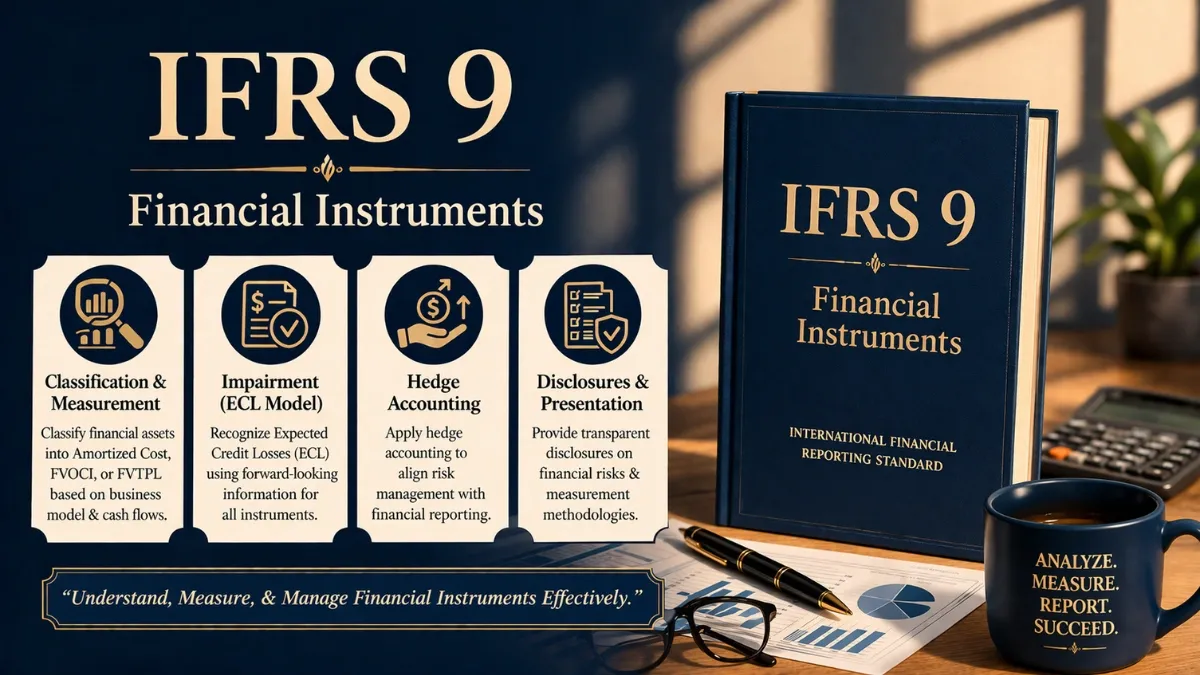
The One difference amongst Many of IFRS 9 Vs IAS 39 STATES that the key difference is in relation to the approach to ‘IMPAIRMENT’. IFRS 9 uses ‘Expected Credit Losses‘ (ECLs) to recognize impairment losses on financial assets, as compared to IAS 39 ‘Incurred Losses‘. Financial Reporting Standards · Comparative … Read More

Hedge Accounting – Managing Financial Risk | IFRS 9

Hedge Accounting

Hedge Accounting APPLIES to all hedge relationships, with the EXCEPTION of fair value hedges of the interest rate exposure of a portfolio of financial assets or financial liabilities. Financial Accounting · Risk Management What Is It? Hedge Types Criteria Standards Process Journal Entries Effectiveness Benefits & Risks Glossary FAQ Hedge accounting … Read More

ISA 220 (Revised) – Quality Management for an Audit of Financial Statements

ISA 220

ISA 220 (Revised) DEALS with the SPECIFIC responsibilities of the auditor regarding ‘Quality Management‘ for an Audit of Financial Statements. International Standard on Auditing Revised 2022 IAASB Issued Effective Dec 2022 Replaces ISA 220 (2009) Contents Overview Objective Scope & Application Key Responsibilities Core Requirements Engagement Quality Review ISA 220 … Read More